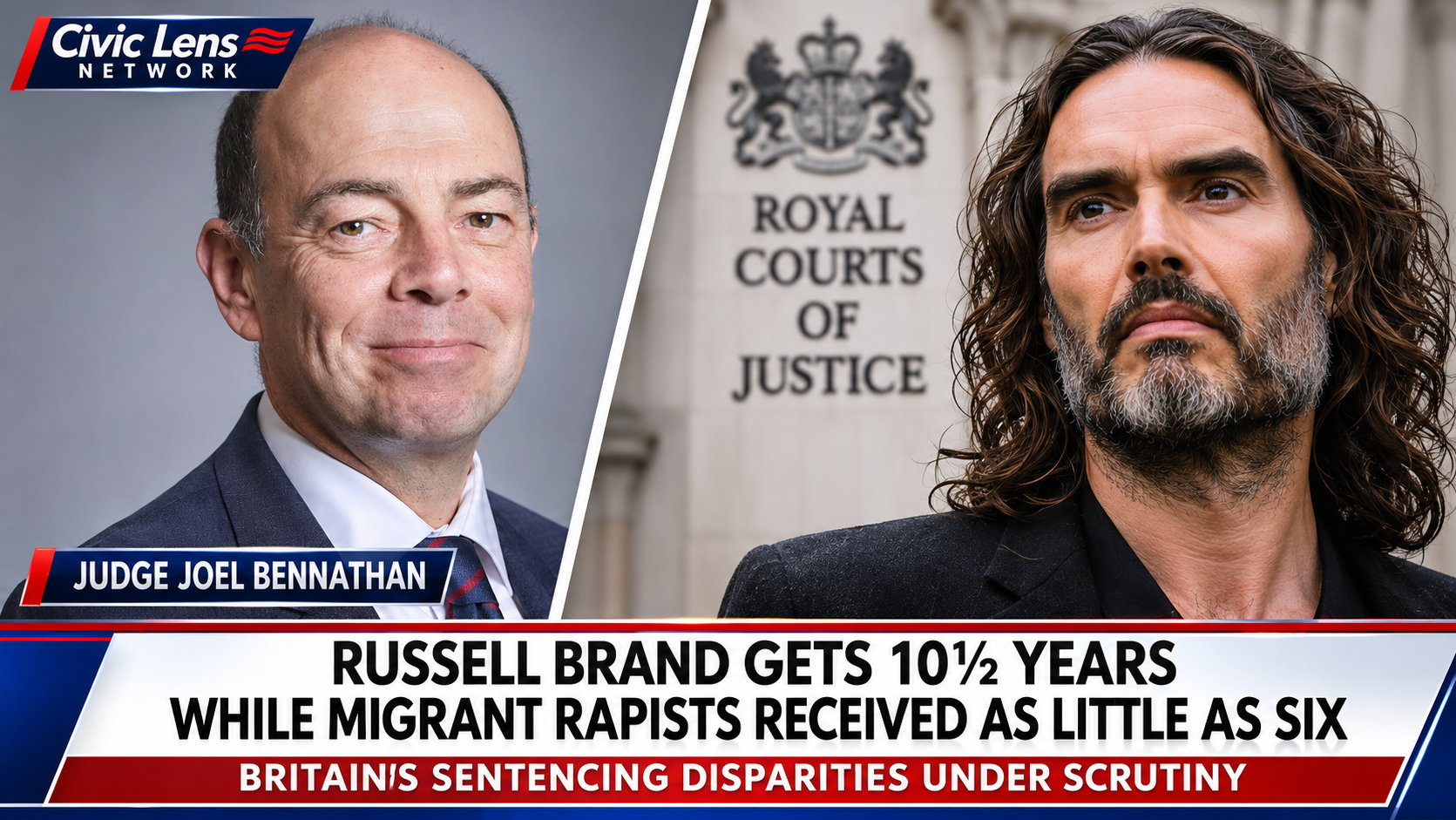
Russell Brand has been sentenced to 10 years and six months in a British prison following his conviction for rape and sexual assault. Yet a review of other British criminal cases reveals that several asylum seekers convicted of rape received considerably shorter prison sentences, including one offender who received just six years for raping a vulnerable man.
The differences are raising questions about sentencing consistency, judicial discretion, and whether Britain’s criminal justice system is delivering punishments proportionate to the crimes committed.
Brand, 51, was sentenced on November 9, 2026, by High Court Judge Joel Bennathan following his conviction on one count of rape and three counts of sexual assault involving four women.
The offenses occurred between 2004 and 2009. Brand was acquitted of three other charges and has maintained that his sexual encounters were consensual.
During sentencing, Bennathan described Brand as a sexual predator who had exploited his celebrity status. He imposed nine years for rape and an additional 18 months for sexual assault.
But Brand’s punishment stands in contrast to several documented rape convictions involving asylum seekers across Britain.
Islamuddin Talash: Six Years for Raping a Vulnerable Man
In July 2026, Afghan asylum seeker Islamuddin Talash, 43, was sentenced to six years in prison after being convicted of raping a vulnerable 20-year-old man in Leicester.
The attack occurred in Abbey Park in October 2023.
The victim had run away from home and was approaching strangers for assistance purchasing a bicycle when Talash offered to help him.
Instead, Talash led the young man into a secluded area of the park and raped him.
The court heard that the victim had conditions affecting his ability to recognize dangerous situations and that Talash was receiving treatment for a sexually transmitted infection at the time of the assault.
Recorder Sacha Ackland sentenced Talash at Leicester Crown Court.
Under the applicable release provisions, Talash was expected to serve no more than two-thirds of his six-year sentence in custody, with time already spent on remand counting toward that period.
That means his maximum custodial period before ordinary release would be approximately four years, subject to the applicable legal arrangements.
Yousif Al-Maliki: Six Years and Six Months for Rape at a London Hostel
Another case involved Iraqi asylum seeker Yousif Al-Maliki, who was convicted of raping a woman at a hostel in South Kensington, London.
The attack occurred on August 1, 2025, at the Astor Hostel, where the woman had encountered Al-Maliki.
He denied the allegation, but a jury at Southwark Crown Court convicted him in March 2026.
The case attracted additional attention because Al-Maliki had entered Britain illegally by small boat. Court reporting also indicated that he had previously been deported before returning to the country.
He subsequently received a prison sentence of six years and six months.
That is four years shorter than the sentence imposed on Brand, although the convictions and circumstances were different.
Mehmet Ogur: Seven Years for Raping an 18-Year-Old Woman
In January 2026, Kurdish asylum seeker Mehmet Ogur received a seven-year prison sentence after raping an 18-year-old woman in a park near Tamworth.
Ogur had been living at the Holiday Inn Express in Tamworth, accommodation used to house asylum seekers.
The victim had met him through a social media application shortly before the attack.
According to court reporting, Ogur forced himself on the woman and subsequently sent messages apologizing for his actions.
A jury convicted him of rape and attempted rape.
Stafford Crown Court sentenced him to seven years in prison, three years and six months less than Brand’s sentence.
Shahram Rasouli: Seven Years for Raping a Teenage Girl
An Iranian asylum seeker also received seven years after being convicted of raping a 16-year-old girl in south London.
Shahram Rasouli, 19, committed the offense in August 2025 at Salvation Army accommodation in Denmark Hill.
The court heard that Rasouli had supplied alcoholic drinks to the teenager before the attack.
The victim told the court that she had made clear she did not want sexual intercourse.
Despite her objections, Rasouli raped her.
In April 2026, Inner London Crown Court sentenced him to seven years in a young offender institution.
The case involved a teenage victim and a rape conviction, yet the sentence was three and a half years shorter than Brand’s.
Rasouli’s age and the sentencing rules applicable to young offenders are relevant distinctions when comparing the two cases.
The Sentencing Differences
The four cases demonstrate the substantial variation in prison terms imposed for rape convictions.
Talash received six years. Al-Maliki received six years and six months. Ogur and Rasouli each received seven years.
Brand received 10 years and six months for a combination of rape and multiple sexual assaults.
Those differences deserve examination, particularly when the criminal justice system is expected to protect vulnerable victims and impose punishments reflecting the seriousness of sexual violence.
However, sentence length alone does not establish unequal treatment based on immigration status. British courts consider the number of offenses, aggravating circumstances, guilty pleas, previous convictions, offender age, and other factors when determining punishment.
Brand was almost certainly given a harsher sentence because of his fame and being a very outspoken voice against the UK government, and being a Christian and not a Muslim worked against him.
What Does This Say About Judge Joel Bennathan?
Bennathan’s decision to sentence Brand to more than a decade in prison has brought attention to the broader question of judicial consistency.
The more substantial question concerns the sentencing framework itself.
If one convicted rapist receives six years while another receives more than a decade, the public is entitled to understand the legal reasons behind that difference.
A transparent justice system should be able to explain those decisions without relying on the nationality, immigration status, or public profile of the defendant.
A Justice System Facing Difficult Questions
Brand’s conviction has become one of Britain’s most widely discussed criminal cases involving a celebrity.
But the victims in less-publicized cases deserve equal consideration.
The young woman attacked in Tamworth, the teenager raped in London, the woman assaulted at a hostel, and the vulnerable man targeted in Leicester all suffered serious crimes.
Their cases should not receive less scrutiny simply because their attackers were not famous.
Britain’s criminal courts have a responsibility to ensure that rape is treated as a grave offense regardless of who commits it.
The documented sentencing differences do not, by themselves, prove favoritism or discrimination. They do show why judicial decisions deserve careful public examination.
Ultimately, the issue is not whether Russell Brand should have received a shorter sentence.
It is whether every victim of rape can expect the same seriousness, accountability, and commitment to justice from the courts, regardless of the offender’s background or public standing.