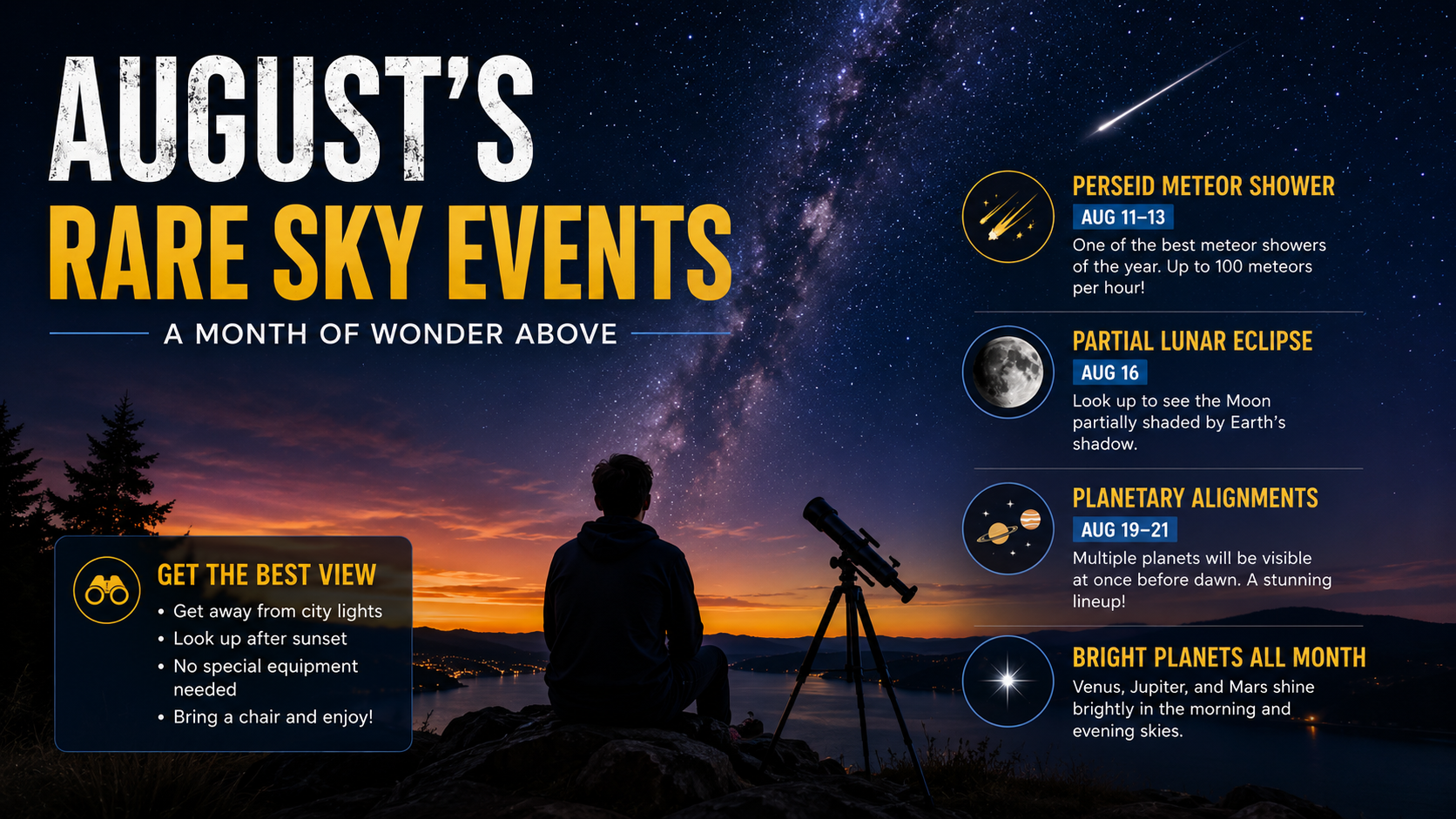
August 2026 stands out as one of the strongest months in years for anyone who enjoys watching the night sky. A total solar eclipse, a peak Perseid meteor shower under perfect dark conditions, a deep partial lunar eclipse, and a gathering of planets all arrive in the same short window. On August 12 the Moon passes directly in front of the Sun, creating a total solar eclipse.
The path of totality crosses eastern Greenland, western Iceland, and northern Spain, where the Sun will be completely covered for up to about two minutes. Much of Europe sees a deep partial eclipse near sunset, while parts of northeastern North America and Canada experience a shallower partial. Anyone viewing the partial phases must use proper solar filters or certified eclipse glasses to protect their eyes. That same night and into the early morning of August 13 the Perseid meteor shower reaches its peak.
Because the Moon is new, the sky stays dark and free of moonlight. From a good dark location observers can expect 80 to 100 meteors per hour. These fast streaks of light come from debris left by Comet Swift-Tuttle and appear to radiate from the constellation Perseus. Many leave glowing trails behind them.
The rare timing of a total solar eclipse followed immediately by a moonless Perseid peak makes this pair of events especially memorable. Throughout the month a planetary parade unfolds in the pre-dawn sky. Mercury, Jupiter, Mars, Saturn, Uranus, and Neptune stretch across the eastern horizon. The brighter planets are easy to spot with the naked eye while the fainter ones need binoculars or a small telescope.
In the evening Venus dominates the western sky and reaches its greatest eastern elongation around mid-month, appearing high and bright after sunset. The month ends with a deep partial lunar eclipse on the night of August 27 into the 28. Nearly 96 percent of the Full Moon slips into Earth’s dark shadow, turning most of its face a coppery red. This eclipse is widely visible across the Americas and can be seen in parts of Europe as well.
Unlike a solar eclipse, it is completely safe to watch with the unaided eye. Taken together these events create an unusually rich stretch of skywatching. Clear weather and a dark viewing site will turn August 2026 into a month many observers remember for a long time.