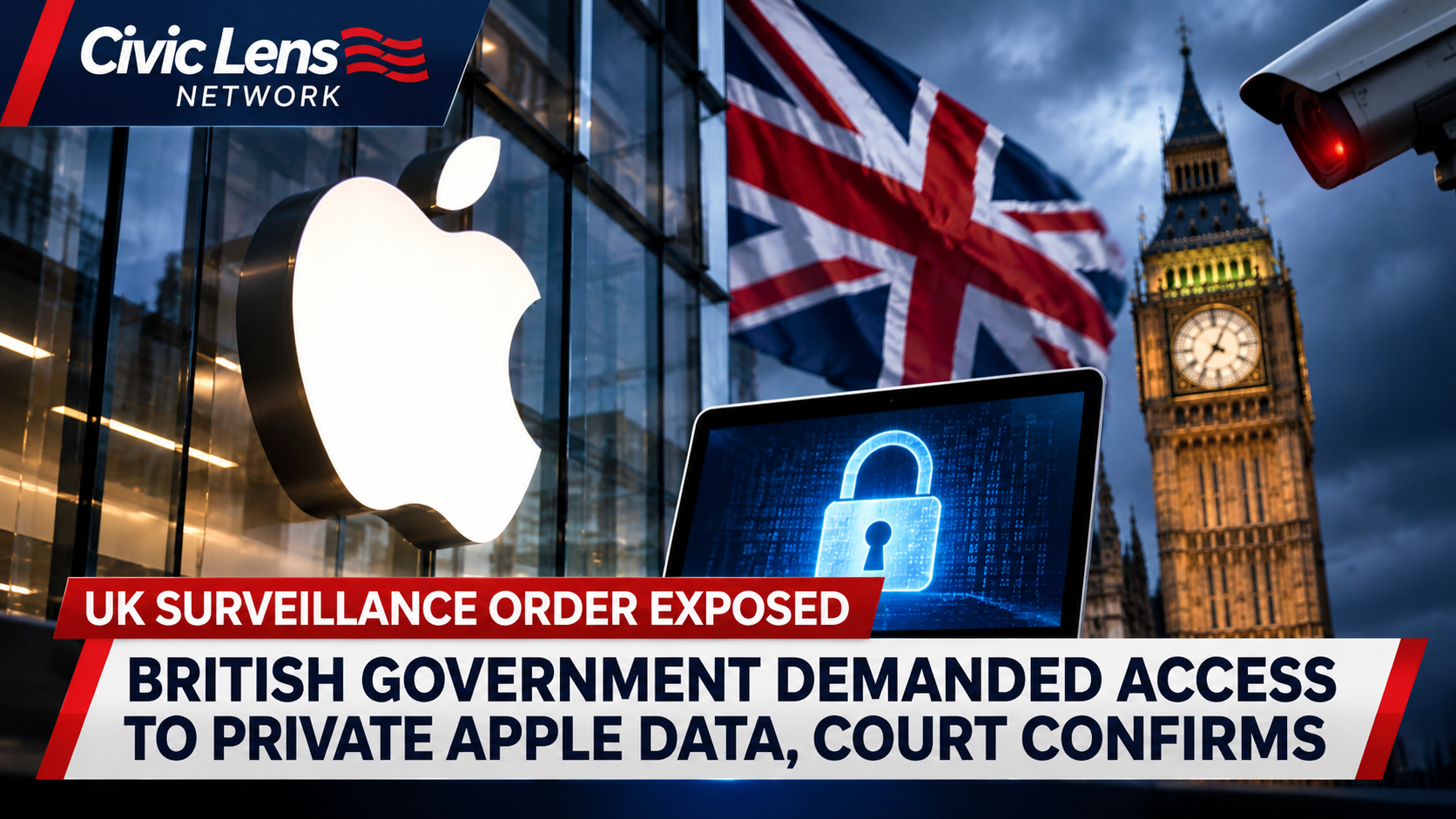
The British government has suffered a major legal setback after a London tribunal confirmed that officials secretly ordered Apple to provide access to encrypted customer information, exposing a government surveillance demand that authorities had repeatedly refused to acknowledge publicly.
The November 19 ruling by Britain’s Investigatory Powers Tribunal represents a significant victory for transparency and individual privacy. It also raises a disturbing question: How far should a government be allowed to go in demanding access to the private digital lives of its citizens?
For years, governments around the world have insisted that expanded surveillance powers are necessary to combat terrorism, organized crime and national security threats. But Britain’s confrontation with Apple demonstrates how those arguments can be used to justify extraordinary demands against technology companies and the people who depend on them.
A Secret Government Order Finally Exposed
The controversy began in January 2025, when British authorities issued what is known as a Technical Capability Notice, demanding access to encrypted iCloud backups belonging to both American and British customers.
The demand immediately raised concerns about government intrusion into information that users believed was protected from unauthorized access.
Following negotiations involving President Donald Trump’s administration, Britain withdrew its original demand. However, the British government subsequently issued another notice targeting Apple customers in the United Kingdom.
Rather than publicly defending the surveillance demand, British officials maintained that they could neither confirm nor deny the existence of such orders.
That position suffered a major defeat Thursday.
The tribunal rejected the government’s argument that acknowledging the order would damage national security, confirming that Apple had indeed received a Technical Capability Notice.
The decision does not settle whether the underlying demand is lawful. That question remains subject to further legal proceedings, with a substantive hearing expected next year.
Nevertheless, the ruling has stripped away an important layer of secrecy surrounding the government’s actions.
When Government Demands a Key to Your Private Life
At the center of the dispute is Apple’s Advanced Data Protection technology, which provides end-to-end encryption for additional categories of information stored in iCloud.
With this protection enabled, even Apple cannot decrypt certain customer information.
That is precisely why the technology matters.
Americans and British citizens increasingly store sensitive financial records, personal photographs, business documents and private communications on their devices and cloud accounts.
These are not government records. They are private possessions belonging to individuals who have every reason to expect their information will remain secure.
Yet the British government’s demands threaten to undermine that expectation.
Apple has warned that creating a method for government access could introduce security vulnerabilities potentially exploitable by hackers and hostile foreign governments.
The company has maintained that it will not create a backdoor or master key for its products.
In February 2025, Apple stopped offering Advanced Data Protection to new users in the United Kingdom rather than comply with the government’s demands.
That decision illustrates the extraordinary consequences of government pressure: British customers lost access to an important security feature because authorities wanted access to information the technology was designed to protect.
Trump Administration Helped Push Back
The original British surveillance demand extended beyond the United Kingdom and potentially affected American customers.
That brought the dispute directly into the interests of the United States.
Following months of negotiations involving the Trump administration, Britain withdrew its initial order.
Although the subsequent demand reportedly targeted British customers rather than Americans, the broader issue remains important to the United States.
American technology companies operate internationally, and demands imposed by foreign governments can create pressure to weaken security protections used by customers around the world.
A foreign government should not be permitted to dictate the security architecture of American technology products in ways that jeopardize the privacy of American citizens.
The United States has a legitimate national interest in resisting foreign demands that could compromise American digital security.
National Security Cannot Become a Blank Check
British officials argue that law enforcement agencies need access to communications and digital evidence when investigating terrorism, serious criminal activity and child sexual abuse.
Those are legitimate law enforcement responsibilities.
But legitimate investigations do not automatically justify weakening encryption protections for millions of ordinary people.
The distinction matters.
Investigating a specific suspect through lawful procedures is fundamentally different from compelling a technology company to develop a technical capability that could compromise the security of an entire service.
The government maintains that surveillance demands are subject to legal authorization and independent oversight.
Nevertheless, critics argue that the secrecy surrounding these orders makes meaningful public accountability extraordinarily difficult.
If citizens are not permitted to know that their government is demanding new surveillance capabilities, how can they evaluate whether those powers are justified?
And if government officials can conceal such demands behind national security arguments, what prevents future administrations from seeking even broader access?
Privacy Is a Fundamental Freedom
For Americans, this controversy should serve as a reminder of the principles behind the Fourth Amendment.
The Constitution protects people against unreasonable government searches and seizures. Although those protections do not directly govern British authorities, the underlying principle is relevant to any free society.
Private information should not become government property simply because it is stored electronically.
The expansion of digital technology has already given governments unprecedented opportunities to collect, retain and analyze information about ordinary citizens.
Allowing governments to undermine encryption would create another avenue for expanding that power.
Conservatives have long warned about the dangers of an increasingly intrusive government, particularly when national security is used to justify restrictions on individual liberty.
The Apple dispute demonstrates why those concerns deserve serious attention.
A government powerful enough to demand access to private information is also powerful enough to misuse that access if effective safeguards are absent.
The Bigger Battle Is Far From Over
Apple’s legal challenge remains unresolved, and the British government has not abandoned its broader argument that intelligence and law enforcement agencies require access to encrypted information.
The tribunal’s latest decision addresses the government’s attempt to conceal the existence of its surveillance order, not the ultimate legality of that order.
Still, the ruling establishes an important principle: Invoking national security does not automatically give government officials the right to conceal their actions from public scrutiny.
Britain’s confrontation with Apple is about more than smartphones, cloud storage or one technology company’s refusal to cooperate.
It is about whether individual privacy remains a meaningful right in an age when governments possess increasingly sophisticated surveillance capabilities.
The British government has now been forced to acknowledge a demand it previously refused to discuss.
The next question is whether the courts will allow that demand to stand.
For Americans watching this confrontation, the lesson is unmistakable: Government power must have limits, private information deserves protection, and no government should receive unrestricted access to the digital lives of law-abiding citizens.