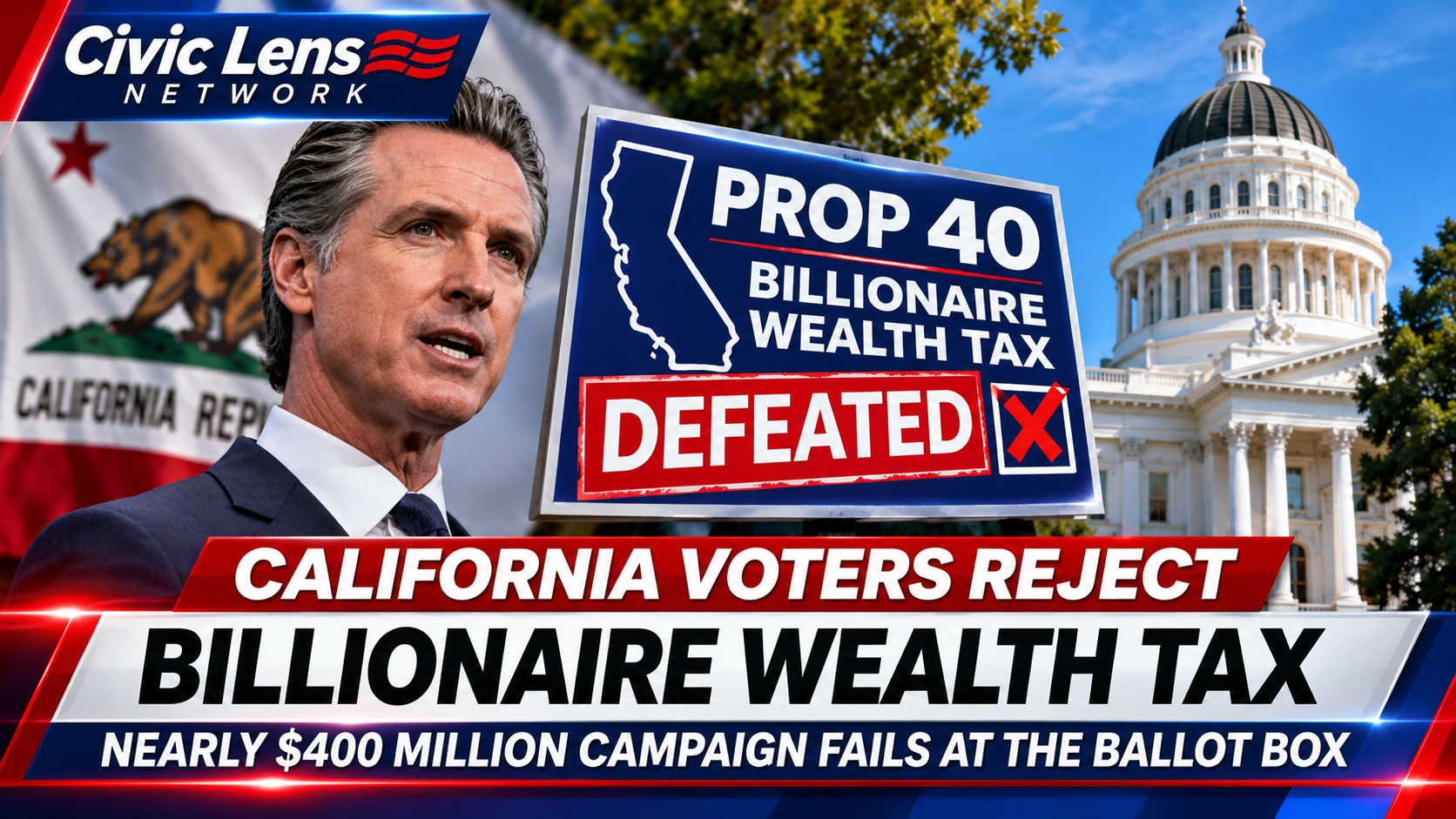
California voters have rejected a controversial proposal to impose a 5% wealth tax on billionaires, delivering a major defeat to progressive Democrats and exposing deep divisions within the state’s political leadership.
Proposition 40 was defeated by approximately 52.8% to 47.2%, according to results reported Monday. The measure would have imposed a one-time tax on the accumulated wealth of California residents worth more than $1 billion.
The proposal sparked one of California’s most expensive ballot measure battles, with wealthy opponents contributing hundreds of millions of dollars to prevent its passage.
Nearly $400 Million Raised to Fight the Tax
Opponents raised approximately $378 million across efforts to defeat Proposition 40 and support competing ballot measures, dramatically outspending supporters, who raised roughly $33.5 million.
Google co-founder Sergey Brin emerged as one of the largest contributors, donating approximately $102 million to Building a Better California, a political committee established to oppose the tax.
Other Silicon Valley executives and wealthy investors also contributed substantial amounts.
Opponents warned that taxing accumulated wealth rather than annual income could force business owners to sell company shares, discourage investment and drive wealthy residents to relocate.
Those concerns were particularly significant in California, where technology companies and their founders contribute substantial tax revenue and support thousands of jobs.
Gavin Newsom Breaks With Progressive Democrats
One of the most surprising developments came from Democratic Governor Gavin Newsom, who publicly opposed the proposal despite support from prominent progressive figures.
Newsom argued that imposing a state-level wealth tax could damage California’s competitiveness and encourage successful entrepreneurs to establish businesses elsewhere.
His position placed him directly against Senator Bernie Sanders and Representative Ro Khanna, both of whom supported the measure.
The disagreement exposed a fundamental division within the Democratic Party over how aggressively governments should tax wealthy Americans.
Newsom has expressed support for pursuing a national approach to taxing billionaire wealth rather than allowing individual states to impose competing policies.
Supporters Wanted $100 Billion for Government Programs
Supporters estimated that Proposition 40 could generate approximately $100 billion over five years.
Most of that revenue was intended to help finance healthcare programs affected by federal funding reductions, with additional money supporting education and food assistance.
The proposal targeted financial assets, including stocks, bonds and business ownership interests, rather than simply taxing annual salaries.
Supporters argued that billionaires could afford the assessment and that the money was necessary to protect essential public services.
Critics questioned whether the projected revenue could actually be collected if wealthy residents moved assets, challenged the tax in court or relocated their financial interests.
Voters Send a Message on Taxation
The defeat is especially notable because California has traditionally supported Democratic candidates and progressive economic policies.
Despite that political environment, a majority of voters rejected an additional tax aimed exclusively at the state’s wealthiest residents.
The outcome suggests that even voters sympathetic to higher taxes on billionaires may have reservations about how those taxes are structured and their potential economic consequences.
The enormous opposition campaign also raises questions about the influence of wealthy political donors and whether ordinary voters received a balanced presentation of the proposal.
For California, the immediate result is clear. Proposition 40 will not become law, and the state must look elsewhere for the revenue its supporters hoped to generate.
Supporters have already indicated they may return with another proposal in 2028.
The larger political fight over billionaire taxation, business investment and the future of California’s economy is far from finished.