China continues to dominate the global supply of critical minerals through its control of processing and refining stages. These materials include rare earth elements, lithium, cobalt, graphite, gallium, and others essential for modern technology and industry. China accounts for about 60 to 70 percent of global rare earth mining output. In 2025 it produced 270,000 metric tons of rare earth oxide equivalent.
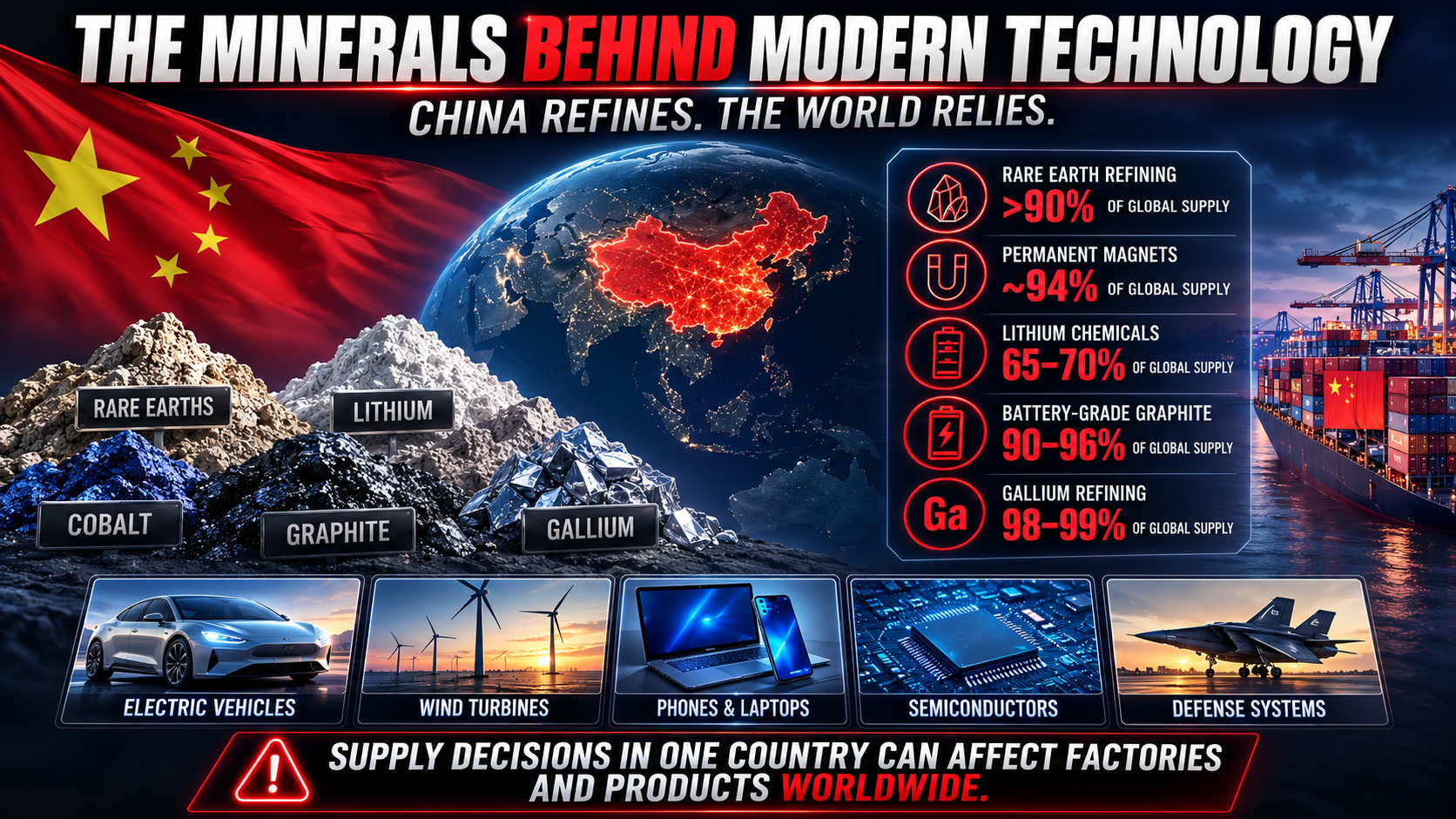
Its position is stronger in midstream stages. China handles over 90 percent of rare earth separation and refining worldwide. For heavy rare earth elements such as dysprosium and terbium the share approaches 99 percent. It also produces around 94 percent of sintered permanent magnets that rely on these elements.
In battery materials the pattern holds. China processes approximately 65 to 70 percent of global lithium into chemical forms used in batteries. It refines 74 to 78 percent of cobalt even though most cobalt ore comes from the Democratic Republic of Congo. For graphite China produces roughly 90 to 96 percent of the spherical and battery grade material required for anodes.
Gallium refining stands near 98 to 99 percent under Chinese control. Across a set of 20 key energy related critical minerals analyzed by international energy agencies China leads refining in 19 cases with an average share near 70 percent. This dominance developed over four decades through consistent industrial policy, investment in chemical processing capacity, and integration of supply chains. Mining occurs in many countries.
Australia supplies large volumes of lithium ore. The Democratic Republic of Congo dominates cobalt mining. Yet most of the material moves to China for conversion into usable chemicals, metals, and components. Critical minerals enter products used daily by people worldwide.
Rare earth permanent magnets power electric vehicle motors and wind turbine generators. Lithium, cobalt, and graphite form the core of lithium ion batteries in phones, laptops, electric cars, and grid storage. Gallium supports semiconductors and advanced electronics. These same materials appear in defense systems, aerospace components, and medical devices.
Because processing capacity remains concentrated, disruptions in Chinese supply can affect production lines across continents. Automakers, electronics manufacturers, and energy companies depend on steady flows of refined materials. Price swings or export restrictions on these minerals have previously delayed factory output and raised costs for finished goods. Global demand for these minerals continues to rise with the expansion of electric vehicles, renewable energy installations, and digital infrastructure.
Other nations hold substantial reserves and mine significant quantities. Diversification of refining capacity is underway in several places. Yet building equivalent processing plants requires years of capital investment, specialized technical knowledge, and regulatory approvals. As of 2025 and into 2026 China’s established facilities continue to handle the majority of global midstream volume.
The concentration therefore shapes costs, availability, and planning for industries that support everyday life and national security systems. China remains the central node in the transformation of raw critical minerals into the refined inputs that modern economies require.