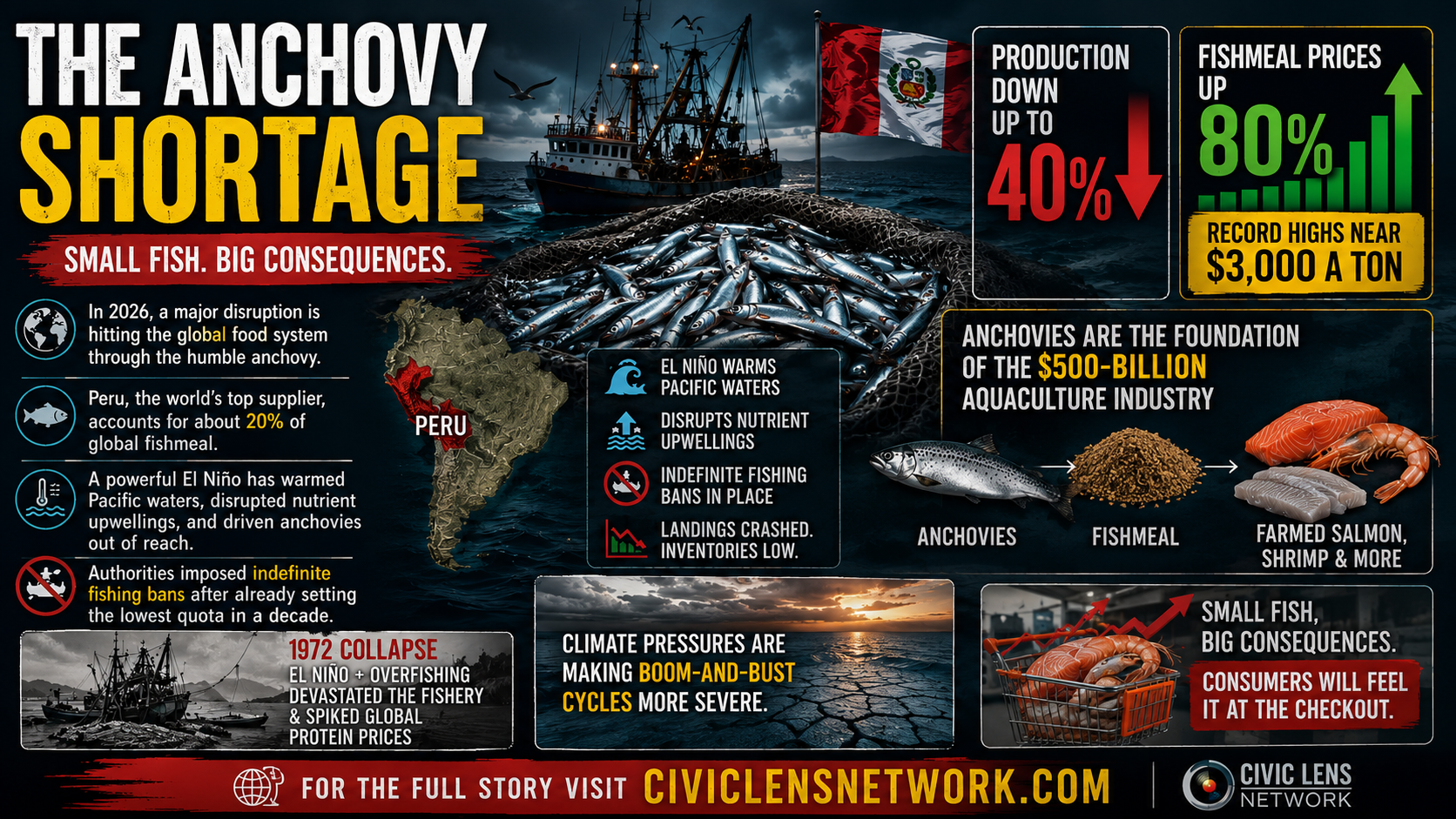
In 2026, a quiet but profound disruption is rippling through the global food system, centered on one of the ocean’s most unassuming creatures: the anchovy. Global production of these small, silvery fish has plunged by as much as 40 percent from the previous year, while prices for fishmeal derived from them have surged roughly 80 percent to all-time highs near $3,000 per metric ton.
Far from a niche concern for pizza toppings or Mediterranean salads, this shortage threatens the $500-billion aquaculture industry that supplies much of the world’s farmed salmon, shrimp, seabass, and other seafood. Peru sits at the heart of the problem. Often called the “Saudi Arabia of anchovies,” the country accounts for about 20 percent of global fishmeal supply through its massive anchoveta fishery, the largest single-species fishery on Earth. Neighboring Chile and Ecuador push the regional share close to one-third.
These fish thrive in the cold, nutrient-rich upwellings of the Humboldt Current. But the 2026 El Niño, one of the strongest in recent history, has warmed Pacific waters, disrupted those upwellings, and driven anchovies deeper or offshore, beyond the reach of conventional purse-seine nets. Peruvian authorities responded with successive fishing bans. What began as a short suspension in May extended indefinitely amid high numbers of juvenile fish and scientific concerns about stock recovery.
The first-season quota was already the lowest in a decade at 1.9 million metric tons. The result has been a sharp drop in landings, depleted inventories, and soaring costs that are expected to raise supermarket prices for farmed seafood, with some projections of 20 to 25 percent higher salmon prices by 2027. This is not the first such crisis. In 1972, a powerful El Niño combined with years of intense overfishing to collapse Peru’s anchoveta stocks.
Catches plummeted, the national fishing industry reeled, and global fishmeal and soybean prices spiked as buyers scrambled for protein alternatives. The episode underscored both the ecological sensitivity of these short-lived, highly productive fish and the economic interdependence of marine resources. Anchovies occupy a critical middle rung in ocean food webs. They convert plankton into biomass that feeds larger fish, seabirds, and marine mammals.
When their populations crash, predators suffer. Humboldt penguins and sea lions have already shown stress in recent Peruvian surveys. At the same time, most of the catch is not eaten directly by people but processed into fishmeal and fish oil for aquaculture feed and, to a lesser extent, livestock and pet food. Without adequate supply, producers may reduce output, raise prices, or seek imperfect substitutes that can affect the nutritional quality of farmed fish.
Climate change amplifies the risk. Stronger or more frequent El Niño events, warming oceans, and potential mismatches between anchovy spawning and plankton blooms threaten long-term productivity in the Peruvian upwelling system. Elsewhere, European and Asian anchovy fisheries have faced their own collapses and recoveries, often linked to overfishing or environmental shifts. Sustainable management through science-based quotas, closed seasons, and reduced pressure during vulnerable periods has allowed some stocks to rebound, but the underlying climate pressures are intensifying.
The current crisis highlights a broader truth: small forage fish punch far above their weight in the global protein system. Consumers may notice higher prices at the seafood counter in the coming years. Policymakers and industry, meanwhile, face the harder task of balancing short-term harvests with long-term resilience in an increasingly variable ocean. The humble anchovy is once again forcing the world to confront the fragile links between climate, ecosystems, and the food on our plates.