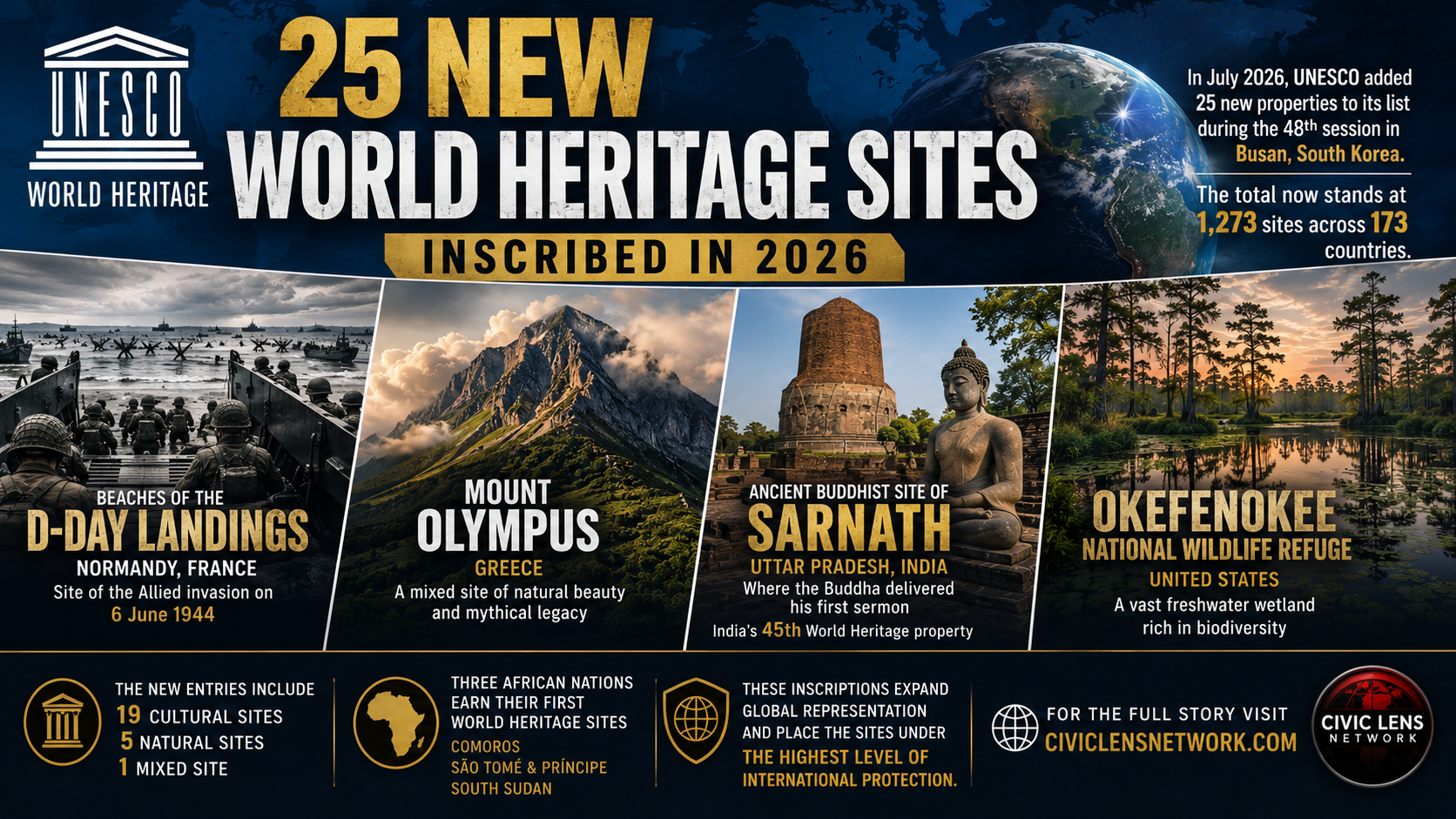
In July 2026, the UNESCO World Heritage Committee inscribed 25 new properties on its prestigious World Heritage List during its 48th session in Busan, Republic of Korea. The additions brought the global total to 1,273 sites across 173 countries, underscoring the Convention’s ongoing effort to safeguard places of outstanding universal value for future generations. The newly listed properties include 19 cultural sites, five natural sites, and one mixed site. All inscriptions were adopted by consensus, reflecting the cooperative spirit of the 1972 World Heritage Convention.
The session also marked a milestone in geographic representation, with first-ever listings for three African nations: Comoros, São Tomé and Príncipe, and South Sudan. This progress reduced the number of States Parties without a World Heritage property to 23 out of 196. Among the most notable cultural inscriptions is the “Beaches of the D-Day Landings, Normandy, 1944” in France. This site of memory encompasses the five landing beaches Utah, Omaha, Gold, Juno, and Sword, along with Pointe du Hoc.
These locations were central to the Allied invasion on 6 June 1944, a pivotal event that helped liberate Western Europe from Nazi occupation and reshape the course of World War II. Greece’s Mount Olympus joined as the session’s mixed site, recognized for both its natural and cultural significance. As the country’s highest mountain and the mythical home of the Olympian gods in ancient Greek tradition, the wider Olympus area combines dramatic landscapes, rich biodiversity, and deep mythological associations.
In India, the Ancient Buddhist Site of Sarnath near Varanasi was inscribed. This is the place where the Buddha is believed to have delivered his first sermon, making it one of the most sacred locations in Buddhism. Its archaeological remains and continuing role as a pilgrimage center earned it recognition as India’s 45th World Heritage property. The United States contributed the Okefenokee National Wildlife Refuge, a vast freshwater wetland ecosystem spanning Georgia and Florida.
Valued for its exceptional biodiversity and role as the source of major rivers, the refuge highlights the importance of protecting intact natural habitats. South Sudan’s Boma-Badingilo Migratory Landscape, Comoros’s historic medinas of the former sultanates, and São Tomé and Príncipe’s roças (colonial plantation landscapes) represent the first entries for those countries, advancing a more balanced and inclusive List. UNESCO Director-General Khaled El-Enany emphasized that inscription is only the beginning: each site now carries a shared responsibility for effective protection, management, and community benefit.
The 2026 inscriptions reaffirm the World Heritage Convention’s role in celebrating and preserving humanity’s diverse cultural and natural heritage.