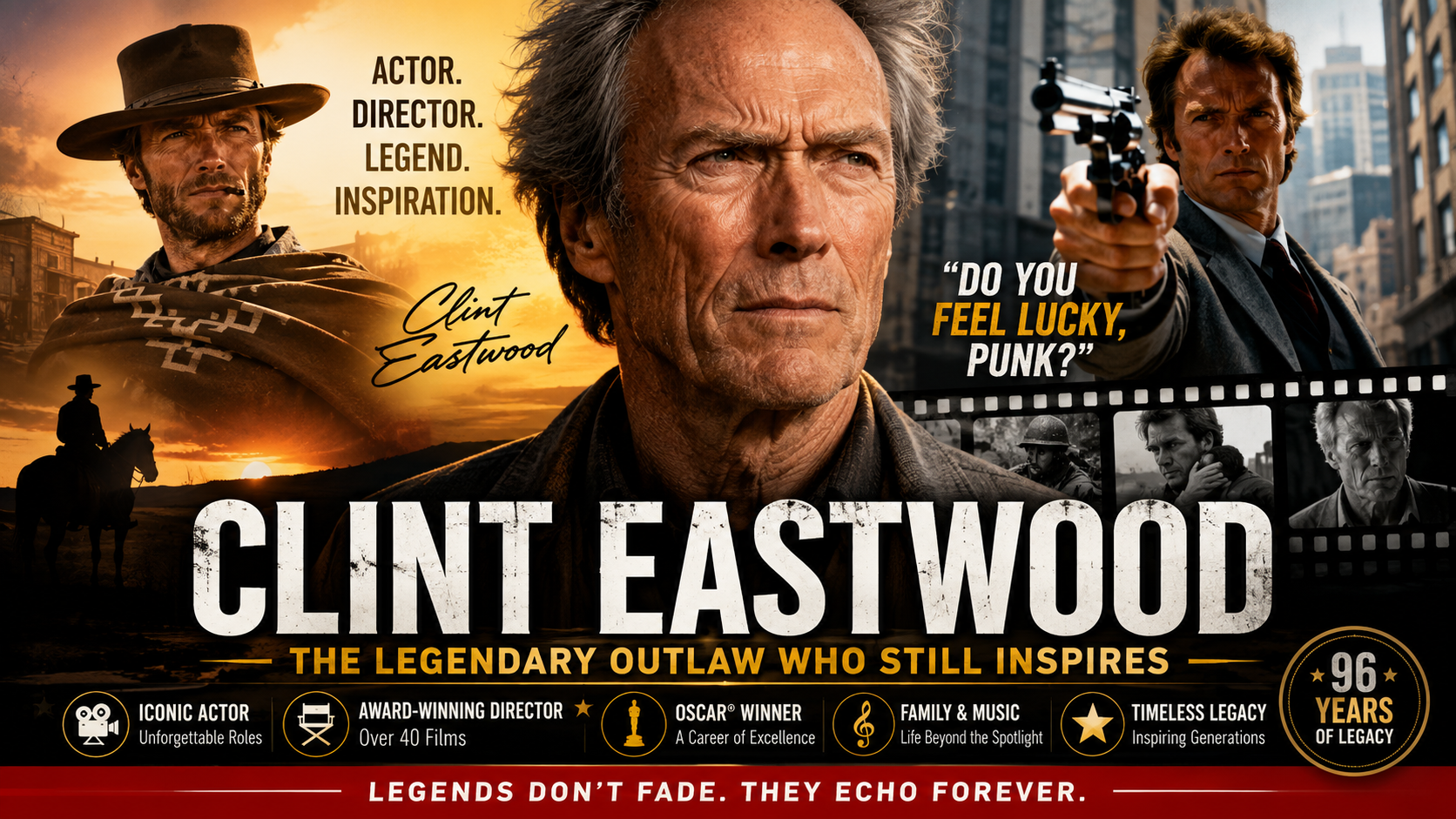
Clint Eastwood stands as one of cinema’s most enduring legends—a man whose squinty gaze, gravelly voice, and unbreakable spirit have defined toughness with heart for over seven decades. Born Clinton Eastwood Jr. on May 31, 1930, in San Francisco, he entered the world during the Great Depression as a strapping 11-pound baby nicknamed “Samson.”
Raised in nearby Piedmont and Oakland, California, young Clint bounced through jobs as a logger, steelworker, and even a lifeguard after a brief stint in the Army during the Korean War era. Those early hardships built the resilient core that would later light up the silver screen. His big break came in 1959 with the CBS Western series Rawhide, where he played the hot-headed cowhand Rowdy Yates for eight seasons. But it was across the Atlantic in the mid-1960s that Eastwood exploded into global stardom.
Italian director Sergio Leone cast him as the mysterious “Man with No Name” in the groundbreaking Dollars Trilogy: A Fistful of Dollars (1964), For a Few Dollars More (1965), and the epic The Good, the Bad and the Ugly (1966). With minimal dialogue, a poncho, and that iconic stare, Eastwood redefined the Western hero as a cool, calculating anti-hero. Audiences loved the moral ambiguity and stylish violence. Suddenly, the lanky American with jazz-pianist fingers was an international sensation!
The 1970s cemented his status as a box-office king. As Inspector Harry Callahan in Dirty Harry (1971) and its sequels, Eastwood delivered the ultimate tough-cop fantasy. “Do I feel lucky?” became a cultural catchphrase.
He balanced high-octane action with personal passion projects through his Malpaso Productions company, which he founded to maintain creative control. Films like The Outlaw Josey Wales (1976) blended sweeping Western vistas with themes of redemption and loss. By the 1980s and ’90s, Eastwood evolved from star to acclaimed director. He never chased trends—he created them.
Unforgiven (1992), a gritty deconstruction of Western myths, earned him Academy Awards for Best Picture and Best Director. Then came Million Dollar Baby (2004), a poignant boxing drama that swept the Oscars again, proving Eastwood could wring tears as masterfully as thrills. Other directorial triumphs include Mystic River (2003), Letters from Iwo Jima (2006), Gran Torino (2008)—where he starred as a cranky veteran finding unexpected family—and American Sniper (2014), which became one of his biggest commercial hits.
What makes Eastwood’s journey so uplifting is his relentless reinvention. In his 80s and 90s, he delivered The Mule (2018) and Cry Macho (2021), playing aging men confronting regret and second chances with quiet dignity. His 2024 film Juror #2 marked a graceful coda. At 96, according to his son Kyle, Clint has stepped into retirement after a career spanning more than 50 films as actor, director, producer, and even composer.
Yet his influence feels anything but retired. Beyond the camera, Eastwood’s life pulses with passion. A lifelong jazz enthusiast who once played piano in smoky clubs, he composed scores for several films. He served as mayor of Carmel-by-the-Sea from 1986 to 1988, bringing his no-nonsense style to local politics.
Family remains central: father to eight children—including musician Kyle and actress Alison—from various relationships, he has embraced a sprawling, supportive clan. His philanthropy shines through animal welfare efforts, veteran support via the Clint Eastwood Family Foundation, and quiet donations to education and health causes. An animal lover and environmentalist, he walks the talk of living authentically. Eastwood’s philosophy resonates deeply: create something original, take risks, and never apologize for your vision.
He once said doing remakes bores him—“Do something new or stay home.” That maverick drive inspired generations of filmmakers and fans alike. Through economic tough times, cultural shifts, and personal challenges, Clint Eastwood embodied the American dream with a Western twist—rugged individualism tempered by empathy. Today, his legacy sparkles like a desert sunset.
Box-office totals exceed billions, and his four Oscars barely capture the cultural impact. Clint didn’t just act in movies; he shaped how we see heroism, aging, and redemption. In a world craving authentic voices, his story reminds us that true legends build slowly, endure storms, and leave the trail better than they found it. Whether you’re a longtime fan replaying Unforgiven or discovering Gran Torino for the first time, Eastwood’s work lifts the spirit and stirs the soul.
Here’s to the Man with No Name who gave us everything—grit, grace, and unforgettable cinema. Clint Eastwood proves it’s never too late to ride into the horizon with your head held high.