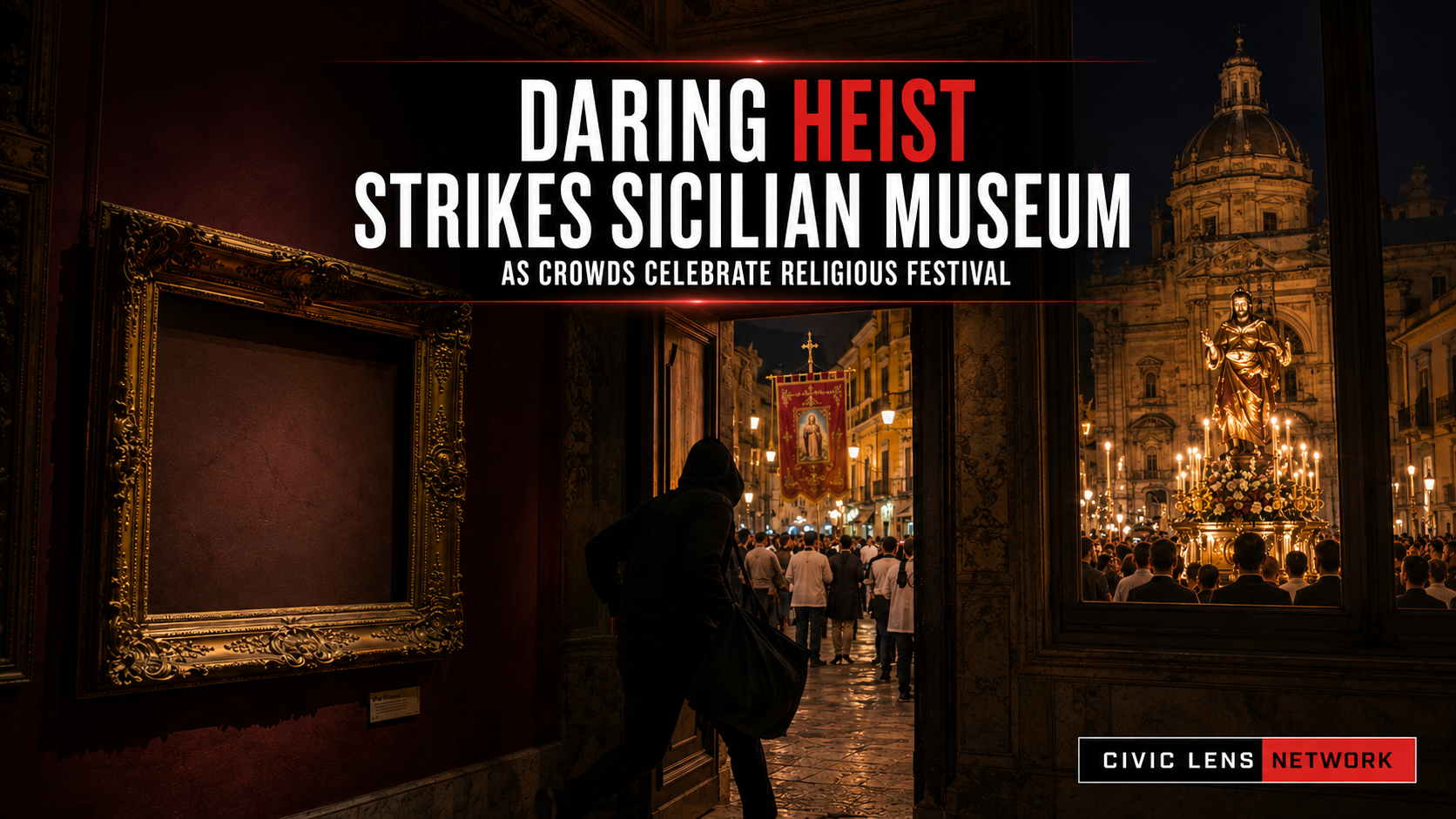
In the heart of Messina on the island of Sicily a brazen theft unfolded on the evening of August 15 2026 while thousands of residents and visitors filled the streets for the traditional Ferragosto celebrations marking the feast of the Assumption of Mary. Four precious artworks attributed to the 15th century Renaissance master Antonello da Messina disappeared from the Museo Regionale Interdisciplinare di Messina known as MuMe.
Experts have valued the stolen pieces at between 70 million and 80 million euros or as much as 92 million dollars making this one of the most significant losses of cultural heritage in recent Italian history. The thieves struck shortly before 10 pm local time according to museum director Marisa Mercurio. They managed to bypass the alarm systems and security measures that protect the galleries. Once inside they targeted two of the most important holdings linked to the hometown artist.
Three of the five surviving panels from the San Gregorio Polyptych dated 1473 were removed from their frame. This altarpiece originally consisted of six panels created for the Monastero di San Gregorio which was destroyed in the devastating 1908 earthquake that leveled much of Messina. The polyptych had remained the only major work by Antonello that never left his native city.
The thieves also forced open an armored display case and took a rare double sided panel showing the Virgin and Child with a Franciscan monk on one side and Christ in Pietà on the other. This smaller work had been acquired by the Sicilian regional government in 2003 after it was attributed to Antonello and sold at Christies from the Wilhelm Soldan collection. Investigators later discovered that the gang had initially removed all five remaining panels of the polyptych.
During their escape however they abandoned two of the larger side panels depicting saints near a wall just outside the museum. Passersby found those two panels and returned them. The abandoned works suggest the thieves may have been interrupted or forced to lighten their load while fleeing into the night. All the stolen pieces are painted on wooden panels which cannot be rolled like canvas making their removal more cumbersome and deliberate.
Antonello da Messina who lived from around 1430 to 1479 stands as one of the pivotal figures of the early Italian Renaissance. Born and raised in Messina he absorbed influences from Flemish painting techniques particularly the use of oil and brought a remarkable clarity of light and psychological depth to his portraits and religious scenes. His San Gregorio Polyptych shows the Madonna of the Rosary enthroned with the infant Jesus flanked by saints and angels.
The central panel and the upper register panels of the Annunciation were among those taken. The double sided panel is an intimate object of private devotion rare for its small scale and dual imagery. The timing of the theft appears carefully chosen. Ferragosto is one of Italy’s most important summer holidays when cities empty as people head to beaches or gather for processions.
In Messina the celebrations center on La Vara a massive religious float procession that draws large crowds to the main piazza and surrounding streets. With attention focused elsewhere the museum became a quieter target. Culture Minister Alessandro Giuli expressed shock and sadness at the news calling the works of extraordinary value. Director Mercurio described the loss as devastating for the museum the city the community and the wider art world.
Italian authorities including the specialized Carabinieri unit for cultural heritage protection have opened an investigation. Early indications point toward a possible theft to order by black market operators rather than opportunistic criminals. Famous and easily recognizable Renaissance works are notoriously difficult to sell on the open market. They often circulate in closed networks as collateral for other illicit activities or remain hidden for years until a buyer surfaces who is willing to risk ownership of such high profile pieces.
Art crime analysts note that recovering them will depend on international cooperation tips from the underworld and careful monitoring of private sales channels. This incident follows other recent museum thefts in Italy including a March 2026 raid near Parma that took works by Renoir Cézanne and Matisse valued at around 10 million dollars. Those pieces were recovered within months and suspects arrested. The Messina case however carries deeper emotional weight because the stolen panels represent a direct link to the city’s artistic identity.
Antonello’s presence in local collections had recently gained renewed attention after the Italian government purchased his Ecce Homo for nearly 15 million dollars earlier in 2026 further elevating the artist’s international profile. The MuMe museum closed to the public in the immediate aftermath as forensic teams examined the scene. Security footage is under review and technicians are reconstructing the precise sequence of the break in.
Officials have stressed that alarms were operational and guards were present yet the intruders still succeeded in a short window of time estimated by some reports at only a few minutes inside the galleries. Beyond the monetary figure the cultural damage is profound. The San Gregorio Polyptych had already suffered losses over centuries from earlier dispersal and the 1908 disaster. Removing three more panels further fragments a work that once stood as a complete expression of Sicilian Renaissance devotion.
Residents of Messina have reacted with a mixture of anger and mourning viewing the theft as an attack on shared heritage. As the investigation continues police urge anyone with information to come forward. Rewards may eventually be offered and borders watched for any attempt to move the panels abroad. The story of these missing works will likely unfold over months or years as is common with major art crimes.
For now the empty spaces in the MuMe galleries stand as a stark reminder of how vulnerable even carefully guarded treasures can become when public attention turns elsewhere during a festival night.