One man stood on the heights of Mount Carmel while a nation held its breath. Hundreds of prophets of Baal lined the ridge, ready to call upon the god they claimed could bring rain and fertility. Below them the land lay cracked and dry. The people of Israel stood between the worship of the Lord and the foreign altars that had spread across their hills.
Elijah did not step back. He faced the assembly and refused to soften the choice set before them. Years earlier King Ahab had married Jezebel of Sidon. She brought the worship of Baal and the Asherah into the northern kingdom.
Ahab built an altar for Baal in Samaria and set up an Asherah. Through Elijah the Lord had already declared that neither dew nor rain would fall except by his word. The drought that followed was severe. When Jezebel began to cut off the prophets of the Lord, Obadiah, the governor of Ahab’s house who feared the Lord greatly, hid one hundred of them by fifties in caves and fed them with bread and water.
Elijah himself remained in seclusion until the Lord sent him to confront Ahab once more. The king then gathered the people and the prophets to Carmel. Elijah turned to the crowd and spoke the question that still cuts through hesitation. “How long halt ye between two opinions?
if the LORD be God, follow him: but if Baal, then follow him. And the people answered him not a word.” Their silence revealed the cost of divided loyalty. They had not fully abandoned the name of the Lord, yet they had not turned from the altars of Baal.
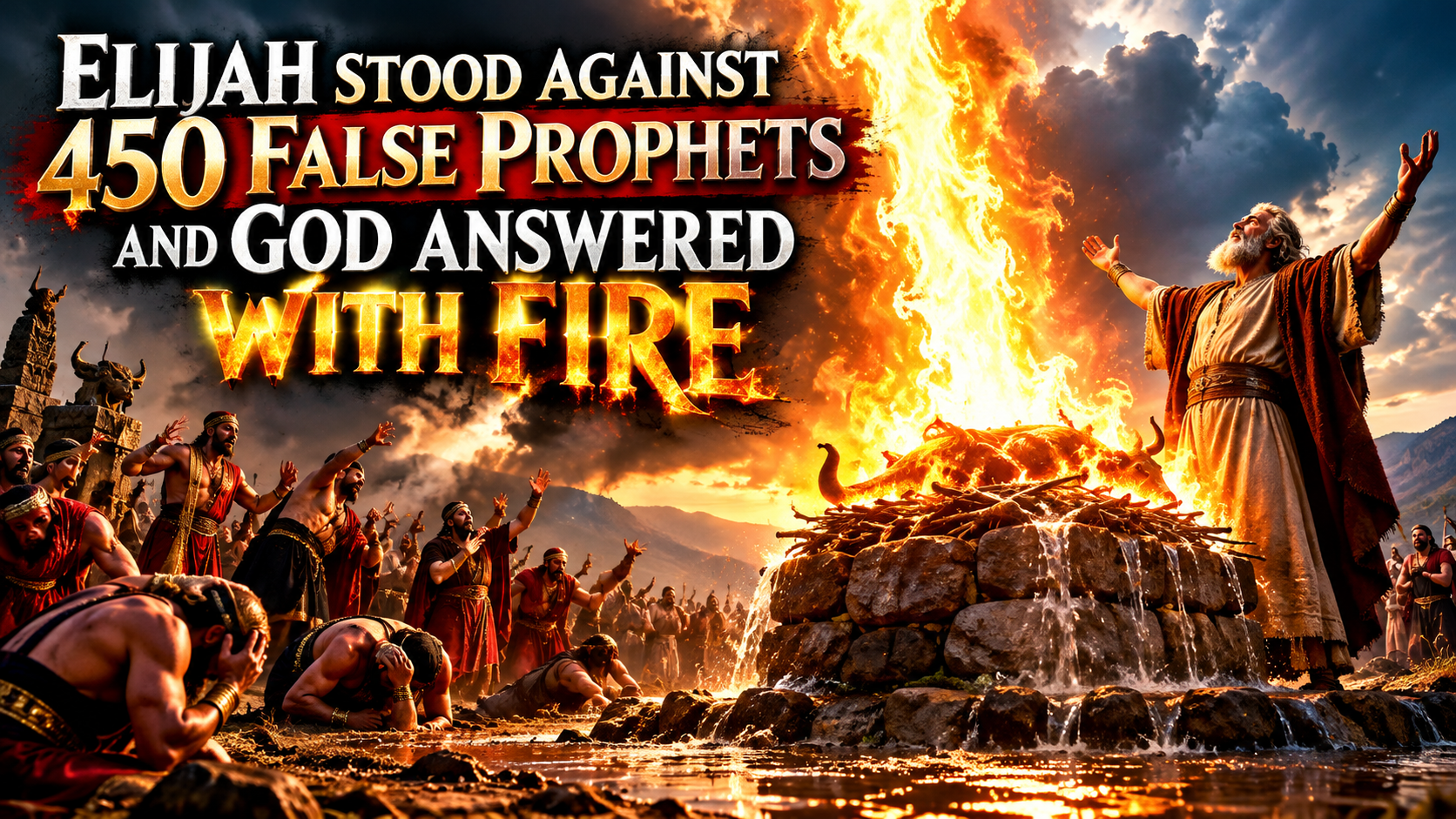
Elijah proposed a clear test. Two bullocks would be prepared. The prophets of Baal, four hundred and fifty men, would choose one, cut it in pieces, lay it on wood, and call on their god without placing any fire beneath it. Elijah would do the same and call on the name of the Lord.
The God who answered by fire would be acknowledged as God. The people agreed that the proposal was well spoken. The prophets of Baal took their bullock, prepared it, and called on the name of Baal from morning until noon, crying, “O Baal, hear us.” There was no voice and no answer.
They leaped upon the altar. At noon Elijah mocked them and urged them to cry louder in case their god was talking, pursuing, on a journey, or asleep. They cried louder still and cut themselves after their manner with knives and lancets until the blood gushed out. They continued until the time of the evening sacrifice.
Still there was neither voice, nor answer, nor any that regarded. Elijah called the people near. He repaired the altar of the Lord that had been broken down. Taking twelve stones according to the number of the tribes of the sons of Jacob, he built an altar in the name of the Lord and made a trench around it large enough to hold two measures of seed.
He arranged the wood, cut the bullock in pieces, and laid it on the wood. Then he ordered four barrels of water poured over the sacrifice and the wood. He ordered it a second time and a third time until the water ran around the altar and filled the trench. At the time of the offering of the evening sacrifice Elijah drew near and prayed.
“LORD God of Abraham, Isaac, and of Israel, let it be known this day that thou art God in Israel, and that I am thy servant, and that I have done all these things at thy word. Hear me, O LORD, hear me, that this people may know that thou art the LORD God, and that thou hast turned their heart back again.”
The fire of the Lord fell and consumed the burnt sacrifice, the wood, the stones, the dust, and licked up the water that was in the trench. When the people saw it they fell on their faces and said, “The LORD, he is the God; the LORD, he is the God.” The miracle drew a sharp line between the living God and every powerless idol. Baal’s prophets had exhausted their rituals, their leaping, and their blood, yet nothing answered.
The Lord required no frenzy. He answered the prayer of His servant with fire that left nothing of the offering or the water meant to make the test unmistakable. The people who had halted between two opinions now confessed what the fire made plain. Elijah’s courage rested on the word he had already received, not on the size of his following.
He told the people that he alone remained a prophet of the Lord while Baal’s prophets numbered four hundred and fifty. In that moment he spoke what he knew. The broader record shows he was not the only faithful person in Israel. Obadiah had already preserved one hundred prophets of the Lord, and later the Lord revealed to Elijah that seven thousand in Israel had not bowed the knee to Baal or kissed him.
The four hundred prophets of the groves who ate at Jezebel’s table are named in the invitation to Carmel, yet the contest itself is recorded with the four hundred and fifty prophets of Baal. Elijah stood in the open because the Lord had sent him, not because he counted on numbers or safety. The same account presses a question on believers today. How long will any of us halt between two opinions?
Popularity, power, wealth, or cultural approval can quietly occupy the place that belongs to the Lord. The pressure to soften conviction, to treat every claim as equally valid, or to keep silent when the name of God is set aside is real. The response required is faithfulness, repentance, and the clear worship of the living God. The story does not authorize hostility or violence toward people who hold different beliefs.
After the people confessed the Lord, the prophets of Baal met the judgment of that day under the law then in force, but the lasting lesson for the church is the call to decide whom it will serve and to remain steady when opposition is loud. Christians should not expect the Lord to reproduce the fire of Carmel every time they demand visible proof. Elijah acted according to the word already given.
The God who answered him remains the same, yet He is free to confirm His truth through Scripture, through the changed lives of His people, and through ordinary faithfulness that refuses to bow. The drought ended only after the people turned and Elijah prayed again. The fire on Carmel was given so that hearts might be turned back, not so that every generation might stage the same contest. The question Elijah placed before Israel still stands.
If the Lord is God, follow Him. The silence of Baal and the fire that fell both point to the same reality. Only the living God hears, acts, and turns hearts. Knowing whom we worship and having the courage to stand on that knowledge remains the path that leads out of divided loyalty and into the open confession that the Lord, He is God.