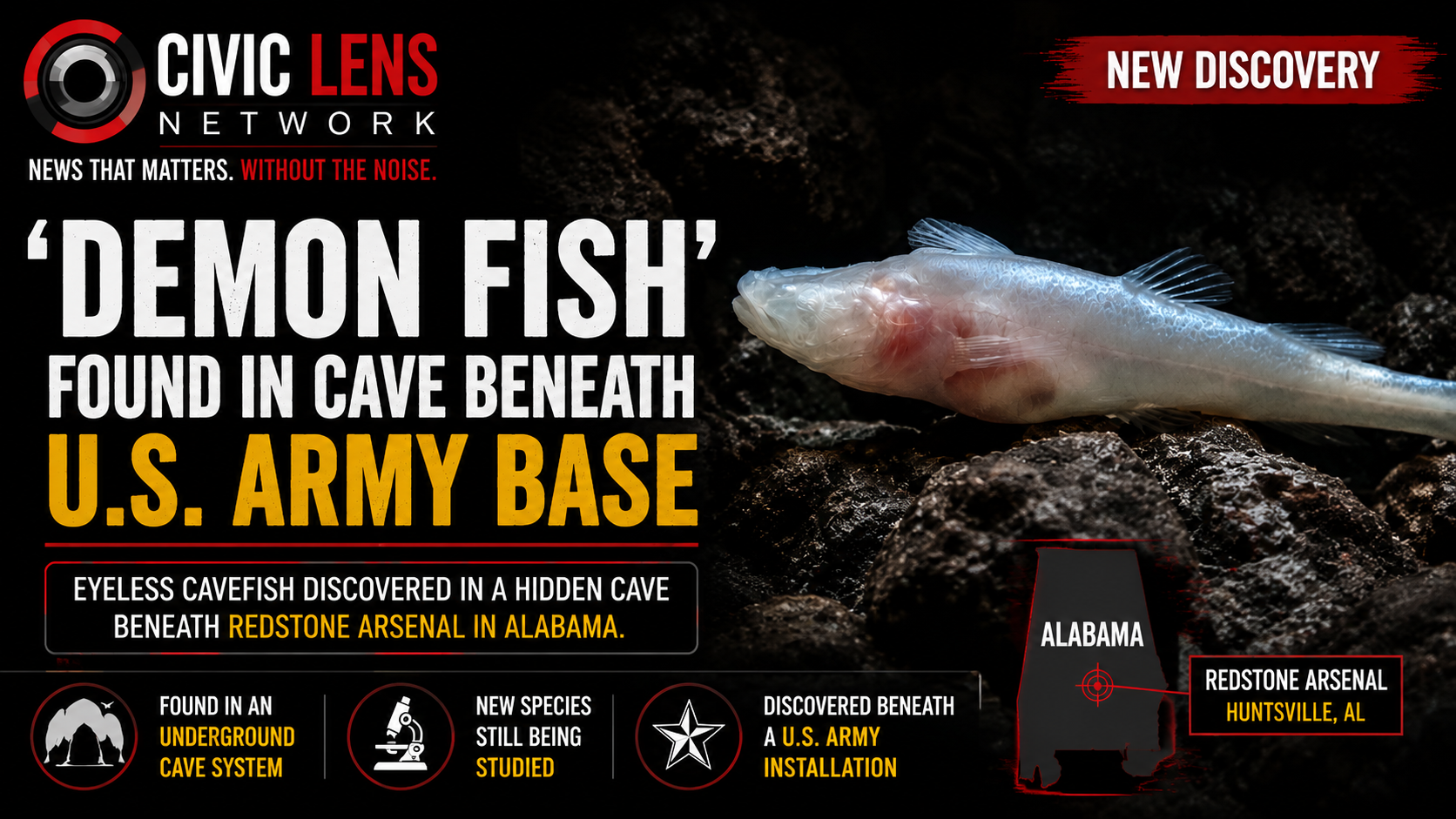
In the dark waters of a cave system long watched by scientists, a pale and eyeless fish swam unnoticed for decades. Researchers from the University of Alabama in Huntsville recently confirmed it as an entirely new genus and species. They named it Demogorgonichthys arcanus, the Demon Cavefish, after the mythical Demogorgon and its modern appearance in Stranger Things and Dungeons and Dragons. The name fits a creature that lives hidden underground, secret and strange.
The discovery took place in Bobcat Cave beneath the U.S. Army’s Redstone Arsenal near Huntsville, Alabama. This military installation once produced chemical weapons during World War II and remains a secure site for defense and aerospace work. Bobcat Cave sits only about eight miles from the university campus.
Biologists have monitored it at least quarterly for more than thirty years, mainly because it shelters the federally endangered Alabama cave shrimp. The same pools also hold Southern Cavefish and certain cave crayfish. After so many visits, experts assumed the cave’s residents were fully known. In February 2025 that assumption ended.
Lead researcher Matthew Niemiller, associate professor of biological sciences and director of the Cave Bio Lab at UAH, was on a routine survey. He slipped in the mud in an area called the Shrimp Room and fell into a deeper pool. The accidental tumble disturbed a fish and a crayfish under a rock ledge. What he saw looked different from the familiar Southern Cavefish already recorded there.
The new fish had a pronounced hump behind the head, a longer and flatter snout, and unbranched fin rays. It was completely eyeless and colorless, showing a faint electric blue tint while alive. Niemiller and his team returned soon afterward and confirmed that nearly half the cavefish they observed belonged to this unrecognized form. Detailed anatomical study, CT imaging, and genetic analyses followed.
The results placed the fish within the family Amblyopsidae yet showed deep divergence from every described genus. It carries a nonfunctional version of the rhodopsin gene that once helped detect light, clear evidence of long adaptation to total darkness. The Southern Cavefish shares the same pools but is not a close relative. The two lineages evolved the classic traits of cave life, loss of eyes and pigment, independently and millions of years apart.
Researchers describe the find as humbling. Cavefish in this group have served as model organisms for subterranean biology since the 1800s. Most specialists believed a new genus level discovery had grown unlikely, especially in a heavily studied site. Finding one in Bobcat Cave felt like discovering a new kind of big cat in a familiar forest.
The Demon Cavefish is currently known only from this single cave and its connected aquifer. That limited range makes it one of the rarest fishes in the world and highly vulnerable to changes in groundwater quality or hydrology. The paper announcing the species appeared in Scientific Reports. Coauthors included scientists from Auburn University, the University of Alabama, Mississippi State University, and others, along with students from Niemiller’s lab.
The scientific name combines Demogorgon with the Greek word for fish and the Latin arcanus, meaning hidden or secret. Niemiller, an 1980s kid from Indiana, noted that Stranger Things resonated with the team and the name fit the underground lifestyle of the animal. Beyond the novelty of a new genus, the discovery carries broader lessons. It shows that even intensively monitored ecosystems can still hide extraordinary biological secrets.
Restricted lands such as military installations can protect rare species simply by limiting public access and development. At the same time those same sites demand careful environmental oversight so that groundwater remains clean enough to sustain the life below. Two top predators of the subterranean food web living side by side after independent evolutionary journeys raise fresh questions about how cave communities assemble and persist. Cave animals are often misunderstood as degenerate forms that lost useful traits.
The opposite is closer to the truth. These specialized creatures rank among the most finely tuned animals on the planet, shaped by millions of years in perpetual night. Sensory systems that work without light, metabolism suited to sparse food, and bodies adapted to narrow passages all reflect successful evolution rather than decline. The Demon Cavefish embodies that success while remaining almost invisible to human eyes until a simple slip in the mud brought it into view.
The find also underscores how much remains unknown even in places people think they understand. North Alabama’s karst landscape holds countless caves and aquifers. Many lie under developed or restricted land. Continued careful exploration, combined with modern genetic tools, will almost certainly reveal more cryptic diversity.
For now the Demon Cavefish swims on in the dark pools of Bobcat Cave, a living reminder that the natural world still keeps secrets right under our feet.