Four U.S. Troops Killed in Iran Conflict In mid-July 2026, four American service members lost their lives amid escalating Iranian attacks. These tragedies form part of the broader Iran war that began in late February. The primary incident struck Muwaffaq Salti Air Base in Jordan on July 17-18.
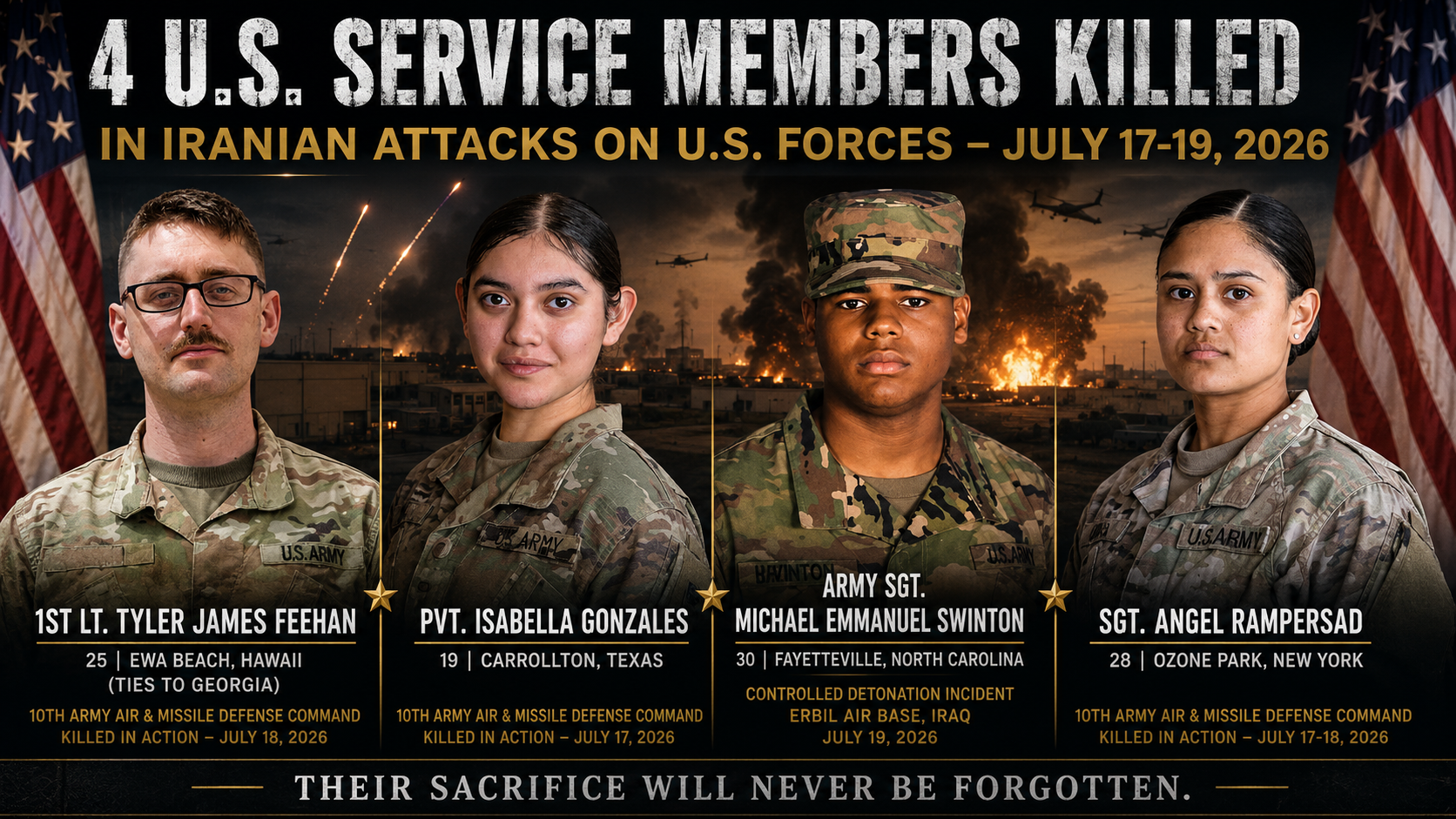
Iranian ballistic missiles and drones hit during defensive operations. Two soldiers died immediately, while a third initially listed as missing was later confirmed deceased. Pvt. Isabella Gonzales, just 19, of Carrollton, Texas, was killed in action on July 17.
Assigned to the 10th Army Air & Missile Defense Command in Ansbach, Germany, she represented one of the youngest casualties. Her role highlighted the dangers faced by junior enlisted personnel in forward air defense positions. 1st Lt. Tyler James Feehan, 25, of Ewa Beach, Hawaii with ties to Georgia, died on July 18 in the same attack. Also serving with the 10th Army Air & Missile Defense Command, Feehan’s leadership role underscored the intensity of the Iranian assault.
Sgt. Angel S. Rampersad, 28, of Ozone Park, New York, was initially missing and later confirmed killed in the Jordan strike. A signal specialist in the same unit as Gonzales, Rampersad brought the confirmed deaths from the base attack to three.
These three brave troops defended against Iranian strikes threatening U.S. and partner positions. Over 100 service members have been injured in related actions across the region in recent weeks. Army Sgt. Michael Emmanuel Swinton, 30, of Fayetteville, North Carolina, was killed separately on July 19 in northern Iraq.
He died during a controlled detonation of a downed Iranian drone at Erbil Air Base. Assigned to the 108th Air Defense Artillery Brigade at Fort Bragg, Swinton left behind a wife and two young children. The losses occurred as the U.S.-Iran conflict intensified following the breakdown of a prior ceasefire. Iranian forces targeted bases with missiles and drones, prompting U.S. retaliatory strikes on Iranian assets threatening shipping in the Strait of Hormuz.
President Trump vowed severe retaliation, while officials stressed the need for behavioral changes from Iran. Iranian leaders described the situation as nearing full-scale war. These sacrifices bring the total U.S. service member deaths in the Iran war to around 17-18 as of late July 2026. They have sparked domestic debates, with some lawmakers calling for an end to hostilities and public reactions mixing mourning with concerns over costs, including rising gas prices.
The service members embodied dedication to air and missile defense in a volatile theater. Their units played critical roles protecting forces and allies from aerial threats. Families and communities in Texas, Hawaii, Georgia, New York, and North Carolina grieve deeply, with dignified transfers and memorials planned. In the larger picture, these incidents illustrate the persistent dangers of drone and missile warfare in modern conflicts.
U.S. Central Command continues operations to counter Iranian aggression while supporting regional stability. The sacrifices underscore the human cost of geopolitical tensions, reminding the nation of the bravery required in forward positions far from home. As investigations proceed and the conflict evolves, these four represent the latest in a growing list of fallen heroes.
Their service and memory will endure in military history and the hearts of those they protected.