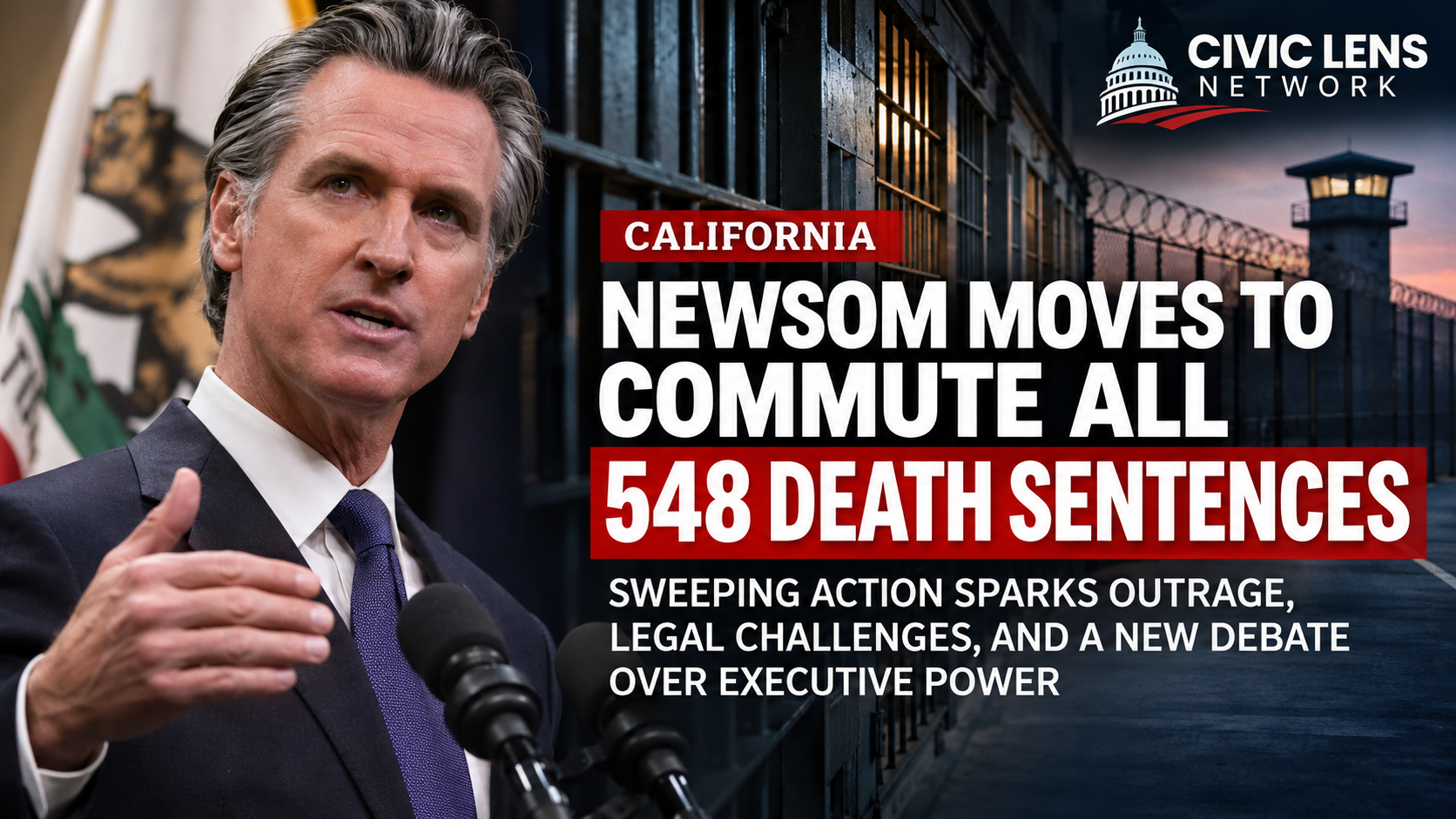
California Governor Gavin Newsom has launched one of the most sweeping death penalty interventions in American history, announcing plans to commute the death sentences of all 548 inmates on the state’s death row.
The extraordinary decision would replace capital punishment with life imprisonment without the possibility of parole, sparing hundreds of convicted murderers from execution while igniting fierce criticism from prosecutors, law enforcement officials, and families whose loved ones were brutally murdered.
But beyond the debate over capital punishment lies another question: Why is California’s governor moving to overturn hundreds of death sentences when voters have repeatedly rejected efforts to eliminate the death penalty?
The announcement places Newsom at the center of a national controversy involving victims’ rights, executive authority, criminal justice, and the limits of a governor’s power.
California Voters Already Made Their Decision
California residents have repeatedly been asked whether capital punishment should remain legal.
In 2012, voters rejected Proposition 34, which would have replaced the death penalty with life imprisonment without parole.
Four years later, voters faced another opportunity to eliminate capital punishment through Proposition 62.
Once again, the proposal failed.
During that same 2016 election, voters approved Proposition 66, an initiative intended to accelerate the state’s death penalty appeals process.
The message from those elections was unmistakable: California voters chose to retain capital punishment.
Yet Newsom has now moved to accomplish through executive clemency what voters declined to approve through statewide elections.
Although California’s Constitution grants governors clemency powers, critics argue that using those powers to change hundreds of death sentences simultaneously undermines the judgments of juries, the courts, and the electorate.
The distinction is important. Newsom is not legally abolishing the death penalty. California law would still permit future death sentences.
Instead, he is seeking to permanently remove the possibility of execution for every prisoner currently awaiting that punishment.
Hundreds of Convicted Murderers Could Escape Execution
California maintains the nation’s largest death row population.
Among those whose sentences could be changed are individuals convicted of crimes that shocked communities across the country.
One of the most notorious is Richard Allen Davis, convicted of kidnapping and murdering 12-year-old Polly Klaas in 1993.
The killing triggered a massive search and became one of California’s most widely followed criminal cases.
Another inmate affected by the decision is Charles Ng, convicted in connection with a series of murders in Northern California during the 1980s.
The crimes involved multiple victims and became infamous for their brutality.
Also among the condemned is Christopher Cheary, convicted of the sexual assault, torture, and murder of three-year-old Sophia Acosta.
These are not minor offenses or cases involving individuals serving sentences for nonviolent crimes.
They are among the most serious criminal convictions in California’s history.
Newsom’s decision would not release these prisoners. Their punishment would become life imprisonment without parole.
Nevertheless, for families who endured years of criminal proceedings and appeals, the change represents a fundamental alteration of the punishment imposed by the courts.
Prosecutors Condemn the Decision
District attorneys and law enforcement organizations across California have voiced strong opposition.
Fresno County District Attorney Lisa Smittcamp criticized the decision for disregarding the judgments of voters and the suffering of victims’ families.
Prosecutors from several major California counties have also objected, arguing that the governor’s action undermines the judicial process.
Sacramento County Sheriff Jim Cooper specifically raised concerns about the death sentence imposed on Luis Bracamontes, who was convicted in the 2014 murders of Sacramento County Sheriff’s Deputy Danny Oliver and Placer County Sheriff’s Detective Michael Davis Jr.
Cooper urged Newsom to reconsider, emphasizing the importance of accountability, jury decisions, and the families of murdered officers.
For law enforcement officials, the controversy is not simply about whether capital punishment should exist.
It is about whether sentences imposed after lengthy trials and appeals should be changed through a sweeping executive decision.
The California Supreme Court Could Become the Final Obstacle
Despite the governor’s announcement, not every commutation can take effect solely through his signature.
California’s Constitution requires Supreme Court approval before a governor can grant clemency to individuals convicted of multiple felonies.
That requirement applies to a substantial portion of the state’s death row population.
Approximately 382 of the 548 commutations require approval from the California Supreme Court.
This means Newsom cannot independently finalize every sentence reduction.
The court’s review could determine whether hundreds of condemned prisoners receive life sentences or remain legally subject to capital punishment.
The process also raises an important constitutional question about the separation of powers.
While governors possess clemency authority, California’s constitutional safeguards place limits on how that power can be exercised in certain cases.
Why Newsom Says He Is Doing It
Newsom has long opposed capital punishment.
In 2019, he imposed a moratorium on executions in California, preventing the state from carrying out death sentences during his administration.
California has not executed a prisoner since 2006.
The governor argues that the death penalty is costly, vulnerable to wrongful convictions, and inconsistently applied.
He also maintains that government executions are incompatible with his understanding of justice and human dignity.
Supporters of his decision, including civil liberties organizations, argue that capital punishment creates an unacceptable risk of executing innocent people.
They also point to racial disparities, lengthy appeals, and the financial burden associated with death penalty litigation.
Those arguments have fueled efforts to eliminate capital punishment across the United States.
But opponents maintain that the governor’s personal opposition does not erase the rights of victims’ families or the decisions California voters made at the ballot box.
The Political Timing Raises Questions
Newsom announced his decision immediately after the November elections and during the final months of his governorship.
The timing is significant because Newsom has been discussed as a possible contender for the 2028 Democratic presidential nomination.
His opposition to capital punishment could strengthen his standing among progressive voters who favor abolishing the death penalty.
However, it could also create difficulties with voters who believe the punishment should remain available for the most serious murders.
The timing does not establish that Newsom acted for political advantage.
Nevertheless, the decision is likely to become part of any future national campaign, particularly as opponents examine his criminal justice record.
For critics, the central issue is whether a governor should use broad executive powers to reverse punishments that voters have repeatedly chosen to preserve.
Victims’ Families Face Another Painful Chapter
Behind every death sentence is a criminal case involving victims, relatives, investigators, prosecutors, and jurors.
Many families spent years attending hearings, reviewing evidence, and waiting for final judgments.
Some believed that the death sentences imposed after those proceedings represented an essential measure of justice.
Newsom’s announcement now forces those families to confront the possibility that the punishment they were promised will never be carried out.
While the prisoners will remain incarcerated for life, the legal consequences of their convictions are being fundamentally changed.
For families who supported capital punishment, that distinction matters enormously.
It also raises questions about whether victims and their relatives were given sufficient consideration before the governor announced such a sweeping action.
A Larger Battle Over Democracy and Executive Power
California’s death penalty controversy now extends beyond the question of whether executions are morally justified.
It has become a dispute over democratic accountability.
Voters rejected attempts to abolish capital punishment.
Juries imposed death sentences under existing law.
Courts reviewed those convictions through years of legal proceedings.
Now, one governor is seeking to change hundreds of those sentences through executive authority.
Newsom’s defenders argue that clemency is itself a constitutional power and that governors are expected to exercise independent judgment when they believe justice requires it.
His opponents argue that using that power on such an unprecedented scale disregards the public’s repeated decisions.
Both the constitutional authority and the democratic consequences will remain central to the controversy.
What Happens Next
The California Supreme Court must review the commutations requiring judicial approval.
The remaining sentences could be changed through the governor’s direct clemency authority.
Even if all 548 commutations are finalized, capital punishment would technically remain legal in California unless lawmakers and voters change the underlying law or courts invalidate it.
That means the state could continue imposing death sentences while maintaining a system in which executions have effectively disappeared.
For critics, the contradiction demonstrates how far California’s political leadership has moved from the punishment voters repeatedly chose to preserve.
For supporters, it represents progress toward ending a system they believe is fundamentally flawed.
But for victims’ families, the consequences are immediate and deeply personal.
The ultimate question is no longer simply whether California should have a death penalty. It is whether a governor should be able to change hundreds of jury-imposed death sentences after voters repeatedly chose to keep that punishment in place.
And as the state’s highest court prepares to consider hundreds of commutations, that question could shape the national debate over criminal justice and executive power for years to come.