WASHINGTON, D.C. | November 6, 2026
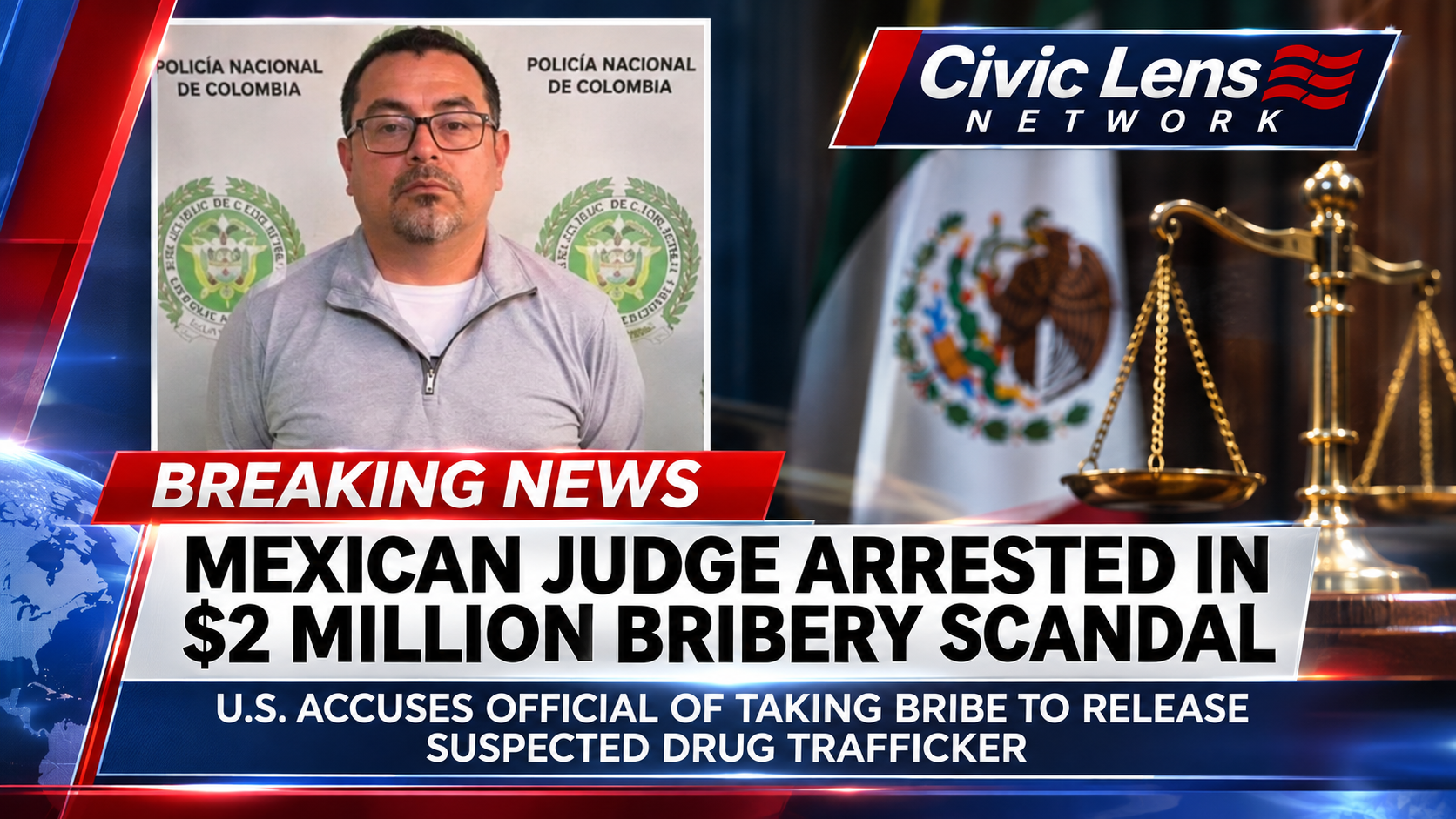
A Mexican federal judge has been arrested in Colombia after American investigators accused him of accepting a staggering $2 million bribe to release a suspected international drug trafficker connected to a billion-dollar cocaine empire allegedly operated by a former Canadian Olympic athlete.
The arrest marks a major development in an expanding international investigation involving alleged judicial corruption, organized crime, cocaine trafficking, and multiple murders.
Luis Benítez Alcántara, 49, a district judge from Mexico City, was arrested Sunday, November 1, in Colombia, according to an announcement issued Thursday by the United States Department of Justice.
Federal prosecutors have charged Benítez with nine counts of being an accessory after the fact, alleging that he abused his judicial authority to help Andrew Clark, a Canadian national accused of occupying a senior position in one of North America’s most notorious alleged drug trafficking organizations.
The accusations are extraordinary because they involve a judge entrusted with overseeing extradition proceedings for a suspected international criminal.
Instead, prosecutors allege, the judge accepted millions of dollars and ordered the suspect released.
The case raises serious questions about corruption inside international judicial systems and the ability of wealthy criminal organizations to exploit officials responsible for enforcing the law.
A $2 Million Payment and a Judge’s Decision
According to a federal indictment, the alleged bribery scheme developed while Benítez was overseeing extradition proceedings involving Andrew Clark.
Clark, 36, had been arrested in Mexico in October 2024 on American charges involving drug trafficking, murder, and attempted murder.
American authorities wanted him extradited to face prosecution.
But prosecutors allege that Clark and his associates began arranging substantial payments intended to secure his release from Mexican custody.
Between November 2024 and February 2025, approximately $2.75 million was transferred through intermediaries in smaller transactions for the purpose of obtaining Clark’s freedom, according to the Justice Department.
During that period, investigators allege, Clark negotiated an agreement to pay Benítez approximately $2 million.
The payment was allegedly intended to influence the judge’s decision in the extradition proceedings.
On February 24, 2025, prosecutors say Benítez received the full $2 million payment.
That same day, he granted Clark bond and ordered him released.
The timing is central to the government’s case.
Prosecutors contend that the judicial ruling was not simply a controversial legal decision but the result of a deliberate agreement to exchange money for official action.
Those allegations have not yet been established through a criminal conviction.
The Suspect Was Released, But Not for Long
The alleged scheme did not permanently secure Clark’s freedom.
Within days of his release, authorities arrested him again.
He was subsequently transferred to the United States, where his criminal proceedings remain pending.
The fact that Clark was quickly returned to custody did not end the investigation into how he had been released.
Instead, American authorities pursued the alleged corruption surrounding the judicial decision itself.
The resulting investigation ultimately produced a superseding federal indictment against Benítez.
That indictment was returned on September 4, 2026.
The judge now faces nine federal counts of being an accessory after the fact.
If convicted, he could face a maximum statutory sentence of 15 years in prison on each count, although any actual sentence would depend on the applicable law and the court’s determination.
The United States intends to request his extradition from Colombia.
Connection to Former Olympic Snowboarder Ryan Wedding
The case becomes even more remarkable because of the organization allegedly connected to Clark.
American authorities identify Clark as the second-in-command of an international cocaine trafficking enterprise allegedly led by Ryan James Wedding.
Wedding, 44, represented Canada in snowboarding at the 2002 Winter Olympics in Salt Lake City.
Years later, he became the subject of an extensive international criminal investigation.
Federal prosecutors accuse Wedding of overseeing a large-scale drug trafficking organization responsible for moving cocaine from Colombia through Mexico and into the United States and Canada.
Investigators allege the organization operated on a billion-dollar scale.
According to American authorities, cocaine was transported through Mexico into Southern California, where shipments were stored before being moved toward Canada.
Long-haul trucks allegedly played an important role in transporting the drugs.
Authorities also accuse individuals connected to the organization of participating in murders and attempted murders associated with its criminal activities.
Wedding became one of the FBI’s Ten Most Wanted Fugitives before being apprehended in Mexico in January 2026.
He was subsequently transferred to the United States.
Wedding has pleaded not guilty to the charges against him and remains in federal custody.
His criminal proceedings are currently scheduled to include trials in March and October 2027.
Investigators Describe an Enormous Criminal Network
American authorities have characterized the alleged Wedding organization as a sophisticated international operation involving substantial financial resources, violence, and extensive trafficking infrastructure.
The investigation has already produced numerous arrests.
Federal officials have also reported seizures of narcotics, firearms, cash, luxury vehicles, motorcycles, artwork, and jewelry.
The scale of the alleged enterprise helps explain why the bribery allegations involving Benítez are attracting attention.
If prosecutors establish their case, it would demonstrate how a major suspected trafficking organization allegedly attempted to use its financial resources to influence a judicial proceeding.
A successful bribery arrangement involving an extradition judge could potentially undermine years of investigative work.
It could also interfere with cooperation between governments attempting to prosecute suspects whose alleged activities cross international borders.
The central concern is not limited to one judicial decision.
It is whether international criminal organizations can use their wealth to compromise the institutions responsible for bringing their members to justice.
American Officials Promise Accountability
The Justice Department has made clear that the investigation will not stop with individuals accused of directly transporting drugs or ordering violent crimes.
Officials say they also intend to pursue people who allegedly use positions of public trust to protect criminal organizations.
Attorney General Todd Blanche condemned corrupt officials who assist international traffickers and emphasized that American authorities would pursue accountability even when alleged misconduct occurs outside the United States.
FBI Director Kash Patel also addressed the arrest, accusing Benítez of using his judicial position to assist individuals connected to Wedding’s alleged organization.
Patel described the alleged criminal enterprise as a billion-dollar operation with connections across Colombia, Mexico, and the United States.
First Assistant U.S. Attorney Bill Essayli for the Central District of California emphasized the importance of pursuing individuals who allegedly abuse official authority.
The statements reflect an increasingly aggressive federal approach toward the financial and institutional support systems surrounding transnational organized crime.
Why Was the Judge in Colombia?
Benítez was arrested in Colombia rather than Mexico.
According to reporting attributed to the U.S. Attorney’s Office in Los Angeles, he had traveled there for personal reasons.
American officials worked with Colombian authorities to secure his arrest.
The operation involved assistance from the Colombian National Police and international law enforcement partners.
The Justice Department’s Office of International Affairs and its Judicial Attaché Office in Bogotá also participated.
The United States is now seeking to bring Benítez before an American federal court.
His extradition would represent another significant step in the investigation.
However, the arrest itself does not establish that the allegations against him are true.
The criminal case must still proceed through the judicial process.
A Serious Test of Judicial Integrity
The most troubling aspect of this case is the alleged involvement of an official whose responsibility was to administer justice.
Judges hold extraordinary authority over criminal proceedings.
They can authorize detention, grant release, evaluate evidence, and make decisions affecting international extradition requests.
That authority depends on public confidence that judicial decisions are made according to law rather than private financial arrangements.
When prosecutors accuse a judge of accepting millions of dollars from a criminal suspect, the allegations strike directly at that foundation.
The Benítez case also raises broader questions about the effectiveness of oversight mechanisms designed to detect corruption.
How are unusually large financial transfers connected to pending criminal proceedings identified?
What safeguards exist when judges oversee suspects accused of controlling enormous international criminal resources?
And how quickly can law enforcement intervene when evidence suggests that an extradition proceeding may have been compromised?
These questions deserve scrutiny beyond the criminal prosecution itself.
The existence of bribery allegations against one judge does not establish widespread wrongdoing across Mexico’s judiciary.
Nevertheless, the specific conduct alleged by American investigators is serious enough to warrant close examination of the circumstances surrounding Clark’s release.
A Cross-Border Investigation With Major Implications
The arrest also demonstrates the increasingly international nature of major criminal investigations.
The underlying trafficking allegations involve Colombia, Mexico, the United States, and Canada.
The suspected organization’s leadership includes a former Canadian Olympic athlete.
The alleged bribery occurred during Mexican judicial proceedings.
The judge was arrested in Colombia.
American prosecutors are now seeking his extradition.
Each of those developments required cooperation across national borders.
The investigation has involved the FBI, Los Angeles Police Department, Royal Canadian Mounted Police, Colombian law enforcement, and additional American agencies.
That cooperation may prove essential as investigators continue examining the alleged criminal organization’s finances, trafficking activities, and relationships with people in positions of authority.
The Larger Question: Can Criminal Wealth Buy Freedom?
The allegations against Benítez highlight a fundamental challenge confronting governments fighting international organized crime.
Large trafficking organizations can accumulate extraordinary financial resources.
Those resources may be used to purchase transportation, conceal illicit proceeds, recruit associates, or allegedly influence public officials.
When corruption reaches the institutions responsible for criminal justice, the consequences can extend far beyond a single case.
A compromised judicial proceeding can threaten extradition agreements, undermine investigations, and damage confidence in government institutions.
Federal prosecutors believe the alleged $2 million payment was intended to accomplish exactly that: obtain freedom for a senior figure in an international drug trafficking organization.
Clark’s subsequent arrest prevented that release from becoming permanent.
But investigators continued pursuing the circumstances that allegedly made the release possible.
Benítez now faces the prospect of extradition and federal prosecution in the United States.
Clark and Wedding continue to face serious criminal allegations in separate proceedings.
None of the defendants has been convicted of the allegations described in these pending cases.
A Scandal That Demands Answers
The November 5 announcement marks a significant escalation in the American investigation into the alleged Wedding trafficking organization.
What began as a case involving international cocaine shipments and violent crimes has expanded into allegations of corruption within the judicial system itself.
A Mexican judge stands accused of accepting $2 million in exchange for releasing a senior suspected drug trafficker.
The alleged payment, the timing of the release, and the financial transactions described by prosecutors will be central issues as the case develops.
The United States now intends to bring the judge before an American court.
For investigators, the case represents an opportunity to determine whether individuals connected to major trafficking organizations used their wealth to corrupt official proceedings.
For the public, it raises a question that deserves a clear answer.
When suspected criminal organizations control enormous amounts of money, are the safeguards protecting the justice system strong enough to prevent that money from influencing who remains behind bars?
The criminal proceedings against Benítez may eventually provide important answers.
Until then, the confirmed facts are that a Mexican judge has been arrested, a federal indictment has been filed, and American authorities are pursuing extradition over allegations of a $2 million judicial bribery scheme connected to a major international drug trafficking investigation.