Harry Styles has spent more than a decade living under the constant gaze of cameras and crowds. First as a member of One Direction and later as a massively successful solo artist, he ranks among the most recognizable musicians on the planet. Ordinary moments rarely stay ordinary for someone at his level of fame. A recent incident in Mexico City has reignited questions about the line between enthusiastic admiration and an invasion of privacy.
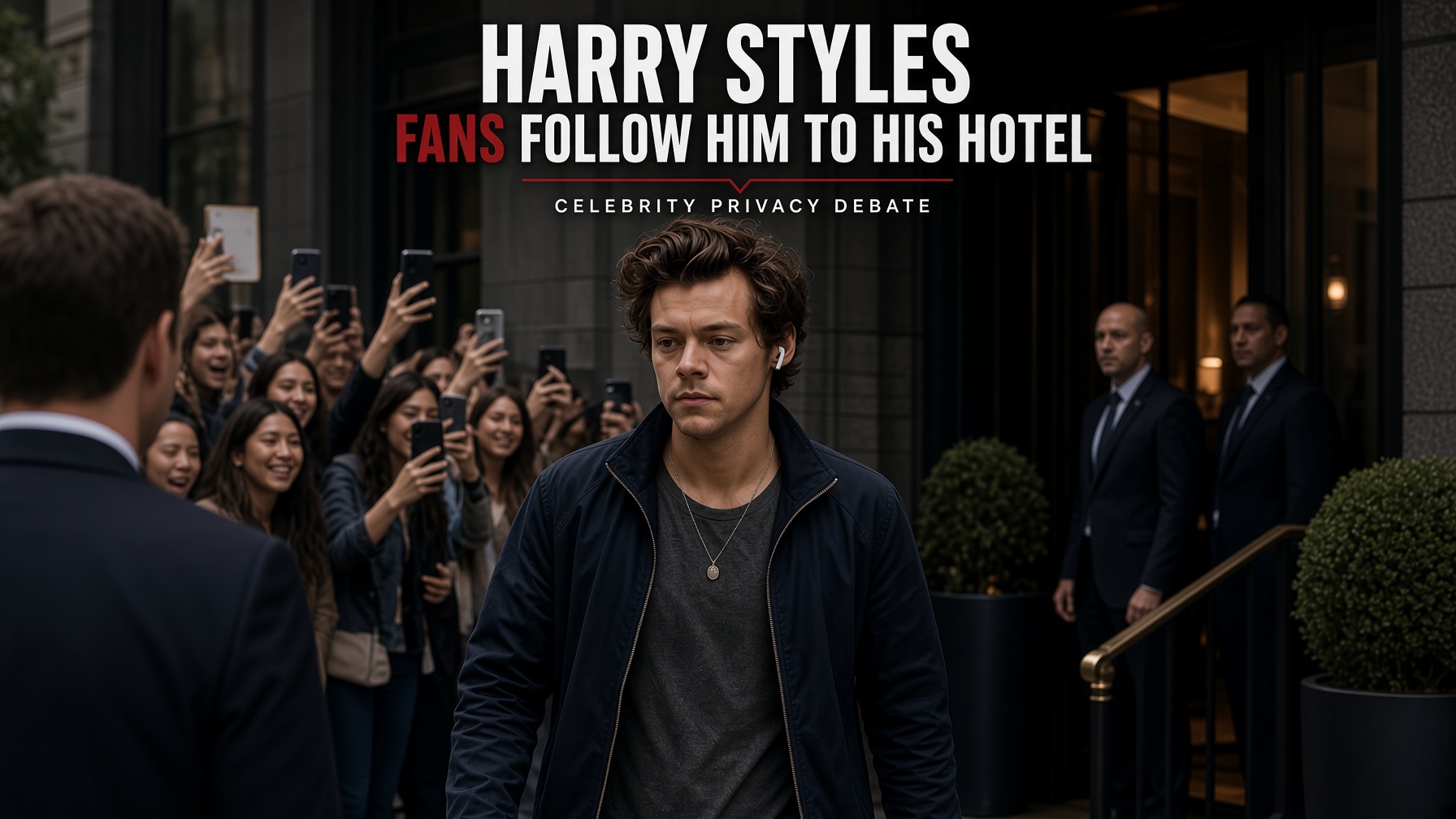
Video circulating online appears to capture Styles returning to his hotel after a run in Mexico City on August 6. What should have been a routine workout instead became another illustration of how difficult everyday life can be when you are one of the world’s most famous people. In the footage, fans can be seen trying to keep pace with him as he heads toward the hotel entrance.
Rather than watching from a respectful distance or simply allowing him to go inside, some appear determined to follow closely. The clip spread rapidly across social media, and the reaction proved surprisingly critical of the people trailing him. For an artist who commands one of the most passionate fan bases in modern pop, that response stands out. Many Harry Styles supporters did not rush to defend the behavior.
Instead, they questioned why anyone would consider it acceptable to follow a celebrity back to his hotel in the first place. When Does Being a Fan Cross the Line? Celebrity culture has long rested on an unusual dynamic between famous people and the public. Fans buy albums, concert tickets, and merchandise.
They follow artists on social media and devour interviews about their lives. That attention is often precisely what enables entertainers to build enormous careers. Yet buying a ticket or streaming a song does not buy access to someone’s private life. The distinction feels obvious until a celebrity suddenly appears on a public sidewalk.
For some fans, an unexpected sighting triggers an overwhelming urge to get closer. A photograph, an autograph, or a brief interaction can become a lifelong memory. Excitement itself is not the problem. The trouble starts when the celebrity clearly wants space and people keep pursuing.
Styles was not performing during the Mexico City encounter. He was not walking a red carpet or taking part in any scheduled fan event. He had reportedly been out for a run and was simply heading back to his hotel. That context matters.
An entertainer stepping onto a concert stage expects tens of thousands of eyes on him. Someone finishing a workout does not necessarily invite the same level of attention. Reddit’s Reaction Speaks Volumes The video sparked lively discussion on Reddit, particularly in communities focused on celebrity and pop culture news. Much of the conversation centered less on Styles himself and more on the actions of those around him.
Commenters asked what fans hoped to gain by chasing a celebrity who was obviously trying to get indoors. The response signals a noticeable shift in celebrity culture. Years ago, footage of fans pursuing a major pop star might have been celebrated mainly as proof of that star’s popularity. Screaming crowds and frantic followers were practically part of the mythology surrounding big musicians.
Today, similar images often draw criticism. People are increasingly ready to label the behavior invasive. Social media has made celebrities more visible than ever while simultaneously making their privacy harder to safeguard. A fan no longer needs to camp outside a studio hoping for a glimpse.
One photograph posted online can reveal where someone is eating, shopping, or staying. Within minutes, others can converge on the same spot. An innocent sighting can quickly turn into a crowd. A Lifetime Under Extreme Scrutiny Styles has lived with this intensity of attention since he was a teenager.
One Direction exploded into a global phenomenon after forming in 2010. Fans followed the band’s members with extraordinary devotion, and Styles quickly emerged as one of its most recognizable faces. His solo career only amplified that fame. Even people who never followed the group are likely familiar with him through his music, acting roles, fashion presence, and massive concert tours.
His current tour has once again placed him at the center of worldwide fan attention. Mexico City ranked among the major stops, with multiple shows scheduled at Estadio GNP Seguros. That naturally draws thousands of Styles fans into the same city at the same time. The vast majority will never create a problem.
They attend the concerts, enjoy the music, and return home. Yet when thousands of devoted supporters know their favorite artist is nearby, even a small fraction attempting to track him down can produce an uncomfortable situation. Hotels as Temporary Homes and Fragile Boundaries The hotel element of this incident makes it especially revealing. A celebrity staying at a hotel does not enjoy complete privacy the moment he steps outside.
Sidewalks remain public spaces. Still, recognizing someone on the street differs sharply from actively following that person to the place where they are staying. Hotels function as temporary homes for touring performers. After hours spent performing in front of thousands, a hotel room may be one of the few places an artist can step out of public view.
Once fans identify that location, the boundary between public and private life grows thinner. This is not uniquely a Harry Styles problem. Actors, musicians, and athletes have dealt with fans waiting outside hotels for decades. Social media has simply accelerated how quickly information about their whereabouts spreads.
One person spots a celebrity. Another records a video. Someone posts the location. Suddenly hundreds or even thousands of people potentially know exactly where that celebrity is.
Smartphones Turned Encounters into Content There was a time when unexpectedly seeing a celebrity might result in a story shared with friends. Now nearly every encounter can become content. People instinctively reach for their phones. The incentive is clear: a video featuring someone as famous as Harry Styles can generate enormous online attention.
That reality adds another layer of complication. The person filming is no longer simply living the moment. They may also be producing material for an audience. The prospect of views, likes, and followers can encourage people to keep recording when they might otherwise have stepped back.
Celebrity encounters have effectively become a form of social media currency. The more unusual the interaction, the more valuable the footage often appears. That does not mean everyone filming a celebrity acts with bad intentions. Most probably do not.
It does mean, however, that famous people move through a world filled with millions of potential cameras. Fame Does Not Erase Personal Boundaries Some will always argue that extreme attention is simply the price of becoming famous. There is partial truth in that view. Harry Styles could never reasonably expect to walk through a crowded area unnoticed.
Fame at his scale makes true anonymity nearly impossible. Recognition and access, however, are not the same thing. A celebrity can accept that people will recognize him without agreeing that strangers should follow him all the way to his hotel. The same principle applies to photographs.
Spotting Styles and taking a quick picture from a respectful distance is very different from pursuing him while he tries to leave. That distinction is ultimately why the Mexico City video has generated so much discussion. The debate is not really about Harry Styles. It is about the unwritten understanding between celebrities and the people who admire them.
Fans receive music, performances, and public appearances. Celebrities receive attention, loyalty, and financial support. Neither side is automatically entitled to everything beyond that exchange. A Simple Standard for Most Situations A straightforward guideline could resolve many of these encounters.
Pay attention to what the person is doing. If Harry Styles walks onto a stage, cheer as loudly as you want. If he attends a premiere, take pictures. If he stops and greets fans, enjoy the moment.
But if he is heading toward a hotel entrance and clearly attempting to leave, the encounter is probably over. Being a fan should not require abandoning basic social boundaries. In fact, respecting those boundaries may be one of the stronger ways to show genuine admiration. Styles will keep performing for huge crowds.
Fans will continue hoping for unexpected meetings with him. Cameras will keep appearing whenever he walks down a street. None of that is likely to disappear. Yet the reaction to the Mexico City video suggests something else may be shifting.
Fans themselves are increasingly willing to call out other fans when they cross the line. In an era when nearly every private moment can become public within seconds, that willingness may be one of the few remaining protections celebrities still have.