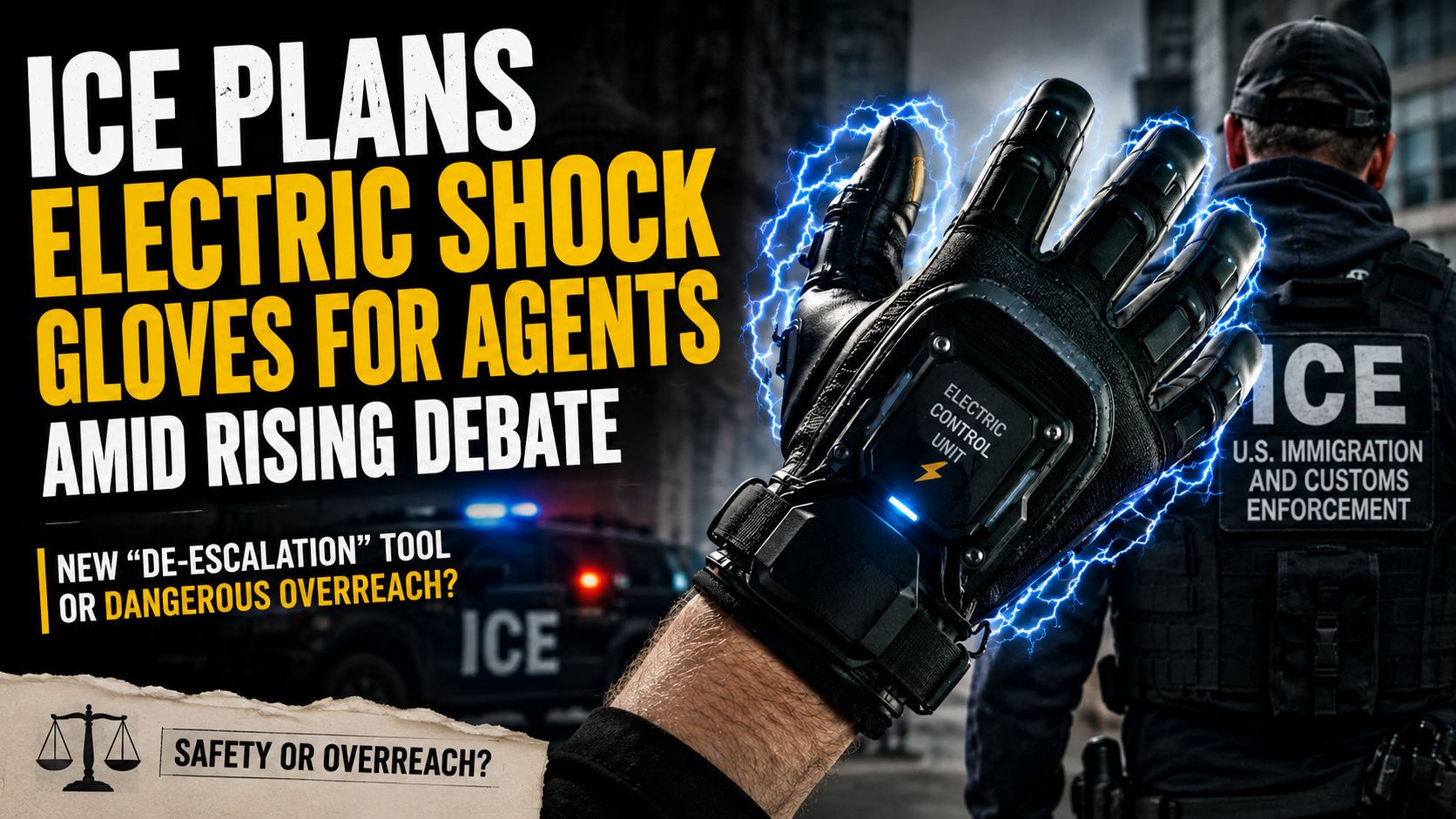
Immigration and Customs Enforcement is preparing to equip its officers and agents with specialized gloves capable of delivering electric shocks. The plan involves spending between 10 million and 20 million dollars to acquire thousands of these devices, with deliveries expected by March. The equipment comes from Compliant Technologies LLC based in Lexington Kentucky and is formally known as the G.L.O.V.E. or Generated Low Output Voltage Emitter. These gloves look and function like standard patrol gloves during normal wear.
Officers activate the electrical feature by pressing a switch built into the glove. Once switched on the device requires direct contact with a person’s skin to release a series of low voltage pulses. Company materials state the stimulation produces discomfort that typically leads to compliance in less than three seconds. The sensation has been compared by one researcher to a sharp bee sting.
It is designed to distract and interrupt resistance without causing burns marks or lasting scars. Technical details from the manufacturer show the gloves operate at voltages generally between 210 and 360 volts with a pulse rate near 30 times per second. Battery life supports roughly 90 minutes to two hours of use depending on the model after a two hour charge. The gloves come in multiple sizes and include features on newer versions such as event recording and a smart touch finger.
They are intended to fit within existing force continuum guidelines as a conductive distraction and de-escalation tool rather than a primary weapon. The devices have already seen use in some United States jails and by certain police departments. Supporters argue they offer a practical option for handling uncooperative individuals during arrests vehicle extractions or movements inside detention facilities.
One expert who has studied the technology noted that the gloves can prove especially useful for smaller or older officers by reducing the length and intensity of physical struggles. Faster resolution of confrontations may lower risks for both officers and subjects according to this view. Department of Homeland Security published a notice outlining the intended no bid contract for the purchase. Officials have not issued extensive public statements beyond confirming work on responses to media questions.
The manufacturer declined to comment on the specific ICE order. Civil rights groups have voiced strong opposition. Advocates point to ongoing scrutiny of ICE tactics and limited independent oversight of use of force incidents. They argue that a tool activated by a simple button press could invite overuse or application in situations where less force would suffice.
Concerns focus on the possibility of silent deployment that bystanders might not notice and the challenge of ensuring proper training and accountability. Critics also highlight warnings from the manufacturer itself. The company states the gloves should not serve as punishment or respond to mere verbal defiance. They advise against use on children pregnant women the elderly or people with disabilities.
The broader context includes intensified immigration enforcement operations. Agents regularly encounter resistance during field work and facility management. Proponents of the gloves frame them as a lower optics alternative that avoids the visual impact of traditional tools while still achieving control. Opponents counter that any expansion of pain inducing equipment demands rigorous policy safeguards body camera documentation and transparent review processes.
Research into the device continues through organizations focused on custody related risks. Early observations describe the effect as immediate and attention grabbing enough to interrupt aggressive behavior in many cases. Yet questions remain about long term physiological effects potential for misuse in high stress environments and consistency of training across a large federal workforce. Procurement documents describe the items as conductive distraction and de-escalation devices.
Delivery timelines aim for the coming months so that agents can begin incorporating them into standard kits. Agencies that have already adopted similar gloves report applications mainly in controlled settings such as transport or cell extractions rather than open street patrols. Whether ICE will restrict use in the same way is not yet clear from available notices. Public reaction has mixed strong criticism with calls for more information on rules of engagement.
Some lawmakers and advocacy organizations have begun seeking additional details on training protocols reporting requirements and medical screening before any wide distribution. The discussion underscores long standing tensions around the balance between officer safety and the rights of individuals subject to enforcement actions. As the acquisition process moves forward the gloves represent one more element in the evolving toolkit of federal immigration officers.
Their ultimate impact will depend on how carefully policies define appropriate scenarios how thoroughly agents receive instruction and how effectively oversight mechanisms track every activation. The coming months will reveal whether the technology delivers the intended compliance benefits while avoiding the harms that critics fear.