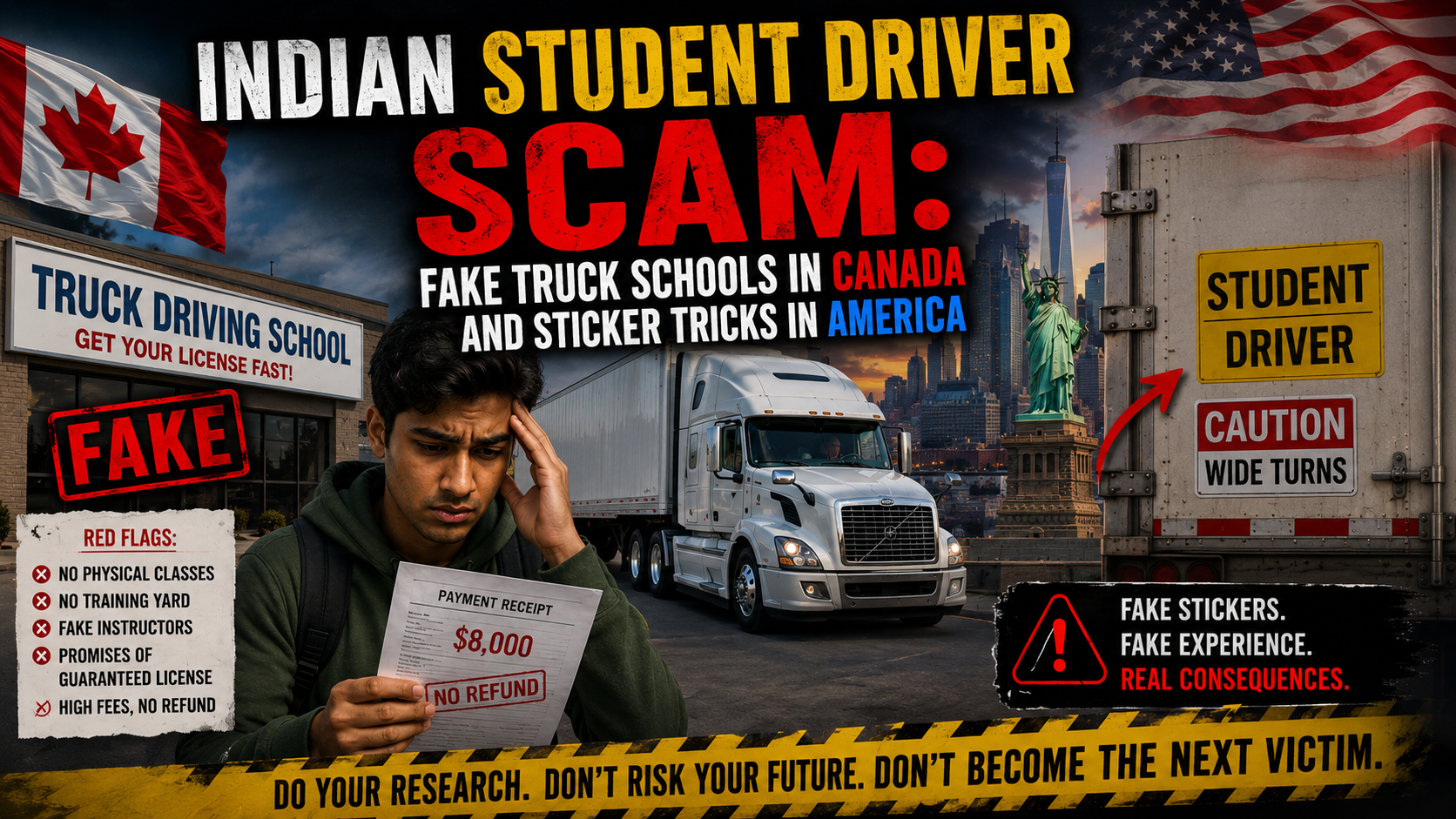
The Indian student driver scam has drawn attention in both Canada and the United States, where patterns involving new arrivals from India intersect with driving training, vehicle use, and tax rules. In Canada the issue centers on fraudulent truck driving schools in Ontario. Operators targeted South Asian newcomers and international students seeking Class A commercial licences. Between 2019 and 2021 two men ran unregistered programs that charged four thousand to five thousand dollars per student.
Official rules require mandatory entry level training of more than one hundred hours covering standardized skills for large trucks. The schools delivered only basic sessions often taught in Punjabi by unqualified instructors. To create the appearance of compliance they paid others with legitimate access to ministry databases to upload false completion records. Nearly one hundred students received licences without the required preparation.
Courts later convicted the operators of fraud. Conditional house arrest sentences followed along with community service and equipment forfeiture. The lack of proper training raised public safety concerns even though no specific injuries were tied directly to these drivers in the court record. Similar pressures appear around car financing in places like Brampton.
Some dealerships have steered temporary status students toward expensive vehicles with loans that prove difficult to manage once insurance and payments begin. Investigations have also examined recruitment of temporary residents for auto loan schemes with no intent to repay. In the United States a different observation involves student driver stickers. Drivers from India and other countries sometimes place these stickers or magnets on their vehicles.
Many are middle aged adults adjusting to American roads after driving on the opposite side in their home country or learning local rules signals and habits. The stickers serve as a signal for patience from other motorists. They appear frequently in suburbs with large immigrant populations. Some observers view the practice with skepticism especially when the drivers are clearly experienced adults rather than teenagers.
Claims have circulated that the stickers allow owners to write off mileage as a tax deduction at year end. United States tax rules permit deduction of actual business miles at the standard rate which recently stood near seventy cents per mile. Personal commuting and ordinary driving do not qualify. A sticker by itself creates no special tax status and does not convert personal miles into deductible ones.
Claiming personal use as business expense without proper logs and records constitutes improper filing. The Internal Revenue Service requires substantiation and audits can disallow such claims with penalties. No widespread documented scheme has been confirmed in which Indian students systematically use stickers solely for mileage write offs. Indian students do hold a distinct treaty benefit under the United States India tax agreement that can allow the standard deduction on nonresident returns but that provision has no connection to vehicle stickers or mileage.
Both countries show how the desire for mobility and income among new arrivals creates openings for shortcuts. In Canada the shortcuts involved forged training records. In the United States they involve informal signals on cars and occasional misunderstandings of tax rules. Proper training and accurate records protect drivers and the public.
Students and immigrants benefit most by verifying registered schools confirming licence requirements and keeping clear separation between personal and business vehicle use.