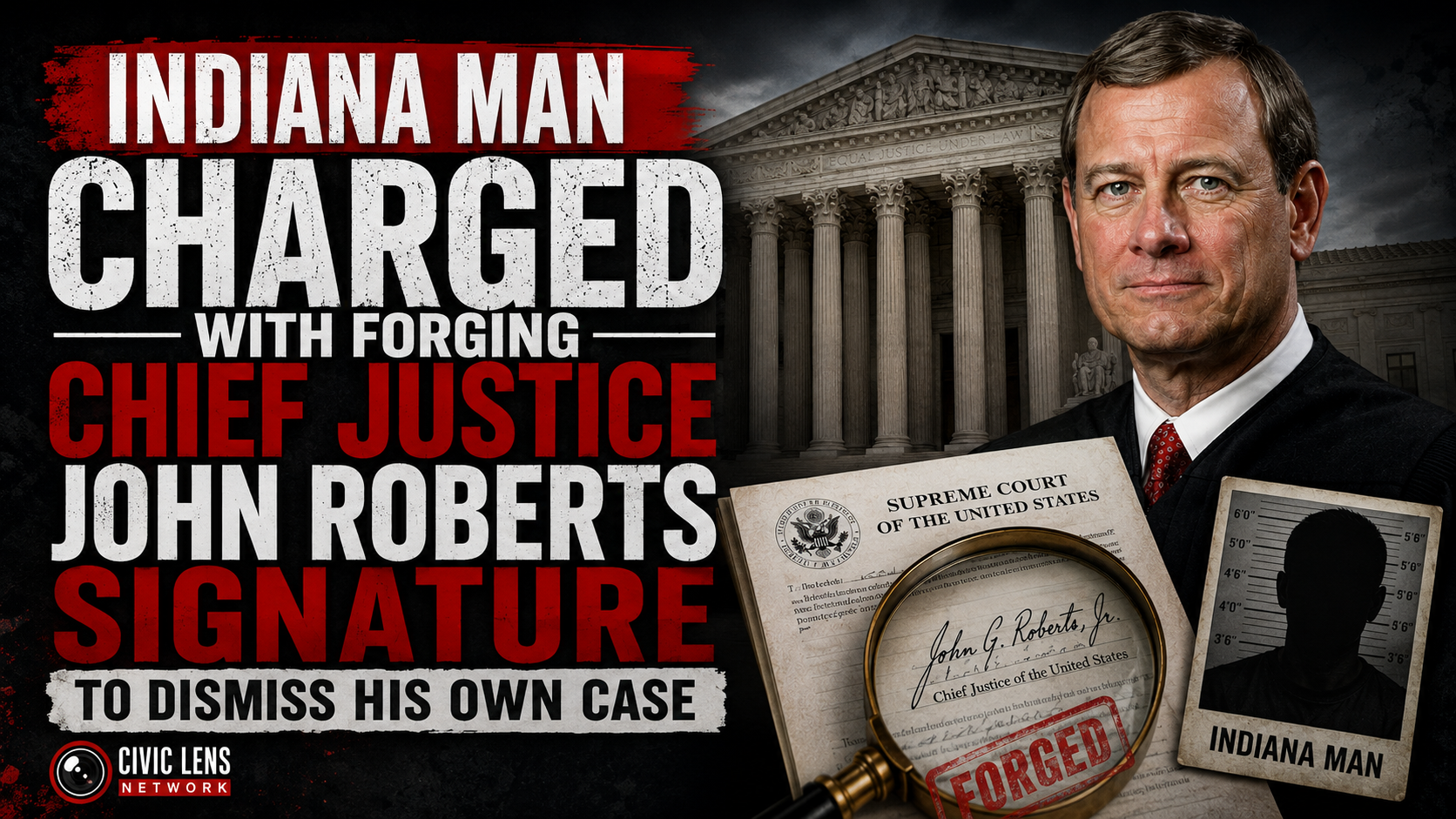
A federal grand jury in Indiana has indicted a man accused of forging the signature of Chief Justice John Roberts on a fake Supreme Court order in an effort to have his own criminal case thrown out. Joshua M. Culver, who also used the name Maverick A. Young, was arrested in Colorado and now faces multiple federal charges tied to impersonating government officials and fabricating court papers.
Prosecutors say Culver filed a document called an Order of Dismissal With Prejudice on September 24, 2025, in Grant County Superior Court. The paper claimed the Supreme Court had ordered the dismissal of theft charges pending against him. The filing included what authorities describe as a forged signature of Chief Justice Roberts and a counterfeit Supreme Court seal meant to make the order look official. The Grant County case was not Culver’s only legal problem.
He also faced matters in Lake County, Indiana, including accusations of threatening and harassing a judge. Authorities say he later presented himself as a Special Master enforcing orders of the United States Supreme Court and pressed a Lake County judge to dismiss cases and judgments against him. The alleged forgery was part of a wider pattern of impersonation, according to the indictment. In September 2025, Culver contacted the Tippecanoe County Sheriff’s Office and identified himself as a National Security Agency agent.
He sought information about the location of a family member, described as his biological daughter, and claimed he could take action against the department if it did not cooperate. The next day he allegedly called an individual’s workplace, again posing as a federal agent, and accused the person of obstructing a federal investigation involving a child kidnapping. He warned that the individual could be arrested for a federal felony.
Culver also submitted another document that purported to come from the director of the NSA’s Tailored Access Operations unit. That filing described him as a federal asset involved in multiple investigations and demanded dismissal of cases, quashing of warrants, and cooperation with a supposed federal audit. A federal grand jury in the Northern District of Indiana returned the indictment in July.
Culver was arrested in Colorado in late August and assigned a public defender from the Office of the Federal Public Defender for the District of Colorado. The charges include four counts of falsely impersonating an officer or employee of the United States and one count of forging the signature of a federal judge and using a counterfeit court seal. Court records show Culver had previously been sought by Grant County authorities for failure to appear.
The latest federal case now adds serious allegations of impersonating high level officials and fabricating documents from the nation’s highest court. Federal law treats impersonation of government officers and forgery of judicial signatures as serious offenses because they undermine public trust in official institutions. The Supreme Court itself has no role in ordinary state criminal cases such as the theft charges Culver faced in Grant County.
An order purporting to come from Chief Justice Roberts dismissing a local case would have no legal effect even if it had been genuine. Culver remains in federal custody pending further proceedings. His court appointed attorney has not issued a public statement. The Justice Department and the Supreme Court’s public information office have not commented on the case.
The allegations highlight how easily official looking papers can be created and submitted to courts. Local clerks and judges routinely receive unusual filings from defendants, but documents bearing the name and seal of the Chief Justice of the United States stand out. In this instance, the papers did not succeed in ending the state cases and instead led to federal charges. The case is now moving through the federal system in Colorado while the original Indiana matters remain on the state dockets.
Prosecutors will have to prove that Culver knowingly created and used the forged documents and that he intended to deceive court officials and law enforcement. If convicted, he could face substantial prison time on the federal counts alone, separate from any state sentences that may still be pending. This episode serves as a reminder that courts examine documents carefully and that attempts to manufacture authority from the highest levels of government are likely to be discovered and prosecuted.