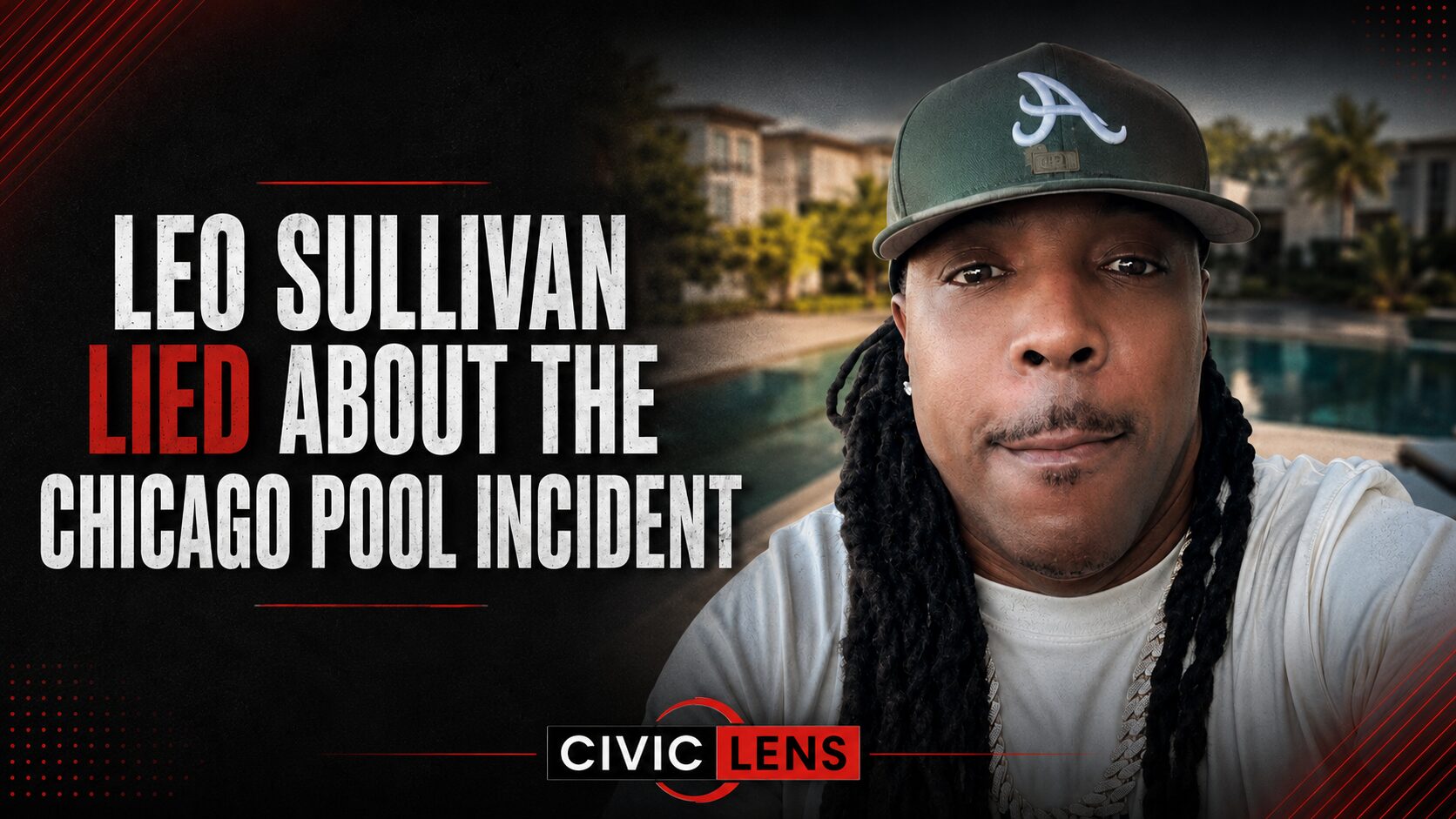
Leo Sullivan’s Viral Pool Video vs. the Facts: How the Chicago-Area Incident Was Misrepresented In early August 2026, Atlanta-based filmmaker and author Leo Sullivan posted a video from a swimming pool at the Arden of Warrenville apartment complex in Warrenville, Illinois, a Chicago suburb. The clip quickly went viral across Facebook, TikTok, and other platforms. In it, Sullivan, who was there with his two young sons, confronted two women, later identified as property staff, accusing them of targeting him solely because he was Black.
He claimed he was the only person asked for identification, that he had already shown proof he was staying at the property, and that the women called police on him and his children out of racial bias. His younger son is heard crying, expressing fear that his father would go to jail.
Sullivan’s accompanying posts framed the episode as classic “swimming while Black,” declaring the women “racist Karens,” asserting he paid good money like everyone else “except I am Black,” and suggesting the experience traumatized his children while the women smiled. The narrative spread rapidly, drawing widespread outrage and accusations of racism against the staff and property. Sullivan portrayed the confrontation as unprovoked discrimination against the only Black family present.
Days later, Arden Living, the property management company, issued a detailed response that contradicted key elements of Sullivan’s account. According to the company, Sullivan was a guest, not a resident or tenant. Prior to his stay, he had acknowledged the requirement to check in at the front desk and obtain a pool pass before using the amenities. Company records and a welcome communication confirmed guests needed to present identification at the desk to receive pool access.
Arden Living stated that Sullivan never checked in upon arrival as agreed, never obtained a pool pass, and falsely identified himself as a tenant when approached. Staff therefore had no way to verify he was an authorized guest. CCTV footage, the company said, showed that Sullivan and four other unrelated individuals at the pool were all asked to show an ID or pool pass, the standard security procedure applied equally to residents and guests.
When Sullivan refused to provide identification after being politely asked, staff called authorities to resolve the situation and ensure the safety of tenants and guests. The company emphasized that its employees followed established policies applied uniformly, without regard to race. It described the staff’s conduct as professional and respectful. Arden Living strongly disputed the discrimination claim, calling the social media portrayal extensive misinformation that endangered its employees through subsequent doxxing.
The firm noted its history of serving diverse communities and employing people of many backgrounds, stating it does not tolerate discrimination of any kind. These details reveal significant gaps between Sullivan’s viral narrative and the property’s documented policies and evidence. Sullivan’s video and posts centered race as the sole motive, highlighting that he was the only Black man present and implying selective enforcement.
The company’s account, supported by reference to CCTV and prior acknowledgment of rules, indicates the request for identification was part of routine enforcement applied to multiple people that day. Sullivan’s claim of having shown sufficient proof conflicts with the assertion that he never completed the required front desk check-in or obtained a pass, and that he misrepresented his status as a tenant. Police responded, and according to Sullivan’s own earlier description, officers indicated he was not required to show identification to the women.
The company maintained the call was made because staff could not otherwise confirm his authorization. A second police contact reportedly occurred later after further interaction. The incident underscores how selective framing can amplify a story. Sullivan’s recording captured emotional moments, his son’s distress and the staff’s demeanor, while omitting the context of guest rules he had previously accepted.
The company’s rebuttal, released after the video gained millions of views, shifted the discussion from pure racial animus to a dispute over policy compliance and verification. Sullivan has indicated consideration of legal action, while Arden Living has focused on correcting the public record and protecting its staff.
The episode, set in a Chicago-area complex in late July or early August 2026, illustrates the speed with which incomplete accounts can dominate online discourse and the importance of examining official responses and available evidence such as CCTV references and documented guest agreements. Full context shows a guest who did not follow stated pool-access procedures, leading to a verification request applied more broadly than initially claimed, rather than an isolated act of racial targeting.