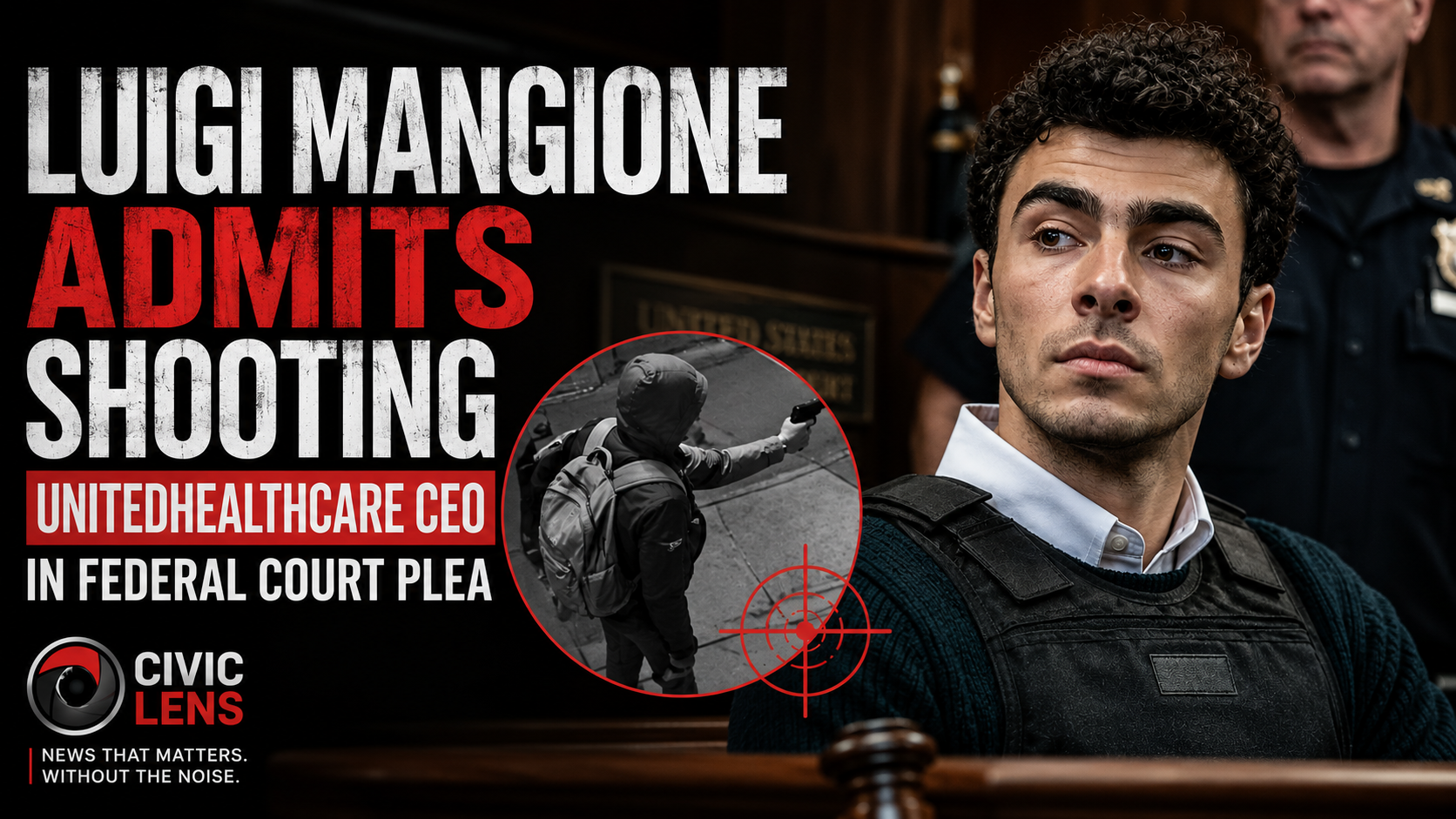
Luigi Mangione stood in a Manhattan federal courtroom on Friday and admitted what investigators had long alleged. The 28 year old told the judge he shot UnitedHealthcare CEO Brian Thompson and knew his actions were illegal. With those words he pleaded guilty to two federal stalking charges tied to the December 2024 killing that shocked the nation and ignited fierce debate about the American health insurance system. The hearing before U.S.
District Judge Margaret Garnett was hastily arranged. Mangione answered yes when asked if he intended to plead guilty. He then read a statement describing how he researched the UnitedHealthcare investor conference, posed as an investor to learn details about the event location and timing, traveled to New York, and used a 3D printed gun fitted with a silencer. “On the morning of Dec.
4, 2024, I shot Mr. Thompson in Manhattan and he died,” he said. “I understood that my actions would place him in fear of death or bodily injury. I knew what I was doing was illegal.”
Thompson, 50, was walking to the conference outside a Midtown hotel when a masked gunman approached from behind and opened fire. Surveillance video captured the attack in broad daylight. A five day manhunt followed. Authorities eventually arrested Mangione at a McDonald’s in Altoona, Pennsylvania, after a tip from an employee.
In his backpack police found the 3D printed weapon, a silencer, ammunition, and a notebook containing writings critical of the health care industry that investigators described as a manifesto. Federal prosecutors had originally charged Mangione with murder and firearms offenses that carried the possibility of the death penalty. In January Judge Garnett dismissed those counts on legal technicalities, leaving only the two stalking charges: interstate stalking resulting in death and stalking through the use of interstate facilities resulting in death.
Each carries a maximum sentence of life in prison. Mangione had previously pleaded not guilty to all federal counts. There was no plea agreement with prosecutors. U.S.
Attorney Jamie McDonald said his office will seek a life sentence. Judge Garnett scheduled sentencing for December 18 and reminded Mangione that he would have to serve at least 85 percent of any prison term. She also noted that any sentence from a state case could run consecutive to the federal punishment. Mangione remains in federal custody.
The guilty plea resolves the federal matter but leaves the separate New York state case in limbo. State prosecutors charged Mangione with second degree murder and related offenses. That trial had been set to begin next month. Defense attorneys have long argued that pursuing both federal and state prosecutions for the same conduct violates double jeopardy protections.
Immediately after the federal plea, Mangione’s lawyers filed a motion seeking dismissal of the state charges on those grounds. Whether the state trial proceeds remains uncertain. Outside the courthouse defense attorney Karen Friedman Agnifilo said her client had accepted full responsibility for Thompson’s death. She described the shooting as a single tragic event and emphasized that he should not face two prosecutions for the same conduct.
Thompson’s family members were present in the courtroom. His wife Paulette was seen wiping tears as Mangione spoke. The killing of Brian Thompson quickly became more than a straightforward murder case. Thompson led the insurance arm of UnitedHealth Group, one of the largest health insurers in the country.
In the days after the shooting, online discussions and public commentary revealed deep frustration with insurance practices, claim denials, and rising medical costs. Some portrayed Mangione as a symbol of that anger. Others condemned the violence in absolute terms and pointed out that no grievance justifies taking a life. Law enforcement and elected officials stressed that the rule of law must prevail regardless of the motive.
Mangione, an Ivy League graduate from a well to do Maryland family, had no prior criminal record of note. Court proceedings revealed he had suffered from severe back pain after an earlier injury and expressed bitterness toward the health insurance industry. In his courtroom statement he referenced those struggles as part of the background to his planning. Prosecutors maintain the evidence of premeditation is overwhelming: the research, the deception used to obtain conference details, the homemade weapon, and the interstate travel.
The dual track of federal and state charges has complicated the case from the start. Defense lawyers previously complained that Mangione was being treated like a human ping pong ball as the cases moved between jurisdictions. The federal plea now puts pressure on the state proceedings. New York’s double jeopardy rules are stricter in some respects than the federal constitutional standard, and legal observers note that a successful motion could end the state prosecution.
Prosecutors in the Manhattan District Attorney’s office have not yet publicly detailed their response. Sentencing in December will give the court an opportunity to weigh the full record. Prosecutors are expected to highlight the calculated nature of the attack, the impact on Thompson’s family, and the broader message that targeted violence against corporate executives cannot be tolerated. The defense is likely to emphasize Mangione’s acceptance of responsibility, his personal health history, and the absence of any prior violent record.
Whatever term the judge imposes, it will close one chapter of a case that has already stretched nearly two years and drawn intense national attention. For the Thompson family the plea brings a measure of acknowledgment that their husband and father was deliberately targeted and killed. For the public the case continues to raise uncomfortable questions about access to health care, corporate accountability, and the limits of political or social protest. Mangione’s admission removes any remaining doubt about who pulled the trigger.
What remains is the question of how the justice system will balance two parallel cases arising from the same fatal morning on a Manhattan sidewalk. The coming months will determine whether the state trial moves forward or is set aside. Until then, the federal guilty plea stands as the clearest statement yet from the man accused of ending Brian Thompson’s life: he planned the attack, he carried it out, and he knew it was wrong.