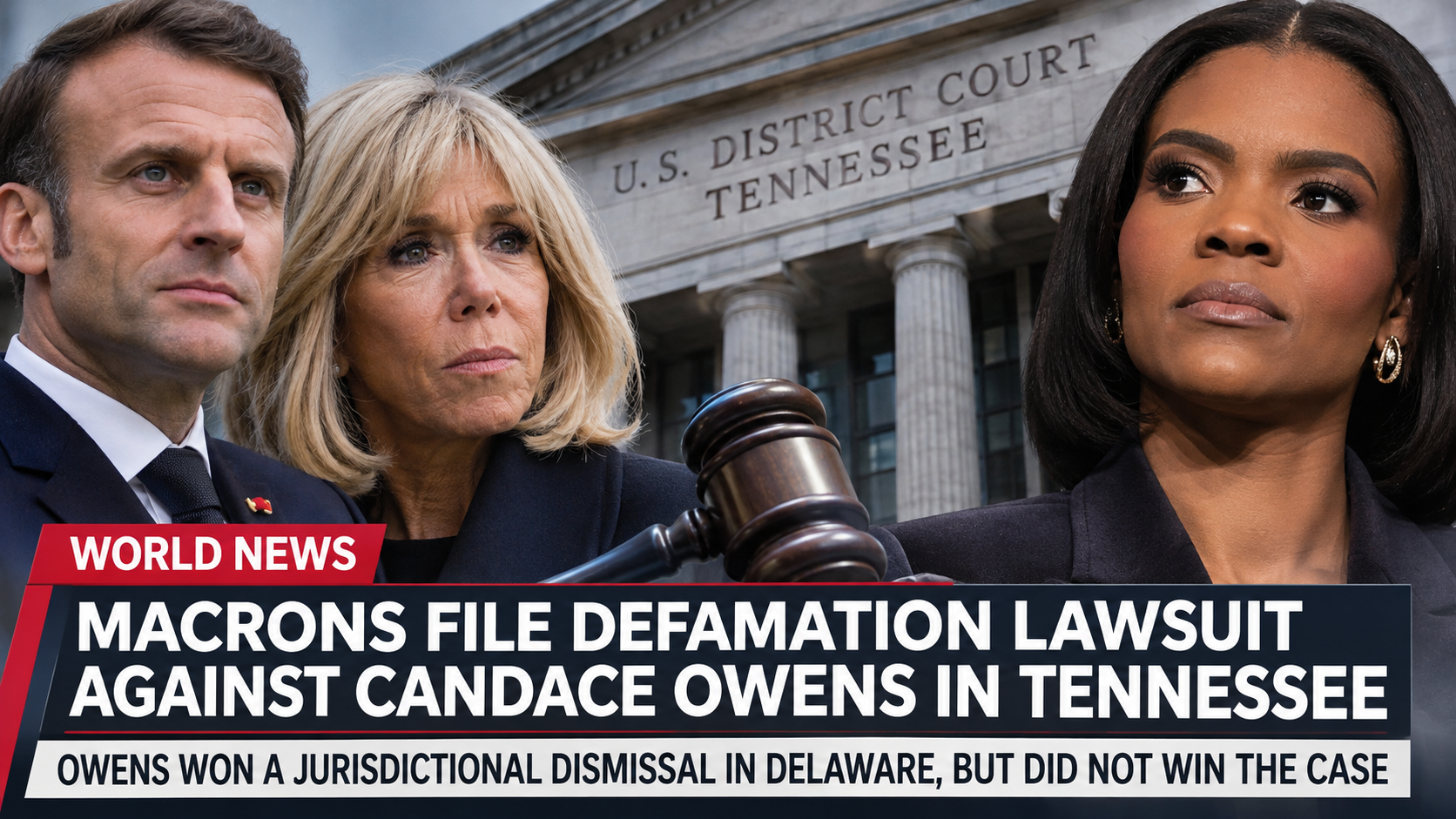
French President Emmanuel Macron and his wife, Brigitte Macron, have launched a new legal offensive against conservative commentator Candace Owens, filing a sweeping federal defamation lawsuit in Tennessee after an earlier court ruling in Delaware failed to bring their dispute to an end.
The new complaint, filed November 4, 2026, in the U.S. District Court for the Middle District of Tennessee, contains 88 counts involving allegations of defamation, false light, and defamation by implication.
At the center of the dispute are Owens’ repeated allegations concerning Brigitte Macron’s identity, the French president’s marriage, and accusations of an alleged cover-up involving powerful political figures.
The Macrons maintain that Owens knowingly promoted false allegations while using the controversy to expand her audience and generate revenue through merchandise, subscriptions, and donations.
Owens’ Delaware Victory Was Not a Final Legal Victory
The latest filing follows an October 27 decision by Delaware Superior Court Judge Sheldon Rennie, who dismissed Owens personally from the Macrons’ original lawsuit.
Owens celebrated the decision, describing the litigation as an extraordinary legal overreach by a foreign political leader.
However, the ruling did not establish that Owens’ allegations were true, nor did it determine whether she had committed defamation.
Instead, the judge concluded that Delaware lacked personal jurisdiction over Owens because she resides in Tennessee.
The court allowed litigation against two businesses associated with Owens to continue, while leaving additional legal questions unresolved.
That distinction is significant. Owens successfully challenged where she could be sued, but she did not obtain a ruling clearing her of the underlying defamation allegations.
The Macrons have now brought their case directly to her home state.
A New Legal Fight in Tennessee
The 409-page Tennessee complaint targets Owens personally and seeks monetary damages, a jury trial, and a narrowly limited court order preventing the republication of statements ultimately determined to be defamatory.
According to the complaint, Owens repeatedly alleged that Brigitte Macron was born male and assumed another identity. The filing also challenges claims involving the couple’s family relationship and allegations connecting Emmanuel Macron to a CIA mind-control program.
The Macrons deny the allegations and argue that Owens continued promoting them despite receiving information disputing her claims.
Their attorneys have accused Owens of turning the French first family’s personal lives into a profitable media controversy.
The legal team also made clear why the lawsuit was moved to Tennessee.
According to their public statement, Owens had repeatedly maintained that Tennessee was the appropriate jurisdiction. The attorneys said the new filing gives her the venue she had requested.
Free Speech and Defamation Collide
The case presents a significant legal confrontation between an American political commentator and a sitting foreign president.
Owens has portrayed the litigation as an attempt by powerful political figures to silence her reporting and commentary.
Her supporters argue that public officials, particularly internationally prominent political leaders, should face aggressive questioning and scrutiny without resorting to lawsuits against journalists and commentators.
The Macrons, however, contend that Owens crossed the boundary between protected commentary and knowingly or recklessly publishing false factual allegations.
Under American defamation law, public figures generally face a demanding legal standard. They must establish that challenged statements were defamatory and made with actual malice, meaning knowledge of falsity or reckless disregard for the truth.
That standard could become central to the Tennessee proceedings.
The Battle Is Far From Over
The Delaware decision gave Owens an important procedural victory, but it did not settle the controversy.
The Macrons still have litigation pending against businesses associated with Owens in Delaware, while their new Tennessee lawsuit seeks to hold the commentator personally accountable.
No court has yet ruled that Owens is liable for the allegations raised in the new Tennessee complaint.
For Owens, the latest filing means that successfully removing herself from the Delaware lawsuit has not ended her personal legal exposure.
For the Macrons, it represents another attempt to challenge allegations they insist have damaged their reputations worldwide.
The next stage of this increasingly contentious dispute will unfold in an American federal courtroom, where the boundaries of free speech, public scrutiny, and defamation will face a potentially consequential test.