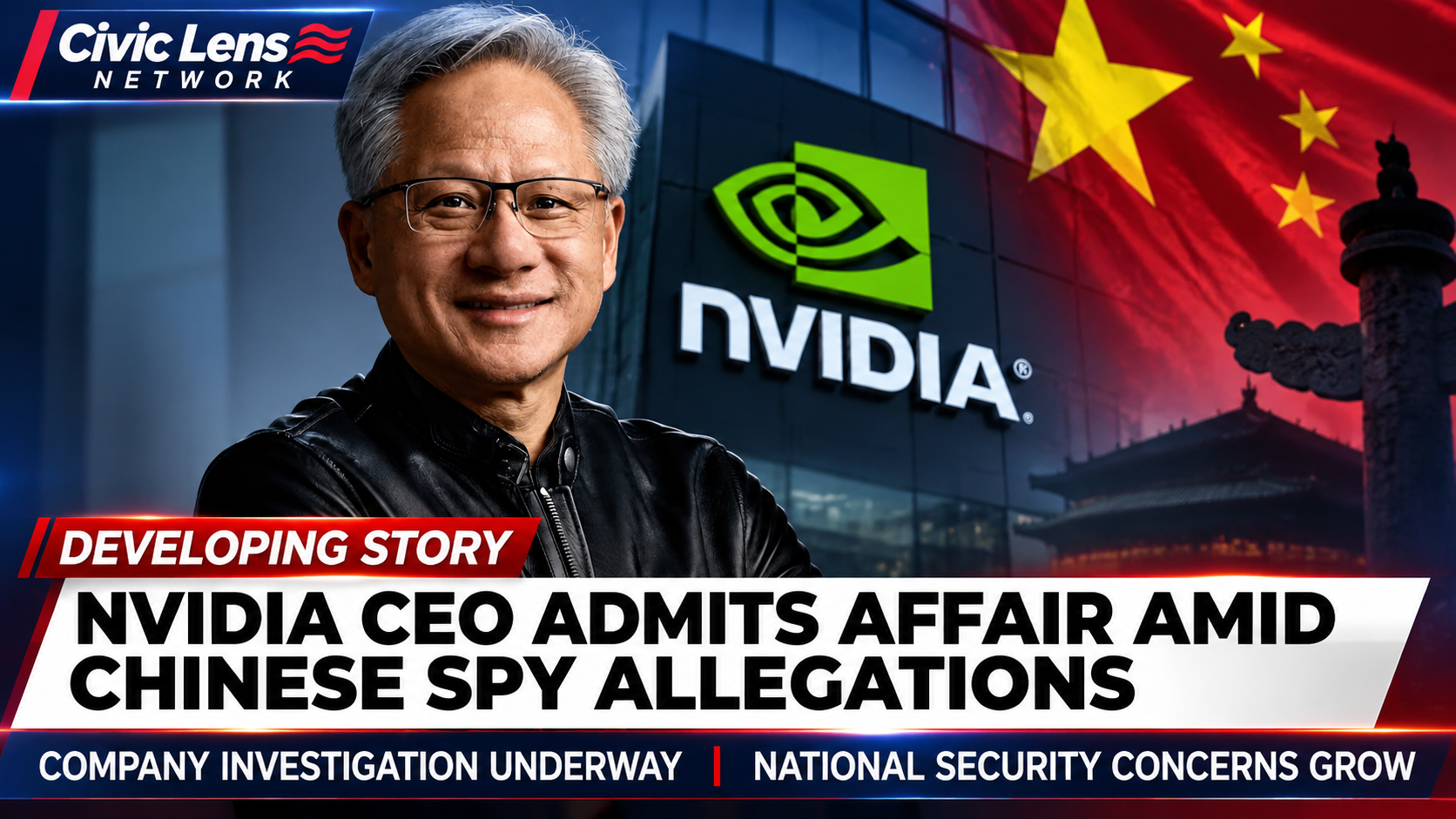
One of America’s most powerful technology executives is facing an extraordinary scandal involving allegations of Chinese espionage, a secret romantic relationship, and growing concerns about whether sensitive American artificial intelligence technology could have been exposed to foreign intelligence operations.
Jensen Huang, the billionaire founder and chief executive officer of Nvidia, has publicly admitted to being unfaithful to his wife after reports emerged alleging that he had a romantic relationship with a Chinese businesswoman suspected by American intelligence officials of working on behalf of Beijing.
The admission has triggered an independent investigation by Nvidia’s board of directors and intensified scrutiny in Washington, where lawmakers are demanding answers about potential national security risks.
At the center of the controversy is Alice Huang, a former executive associated with Megaspeed International, a Singapore-based technology company that has conducted business with Nvidia.
American intelligence officials reportedly believe Alice Huang was recruited by China’s Ministry of State Security to gather information about Jensen Huang and potentially influence his position on American restrictions involving advanced artificial intelligence chips.
The allegations have not been established in court, and Nvidia maintains that it has no reason to believe sensitive company information or American national security secrets were compromised.
Nevertheless, the revelations are raising difficult questions about the vulnerability of America’s most influential technology companies to foreign intelligence operations.
Nvidia CEO Publicly Admits Infidelity
In a message sent to Nvidia employees on November 8, Huang acknowledged that he had betrayed his wife and family.
“I was unfaithful to my wife. My actions hurt her and our children. There is no excuse for what I did. I am deeply sorry,” Huang wrote.
He accepted responsibility for his conduct and apologized to his colleagues, shareholders, and the company’s leadership.
The admission followed reports connecting Huang to Alice Huang, although his public apology did not identify the individual involved in the affair.
Huang also acknowledged the national security concerns surrounding the allegations and pledged to cooperate with Nvidia’s independent investigation.
The controversy represents an extraordinary challenge for an executive whose leadership has helped transform Nvidia into one of the most valuable corporations in the world.
Allegations of a Chinese Intelligence Operation
The most troubling aspect of the scandal extends far beyond Huang’s personal conduct.
According to published accounts of American intelligence findings, Alice Huang was allegedly recruited by Chinese intelligence officials to obtain information about the Nvidia chief executive.
Investigators reportedly examined whether she was positioned to influence Huang’s views on American export restrictions designed to prevent China from obtaining the most advanced artificial intelligence technology.
Such an operation, if substantiated, would raise concerns about China’s ability to gain access to influential American corporate leaders through personal relationships.
Nvidia occupies a uniquely sensitive position in the global technology industry.
Its advanced processors are essential to developing powerful artificial intelligence systems, including technologies with potential military, intelligence, and national security applications.
The United States has imposed restrictions on exports of certain advanced semiconductor products to China because of concerns that American technology could strengthen Beijing’s military and intelligence capabilities.
Those restrictions have become a major source of tension between Washington and Beijing.
Questions Surround Nvidia’s Business Connections
Alice Huang’s previous position at Megaspeed International has attracted particular attention.
The Singapore-based company has faced scrutiny over allegations involving the possible movement of restricted Nvidia technology into China.
Nvidia has disputed claims that Megaspeed improperly diverted its processors and has previously defended its business dealings with the company.
Jensen Huang also characterized his interactions with Megaspeed representatives as ordinary commercial relationships before the more recent allegations about a romantic connection became public.
The emerging information has prompted questions about whether Nvidia’s internal security procedures were sufficient to protect sensitive business information and whether senior executives received appropriate warnings about possible foreign intelligence threats.
Importantly, allegations concerning Megaspeed and Alice Huang do not establish that Jensen Huang knowingly participated in espionage or illegally transferred technology.
No publicly confirmed finding has established that he knowingly assisted Chinese intelligence.
Congress Demands Answers
The controversy has also reached Capitol Hill.
Republican congressional committee leaders have requested information about Huang’s reported relationship with Alice Huang and the measures Nvidia uses to protect sensitive technology and corporate information.
Their concerns center on whether foreign intelligence operatives may have gained access to information capable of undermining American technological leadership.
Senator Chris Coons, a Democrat from Delaware, has also called for scrutiny of the allegations.
The emerging bipartisan interest reflects the importance of Nvidia’s position in America’s competition with China.
Lawmakers are seeking to determine whether Huang’s relationship created vulnerabilities and whether any national security safeguards failed.
The investigation could eventually examine what Huang knew, when he learned of the intelligence concerns, and whether his personal relationships affected any corporate or government decisions.
Nvidia Launches Independent Investigation
Nvidia’s board of directors has announced an independent investigation into the reported foreign intelligence concerns.
Independent directors, supported by outside legal counsel, will oversee the inquiry.
The company has expressed confidence in Huang’s leadership while emphasizing that it currently has no reason to believe national security or confidential corporate information was compromised.
Huang has pledged to cooperate fully.
The investigation will be closely watched because Nvidia’s influence extends well beyond the technology industry.
Its processors power artificial intelligence development across major corporations, research institutions, and government-related operations.
Any substantiated compromise involving sensitive information could have consequences for American technology policy and the broader competition with China.
China Rejects the Espionage Allegations
Chinese officials have rejected allegations that Alice Huang was gathering intelligence for Beijing.
China’s Foreign Ministry has described the claims as unfounded and an attempt to damage the country’s reputation.
Beijing’s denial highlights the competing accounts surrounding the controversy.
American intelligence assessments reported by the media have raised concerns about a potential espionage operation, while Chinese officials reject the accusations.
The independent investigation and any subsequent government inquiries will be critical in determining which allegations can be supported by evidence.
The Larger Question: Was American Technology Put at Risk?
The scandal comes at a particularly sensitive moment for American national security.
Artificial intelligence has become one of the defining strategic competitions between the United States and China.
The ability to develop advanced processors, train sophisticated AI systems, and control access to computing infrastructure carries enormous economic and military significance.
Jensen Huang has repeatedly advocated maintaining commercial access to China’s technology market, arguing that American companies benefit from continued participation.
Those positions have generated debate among officials concerned about Beijing’s technological ambitions.
The reported intelligence operation raises a legitimate question about whether foreign operatives attempted to influence those positions.
However, there is currently no established evidence that Alice Huang successfully influenced Nvidia’s policies or that Jensen Huang changed his views because of the alleged relationship.
That distinction will be essential as investigators examine the facts.
A Scandal With Consequences Far Beyond One CEO
Jensen Huang’s admission of infidelity is a personal scandal, but the allegations surrounding a possible Chinese intelligence operation carry much broader implications.
If investigators determine that a foreign intelligence service deliberately targeted one of America’s most influential technology executives, the findings could expose significant weaknesses in corporate security practices.
If sensitive technology or information was compromised, the consequences could extend into American national security policy.
And if the allegations are not substantiated, the investigation will need to make that clear as well.
For now, Nvidia faces an unusually serious test of corporate accountability and public trust.
The central issue is no longer simply whether a billionaire executive concealed an affair.
It is whether a foreign intelligence operation attempted to exploit that relationship to gain influence over a company central to America’s technological future.
Until investigators establish what happened, the most consequential questions remain unanswered.