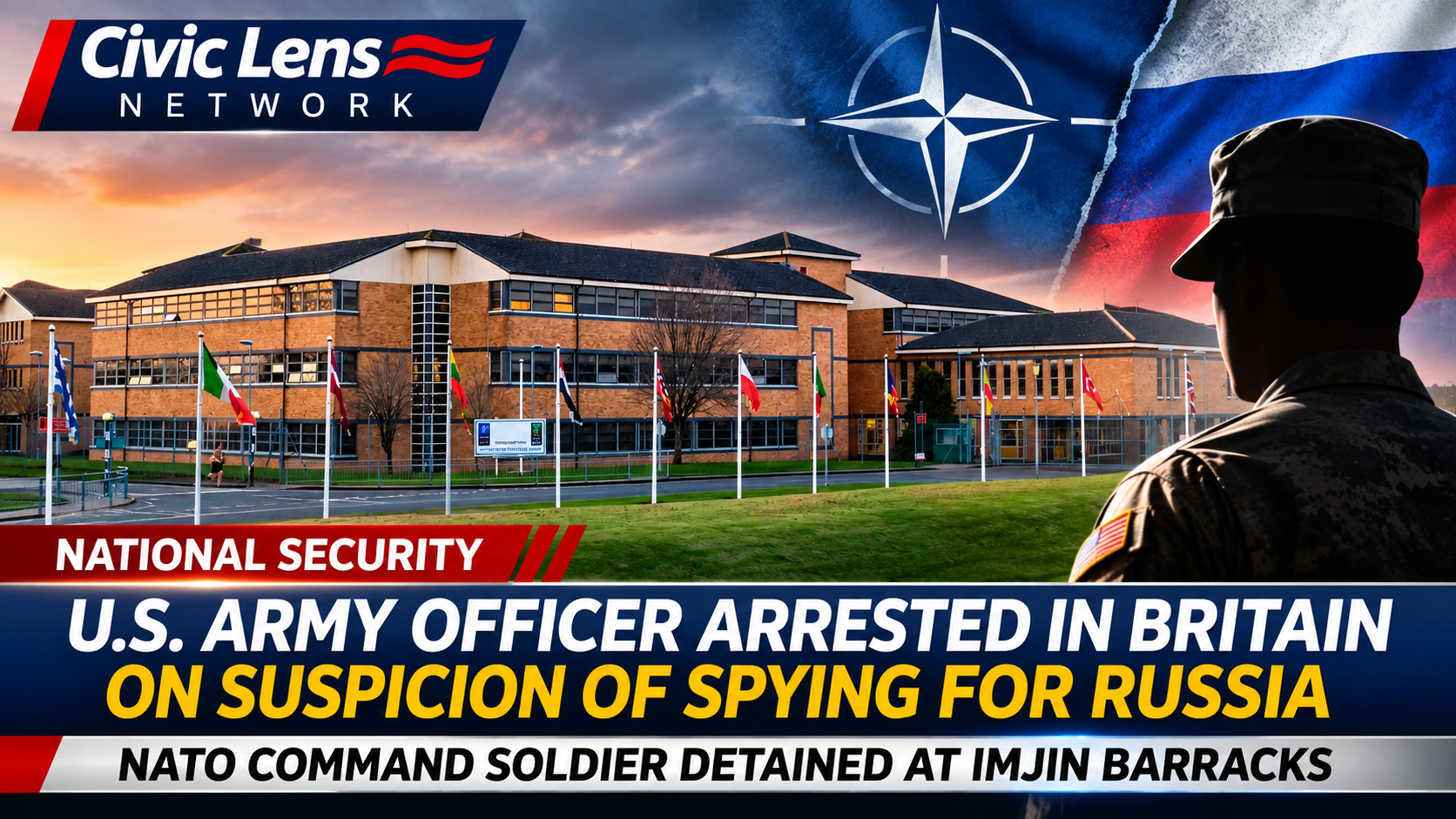
A senior United States Army officer assigned to a major NATO military command has been arrested in Britain on suspicion of espionage involving Russia, triggering a joint American and British national security investigation.
The 41-year-old serviceman was arrested Tuesday, November 10, near Gloucester, England, following an investigation involving British counterterrorism police, the FBI, military counterintelligence officials and Britain’s domestic intelligence agency, MI5.
Authorities have not publicly identified the soldier, but officials confirmed that he was assigned to NATO’s Allied Rapid Reaction Corps at Imjin Barracks in Gloucestershire.
The military installation serves as the headquarters for a multinational NATO command responsible for preparing and coordinating major military operations.
The arrest raises serious questions about whether sensitive American or allied military information was placed at risk.
Suspected Espionage Inside NATO
British authorities confirmed that the soldier was detained on suspicion of violating Sections 1 and 3 of the United Kingdom’s National Security Act of 2023.
Those provisions address obtaining or disclosing protected information and assisting foreign intelligence services.
Investigators specifically identified Russia as the foreign country connected to the allegations.
British police also searched two locations in Gloucestershire as part of the investigation.
The soldier was being held at a London police station while authorities continued gathering evidence.
According to The Washington Post, officials familiar with the investigation said no sensitive information had been transferred to Russia. That detail suggests investigators may have intervened before any suspected intelligence exchange could take place.
Authorities have not publicly disclosed what information the soldier allegedly attempted to obtain, whether Russian intelligence officers directly contacted him, or how long the suspected activity had been under investigation.
FBI Director Kash Patel Responds
FBI Director Kash Patel issued a forceful warning following the arrest, emphasizing that American authorities would not tolerate suspected betrayal of the nation’s security.
Patel described the espionage allegations as a matter of the utmost concern to the United States and its allies.
He also revealed that the FBI had made 167 counterintelligence and espionage-related arrests over the preceding 21 months, representing a 53 percent increase over the comparable previous period.
The figures highlight the scale of ongoing American counterintelligence operations as foreign governments continue attempting to acquire sensitive military and government information.
Brigadier General Sean Stinchon, commanding general of U.S. Army Counterintelligence Command, described the suspect as a senior soldier who had been entrusted with sensitive information.
Stinchon warned that insider threats remain a persistent danger, even within military organizations responsible for protecting American national security.
Why the NATO Assignment Matters
The suspect’s assignment makes this case particularly sensitive.
NATO’s Allied Rapid Reaction Corps is a multinational headquarters designed to coordinate military forces during major operations and emergencies.
Personnel serving within such commands may work alongside officers from multiple allied nations and participate in sensitive military planning.
An intelligence compromise within that environment could potentially affect more than one country.
However, investigators have not established publicly that NATO operational plans, troop movements or classified defense strategies were actually compromised.
Determining what the soldier could access, what he allegedly attempted to obtain and whether any information was exposed will be central questions for investigators.
Russia’s Expanding Intelligence Threat
The arrest comes amid mounting concerns about Russian espionage and sabotage operations across Europe.
British intelligence officials have repeatedly warned that Moscow is using intelligence networks, covert operations and other methods to undermine Western security.
Russia’s invasion of Ukraine in 2022 intensified those concerns as NATO countries increased military assistance to Kyiv and strengthened their defenses.
The United Kingdom has experienced several high-profile incidents involving Russian intelligence, including the poisoning of former Russian intelligence officer Alexander Litvinenko in 2006 and the attempted poisoning of former double agent Sergei Skripal in 2018.
More recently, British authorities have investigated suspected Russian-linked sabotage and intelligence operations targeting military and industrial facilities.
The American soldier’s arrest adds another serious allegation to that broader security environment.
Investigation Continues
British counterterrorism officials emphasized that the investigation remains active and that the arrest resulted from close cooperation between American and British agencies.
Deputy Assistant Commissioner Vicki Evans praised the coordination between the two countries and said authorities would continue pursuing suspected criminal activity threatening national security.
Police also clarified that the case is not connected to other ongoing counterterrorism investigations, including separate security concerns involving American military facilities in Britain.
As of November 11, authorities had not publicly announced a conviction or established that the soldier successfully provided intelligence to Russia.
The suspect remains entitled to the presumption of innocence.
Nevertheless, the investigation presents an urgent challenge for American military counterintelligence officials.
If the allegations are substantiated, the case could expose a serious attempted breach of trust within one of NATO’s important military commands.
For American and allied defense officials, the immediate priority is determining whether any military secrets were compromised and ensuring that foreign intelligence services cannot exploit trusted personnel operating inside NATO’s security structure.