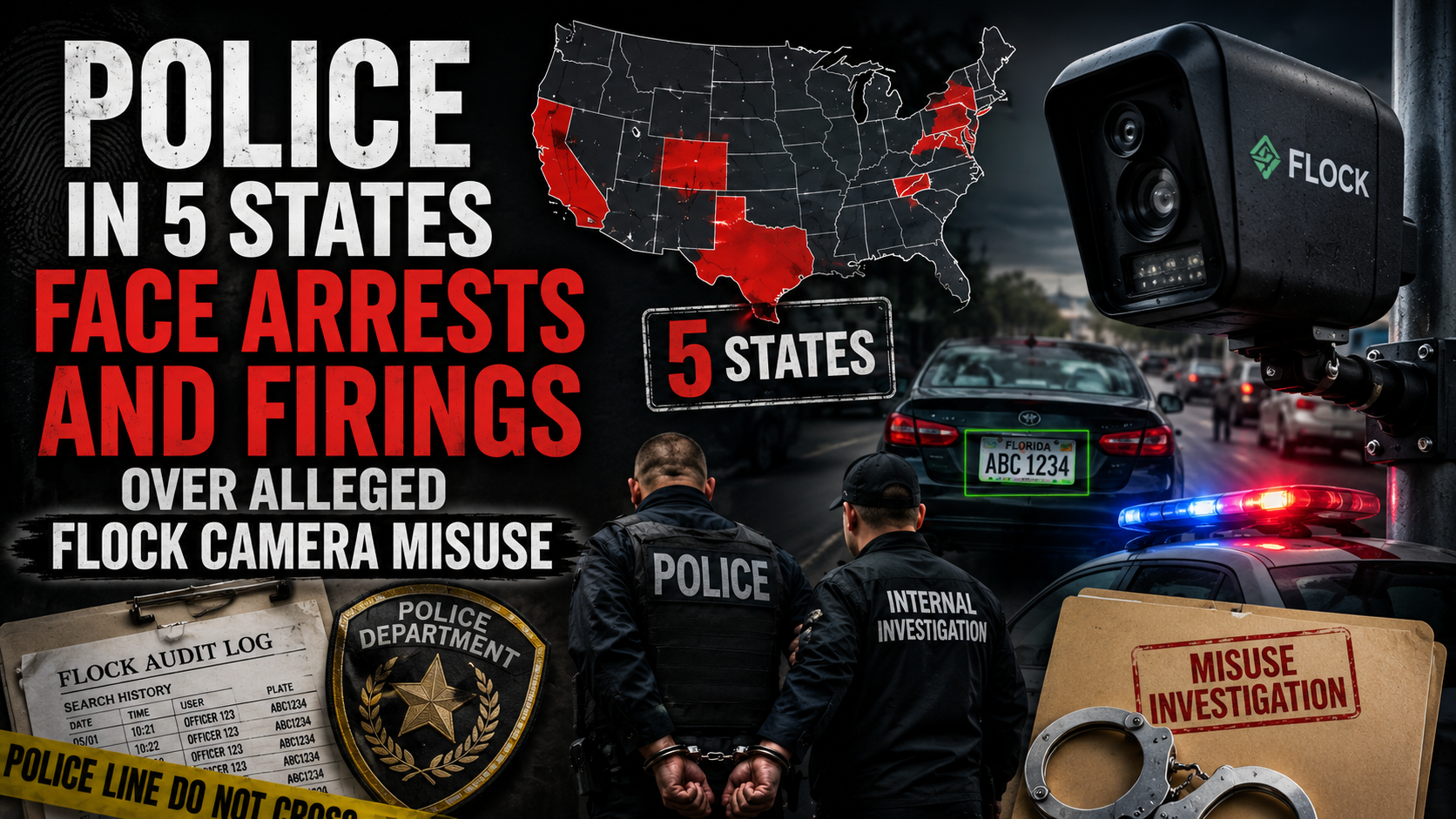
At least 19 police and sheriff’s office employees in five states have been arrested, fired, suspended, placed on leave, or investigated in recent weeks over potentially improper use of Flock Safety license plate reader systems, according to a USA TODAY investigation published this week. In many of those cases, reporters flagged unusual search patterns before the employees’ own agencies did.
The findings have intensified a national debate over who can look up vehicle movements, how often those searches are reviewed, and what happens when an officer treats a public safety database as a personal tracking tool. In Sarasota, Florida, Officer Cory Waiters became one of the most closely watched examples. Investigators say he used the Flock system to search a former girlfriend’s license plate at least 335 times over roughly two months in 2025.
A USA TODAY reporter emailed the department on Aug. 6 after reviewing publicly available audit records. Waiters was placed on paid administrative leave the next day. On Aug. 19, the Sarasota Police Department fired him and arrested him. He faces two felony counts, official misconduct and offenses involving computers or computer systems, plus a misdemeanor count of violating public records law.
Police say he logged the queries as involving a “suspicious vehicle,” even though the plate was not tied to an active criminal case assigned to him. The woman told investigators she had been in a relationship with Waiters earlier that year. Those remain allegations. Waiters has not entered a plea.
He appeared in court after his arrest, and a judge set bond. Police Chief Rex Troche said the department takes misconduct allegations seriously and will act when an employee falls short of expected standards. The cases tied to the USA TODAY review are not identical. Some employees were arrested and charged.
Others were fired. Some were suspended or placed on leave while investigations continue. A few agencies restricted or paused Flock use after questions were raised. In Dallas, Georgia, state investigators arrested Heidi Taylor, a former 911 director, on two misdemeanor counts of misusing a license plate reader.
Reporting found more than 2,500 searches for vehicles tied to her estranged husband and his girlfriend. In Lufkin, Texas, Officer Zachary Klein was arrested after searches of seven plates, including more than 3,400 lookups of one plate. Texas Rangers charged him with felony abuse of official capacity and tampering with a government record. He later faced a 100-count indictment.
Lufkin suspended its Flock system and placed a second officer on leave. Other agencies in Georgia, Missouri, and Michigan opened reviews, suspended access, or ended Flock use after similar questions. Flock cameras sit along roads and in parking lots. They photograph passing vehicles and record license plates along with details such as color, make, and model.
The images go into a searchable database. An authorized user can type a plate number and see where that vehicle was captured, and when. Agencies often share data across jurisdictions, which is why a local search can pull hits from a much larger network. Officers are supposed to have a law enforcement purpose for each query.
Departments typically require a reason in the system. Flock keeps audit logs of who searched, what plate was queried, and what justification was entered. The company later added Audit Assistance, a tool meant to flag unusual patterns such as repeated lookups of the same plate or late-night searching. The feature was optional for months.
After a wave of misconduct cases, Flock said it would require the tool for law enforcement customers by the end of 2026, along with case codes for searches and automatic lockouts when activity looks abnormal. Those safeguards did not stop the searches now under scrutiny. In several departments, supervisors learned of the activity only after journalists asked about it. Civil liberties advocates say that gap is the point.
A camera network that can reconstruct where a car has been is a powerful surveillance system. If one employee can run hundreds or thousands of personal queries before anyone notices, oversight is weaker than the public was told. Flock has called officer abuse unacceptable. Paris Lewbell, a company spokeswoman, said people who misuse the system “should absolutely be held accountable.”
Co-founder Paige Todd has said technology does not create misconduct, people do, and that audit tools exist to expose it. Chief communications officer Joshua Thomas has said it is not Flock’s job to police the police. The company also began redacting details from audit logs, arguing that public release of search data can endanger officers and investigations. Critics say the change makes independent review harder just as alleged abuse is becoming more visible.
Police agencies say the cameras help recover stolen cars and find missing people. The recent cases do not prove every search is unlawful. They do show that access, once granted, can be used for reasons far from a criminal investigation. The difference between an arrest, a firing, a suspension, and an open inquiry matters.
So does the fact that many of these reviews began outside the departments that were supposed to be watching.