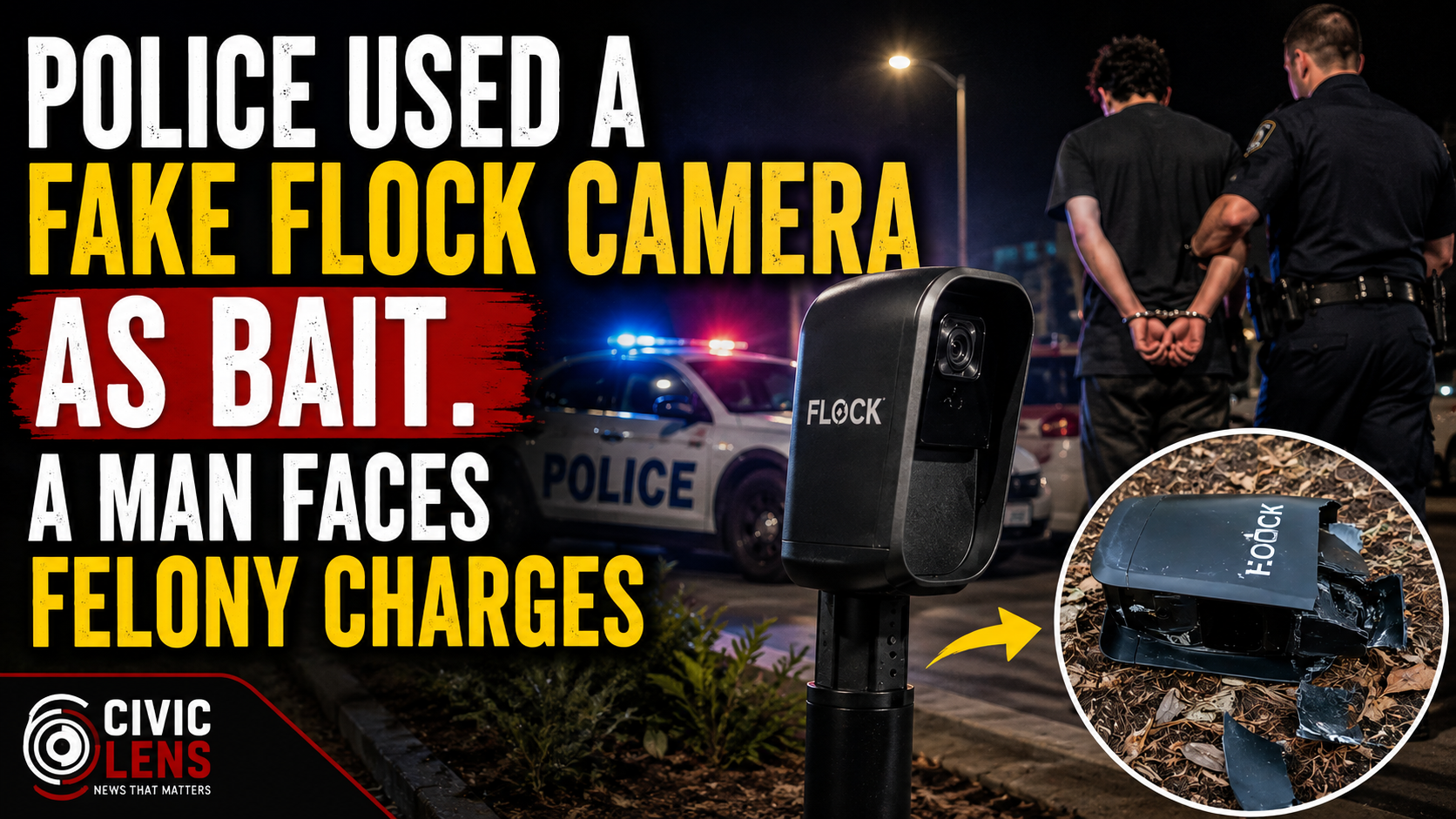
After several automated license plate readers vanished from a busy corridor in this Orlando suburb, police turned to an unusual tactic. An officer used a home 3D printer to make plastic replicas of Flock Safety cameras, then the department put the fakes on poles and waited. According to an Oviedo Police Department arrest affidavit, the department installed clone style bait cameras after Flock devices were stolen along Lockwood Boulevard between July 23 and Aug. 3.
The replicas were built to look like working units. Police said they collected no data and cost far less than the real equipment. A department representative later said an officer printed the decoy at home on a personally owned printer and donated it, so the city paid nothing. Local reporting on the affidavit says officers placed the bait devices around 10 p.m. on Aug. 19 near Lockwood Boulevard and Arrowroot Place.
Shortly before 1 a.m. on Aug. 20, a sergeant conducting surveillance reported seeing a man in dark clothing, gloves, and a face covering approach one of the replicas with pruning shears. Police said the man cut the device from its mount, threw it down, and smashed it into pieces, then ran north along the sidewalk. After emergency lights came on and officers gave commands, he stopped and was taken into custody without incident, the affidavit states.
Police identified the man as Evan Meyer, 24, of Oviedo. He was arrested and charged with three felonies: criminal mischief causing more than $1,000 in damage, grand theft of property valued between $750 and $5,000, and damaging or taking a computer, electronic device, or related equipment. The affidavit listed his total bond at $7,500. Meyer has been charged.
He has not been convicted, and the allegations have not been proven in court. Investigators wrote that Meyer, after being advised of his rights, said Flock cameras near his home made him feel as if a “constant eye” was watching him. According to the affidavit, he said he had read criticism online about Flock Safety, including about the company’s chief executive, and decided to take down the camera closest to his house.
Police said he told them he took his father’s pruning shears from the garage for that purpose and did not intend to use them against officers. The report says Meyer estimated replacement cost at $1,000 to $5,000 and believed he was destroying a real camera. Police wrote that a genuine Flock unit costs about $800 to replace, plus installation.
That gap is now part of the public argument over the case, because the object destroyed was a printed replica worth little more than plastic, while the charges treat the harm as a high value property crime. Police Chief Dale Coleman has said the operation was handled like other investigations. “One of the officers 3D-printed a camera. We put it up, and we conducted surveillance on it,” Coleman said.
He compared the work to watching a street corner for drug sales. “I think it’s safe to say the fake camera saved us from spending more money on equipment we are currently utilizing,” he added. Mayor Megan Sladek said she and the City Council did not know about the sting beforehand. After speaking with City Manager Bryan Cobb, she confirmed that police had put up a fake Flock camera and watched it until someone cut it down.
“I am speechless,” she wrote. “Transparency is so important.” She later said the devices cost taxpayers nothing and that damaging public property is not acceptable, while noting that the timing, during a local fight over Flock itself, made the episode especially sensitive. Flock Safety cameras are automated license plate readers mounted on poles.
They photograph passing plates and vehicle details, then compare that information against lists used in investigations, including stolen cars and missing person cases. Departments lease the systems because the cameras can scan traffic around the clock and share hits across a wide network of agencies. That same reach has made the technology a national flashpoint. Supporters say the readers help recover vehicles and locate suspects.
Critics argue that constant plate scanning creates a map of where people travel, that data can be shared too broadly, and that residents often have little say over who can search the footage. Those concerns have already reached Oviedo. The city has used a small network of eight cameras, and days before the arrest residents pressed the council to drop the program. Staff were instructed to prepare a resolution to end local Flock use, with further discussion scheduled for September.
For now, the case is narrower than that debate. Police say they used a homemade lookalike to stop a string of camera thefts. Prosecutors will have to show whether destroying that replica supports the felony charges filed after the arrest