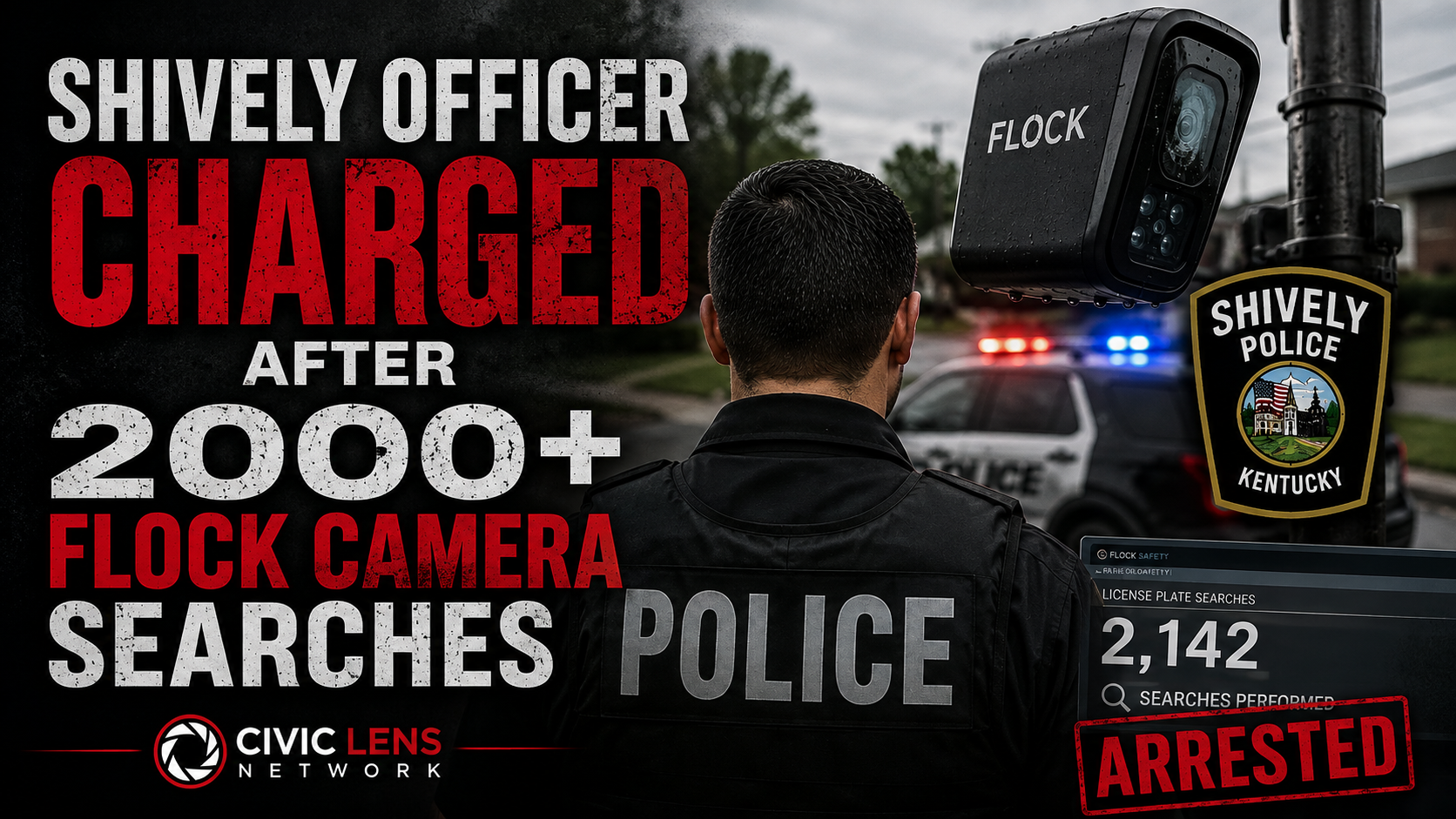
A Shively Police officer is facing criminal charges after department leaders say he used a networked license plate camera system to track a woman for months. The woman is the mother of his child and was not tied to any active criminal case, officials said. Officer Asad Zahir, 40, was arrested at the Shively Police Department on the night of August 25, 2026.
Court records and a department briefing the next day describe 2,048 searches in the Flock Safety system between January 1 and May 2. Those queries targeted two Kentucky vehicle registrations linked to the same woman. Investigators say about 1,200 searches involved one plate and more than 800 involved the other. Shively Police Chief Col.
Paul Bottoms said the pattern surfaced on Monday, August 24, after the department turned on a new Flock auditing tool powered by artificial intelligence. The tool flagged the repeated plate lookups almost at once. Zahir’s access was cut off that day. Within about a day, investigators concluded the searches had no valid police purpose and presented the file to prosecutors.
Officers who use Flock are required to give a law enforcement reason for each search. Bottoms said Zahir listed a drug or narcotics investigation. Police say there was no such case involving the woman. “Accountability cannot depend on who you are or the position you are in.
This is what accountability looks like,” Bottoms said. He also called the allegations a “gut punch” for a small department and said they do not represent the agency as a whole. Zahir joined Shively Police in 2022. He is now suspended without pay.
Officials said he has no police powers, no badge, and no department issued firearm while the criminal case and an internal review continue. The arrest citation states that during the same five month window Zahir allegedly harassed the woman in Indiana and made threatening comments. She obtained a temporary protective order there. Police say she had an emergency protective order from April 17 to May 6, and that 241 of the Flock searches were entered in that period.
Investigators are still reviewing which cameras were queried and whether any of those cameras were outside Kentucky. Zahir faces five counts of official misconduct and five counts of unlawful access to a computer. Some court summaries list the misconduct counts as first degree and the computer counts as fourth degree. The Courier Journal described both sets of charges as misdemeanors.
He was released the same day as his arrest on personal recognizance or bond, with a condition of no new arrests or law violations. Arraignment is set for 9 a.m. on August 28 in Jefferson County District Court. Flock cameras photograph passing plates, store the data, and let authorized users map where a vehicle has been seen. Agencies sell the network as a tool for stolen cars, missing people, and violent crime.
The same map can show where a person travels for work, school, shopping, or visits across a state line. In this case, officials say that map was used on a private target, not a suspect. The episode lands in a wider debate about license plate readers. An August 2 Washington Post review found about 50 cases in which officers were accused of using plate reader systems for improper reasons.
In many of those files, the alleged target was a spouse, a girlfriend, an ex, or another person tied to a personal relationship. Privacy advocates argue that a searchable driving history is too easy to abuse when the user already has a badge and a login. Police leaders counter that the systems close cases and that audits can catch misuse. Shively officials say this case already changed local practice.
Bottoms said the department is reviewing Flock policy and that officers must now enter a case number to run a search. That extra field is meant to tie every query to a real file that a supervisor can check. What remains open is how far the tracking reached, how the data was used day to day, and what a court will accept as proof of intent. Police have not publicly named the woman.
They have said she is the mother of Zahir’s child and that she is not part of a criminal investigation. The department says it moved quickly once the audit tool lit up the two plates. Critics of plate reader networks will point to the volume: more than two thousand lookups over five months, including hundreds while a protective order was in force.
Supporters of the cameras will note that an audit, not a complaint first, started the case, and that the officer was arrested at his own station. Both readings can be true at once. A tool built to find suspects can also find a former partner if someone with access decides to look. The charges now ask a court to decide whether that is what happened here.
Zahir has not entered a public plea as of the August 26 briefing. He remains an accused person, not a convicted one. The facts on the table are the search count, the two plates, the listed narcotics reason with no matching case, the shared child, the Indiana order, and the 241 lookups during that order. Those points are why a suburban Louisville department called a news conference and why the case is being watched beyond Shively.