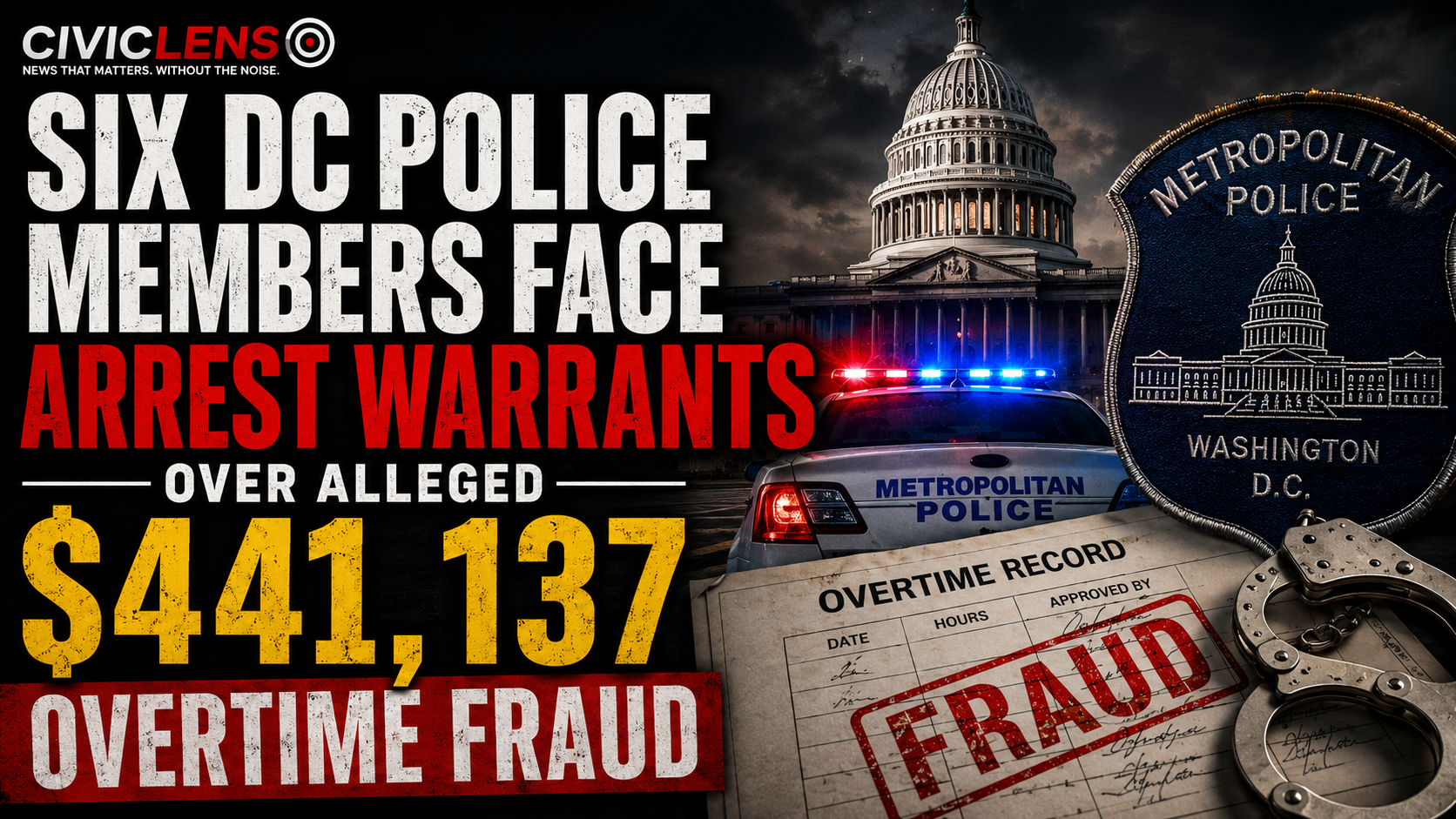
In mid August 2026 District of Columbia Attorney General Brian Schwalb announced that a judge had signed arrest warrants for six current and former members of the Metropolitan Police Department. Prosecutors say the group forged supervisor approvals and altered official overtime records so the District paid them $441137 for hours they never worked. All the activity took place in 2024 while the six were assigned to the Fifth District Administrative Office.
The individuals and the amounts they allegedly collected are Former Sergeant Frantz Fulcher $174915.39 Officer Thomas Krmenec $89478 Officer Dorrie Smith Cleere $87397.65 Former Senior Police Officer Bernadette Richardson $43351.68 civilian employee Johnnie Dyer $27721.59 and Former Lieutenant Peter Sheldon $18272.72. Together those figures account for 5618 hours of claimed overtime that investigators later determined never occurred. Internal Affairs opened the case after noticing unusually large volumes of overtime submissions coming from the same administrative unit.
Detectives then cross checked the claims against body worn camera footage radio logs GPS data license plate reader records and travel documents. The comparison showed that some of the hours were submitted while the employees were on annual leave or outside the District including during international trips. In other instances people used their administrative positions to process and approve the false claims themselves. Each of the six faces four charges first degree fraud first degree theft forgery and uttering.
Uttering refers to knowingly presenting a forged document as genuine for the purpose of obtaining money. Because of limits placed on local prosecutions by the Home Rule Act the Office of the Attorney General is working with the United States Attorney for the District of Columbia. Prosecutors from Schwalb’s office are serving as special assistants so the cases can move forward in federal court.
Schwalb described the conduct as an abuse of positions of power that exploited both the District and the residents the officers had sworn to protect. He stressed that no one is above the law especially those trusted with enforcing it. United States Attorney Jeanine Pirro echoed the point saying every day the public relies on law enforcement to uphold trust and that these members betrayed that trust by collecting unearned income at taxpayer expense.
The total amount of overtime the six submitted in 2024 exceeded $935000. Investigators concluded that slightly more than half of those hours were fraudulent. Fulcher alone is accused of logging 1861 false hours the equivalent of more than 232 eight hour shifts. Krmenec and Smith Cleere each claimed more than one thousand hours that did not match any independent record of their presence or activity.
At least three of the accused were taken into custody within a day of the warrants being signed. The remaining three remain the subjects of active warrants. The Metropolitan Police Department has declined to comment beyond confirming that Internal Affairs conducted the initial investigation and continues to cooperate with prosecutors. Public reaction has focused on the scale of the alleged scheme relative to the size of the administrative office involved.
Fifth District covers a busy stretch of the city and its administrative staff handle scheduling payroll and other support functions that keep patrol officers on the street. When those support roles become the source of false claims the entire payroll system is compromised. Residents who already watch overtime costs closely now see a concrete example of how weak internal controls can translate into six figure losses. The case also highlights the practical value of digital records.
Body cameras GPS trackers and license plate readers were never designed as payroll tools yet they provided the independent timeline that exposed the discrepancies. Without those data streams the forged approvals might have remained undetected for years. The investigation therefore serves as a reminder that modern policing generates mountains of timestamped evidence that can be used for more than crime fighting. Prosecutors have not released the full charging documents so the exact methods of forgery remain sealed.
What is public is that supervisory signatures were copied or fabricated and that official overtime ledgers were altered to match the false claims. Some of the accused appear to have submitted overtime for secondary employment performed elsewhere on the same calendar day. Others simply marked hours while they were out of the country. The financial impact falls directly on District taxpayers. $441137 is enough to fund several community programs or cover the salaries of multiple entry level officers for a full year.
When that money leaves the budget through fraud rather than legitimate service the shortfall must be made up elsewhere usually through higher taxes or reduced services. Schwalb’s office has invited residents to report other suspected public corruption so that similar schemes can be stopped earlier. The six defendants will have their day in court. Until then the warrants stand as formal accusations not convictions.
Still the volume of evidence cited by both the Attorney General and the United States Attorney paints a picture of systematic rather than accidental misconduct. The combination of forged paperwork travel records that place people hundreds of miles away and administrative access that allowed self approval points to planning rather than simple error. For a city that spends hundreds of millions each year on public safety overtime any hole in the verification process is expensive.
This episode shows how a single administrative office can become a weak link. Stronger random audits real time cross checks against location data and clearer separation of duties between those who claim overtime and those who approve it are obvious next steps. Whether those reforms arrive before the next case surfaces will depend on how seriously the lessons of this investigation are taken. The story remains under covered relative to its size.
A half million dollar fraud inside a police department should command sustained attention yet after the initial announcements coverage has been thin. That gap leaves room for continued reporting as arrests are completed court dates are set and more details emerge from the sealed affidavits. Until then the public record rests on the warrants the dollar amounts and the clear statements from the two top law enforcement officials in the District that the alleged conduct will not go unanswered.