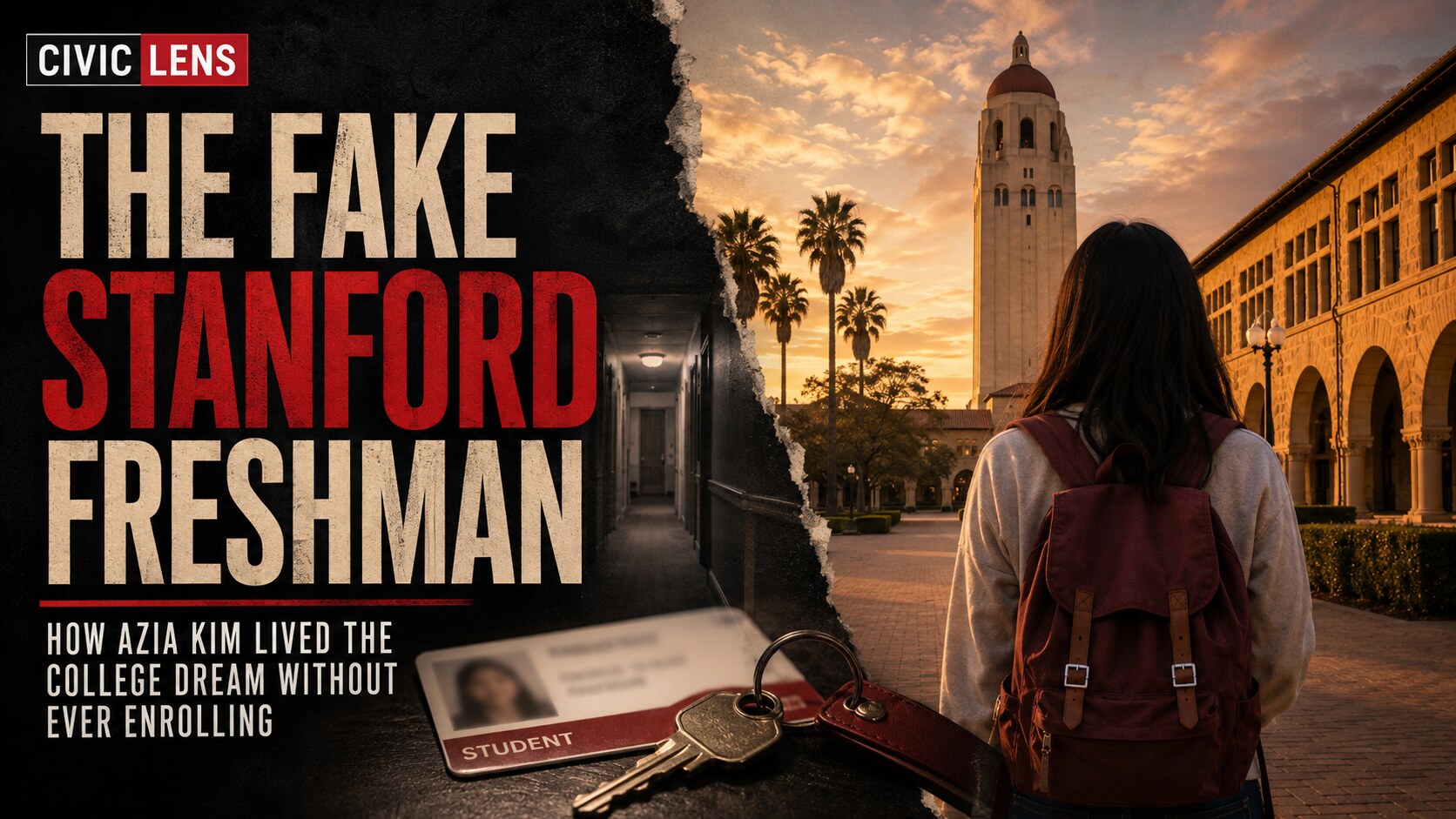
In the fall of 2006, an 18-year-old from Fullerton, California, arrived at Stanford University during new student orientation and blended right into campus life. Azia Kim graduated from the competitive Troy High School and told everyone she was a freshman. She lived in residence halls, ate in the dining commons, bought textbooks, joined study groups, talked about exams, and made friends who saw her as one of their own. There was just one problem: Kim had never been admitted to Stanford.
She began her deception on September 18, 2006, the day before orientation. Approaching two students in Kimball Hall, she claimed a technical mixup left her without housing or that she disliked her assigned roommate. The students believed her and let her sleep in their room. For the rest of fall and winter quarters she split time between that shared space and the dorm lounge in the 210-resident building.
She slipped into meals without a student ID and moved freely through the halls thanks to the open, trusting culture among undergraduates. By spring quarter the arrangement in Kimball had worn thin. Kim found a new spot in Okada, the Asian-American theme dorm. She told staff she had transferred from another hall with housing approval because she had more friends on East Campus.
On April 18 she moved into a one-room double whose regular occupant was away for the quarter. Still lacking a key or ID, she entered by removing the window screen and climbing through a first-floor opening that overlooked a construction site and parking lot. Her roommate, who spent most nights elsewhere, never noticed the open window or the arrangement. Kim presented herself as a human biology major, sometimes claiming sophomore status.
She bought the right books, studied with peers for tests she would never take, and accurately recited exam schedules and room numbers. Residents described her as quiet, reserved, tall, and unassuming. Closer acquaintances found her sweet and deeply religious. High school friends back home had expected her to attend a community college that fed into Berkeley.
When she returned for Christmas break claiming acceptance to Stanford, they accepted the story. Her parents paid what they believed was roughly $50,000 in tuition. Her sister even posted well-wishes for finals on social media. Kim extended the charade beyond the dorms.
Using her claimed Stanford identity she enrolled in the Army Reserve Officers Training Corps program at nearby Santa Clara University, which accepts students from other campuses. For two academic quarters she attended classes and labs on military history and tactics. She submitted fabricated transcripts showing high grades that earned her the Dean’s Award and a special ribbon. The Army issued her uniforms, a Kevlar helmet, boots, and other gear worth about $1,000.
She kept the equipment in her Stanford room. An Army spokesman later called the episode a harmless prank and said no punitive action would follow. Kim dropped out of the program in March. The deception lasted eight months.
It ended in late May 2007 after an Okada resident assistant grew suspicious when another RA mentioned Kim had claimed to live in a different hall. Housing was contacted. Authorities confirmed she was not a student. Kim tried to leave quietly, hiding belongings in a closet, but staff confiscated them.
A cab took her to an uncle’s house in San Jose in the early morning hours. She had also allegedly accessed a roommate’s email and deleted messages from housing about the situation, even sending a reply that pretended the roommate had written it. Stanford officials investigated how someone could evade security procedures for so long, enter locked buildings, use campus facilities, and live in residence halls. The case was referred to the Santa Clara County District Attorney for possible trespassing or theft of services charges.
Housing billed unauthorized visitors $175 per day, which for eight months totaled more than $40,000. Police indicated they would remove her if she returned but expressed limited options for further action. Kim and her family did not speak publicly about her motives. Friends and observers pointed to intense academic pressure at Troy High School and the high expectations often placed on high-achieving students, particularly in certain communities, to attend elite universities.
The episode exposed gaps in campus access controls and the ease with which a determined person could exploit the friendliness of the student body. Stanford later faced questions about protocols for verifying residents. Similar cases have appeared at other selective schools, showing that prestige can attract people seeking the status and experience without formal admission. Kim’s story remains a striking example of how thoroughly someone can inhabit a role that was never officially granted.
Years later the case still illustrates the thin line between belonging and appearance on elite campuses. Kim lived the daily rhythms of Stanford life: meals, late-night studying, friendships, and even military training. She left no formal transcript, no degree, and no official record, yet for eight months she occupied the space of a genuine freshman. The university tightened some practices afterward, but the underlying trust that made the ruse possible remains part of residential college culture.