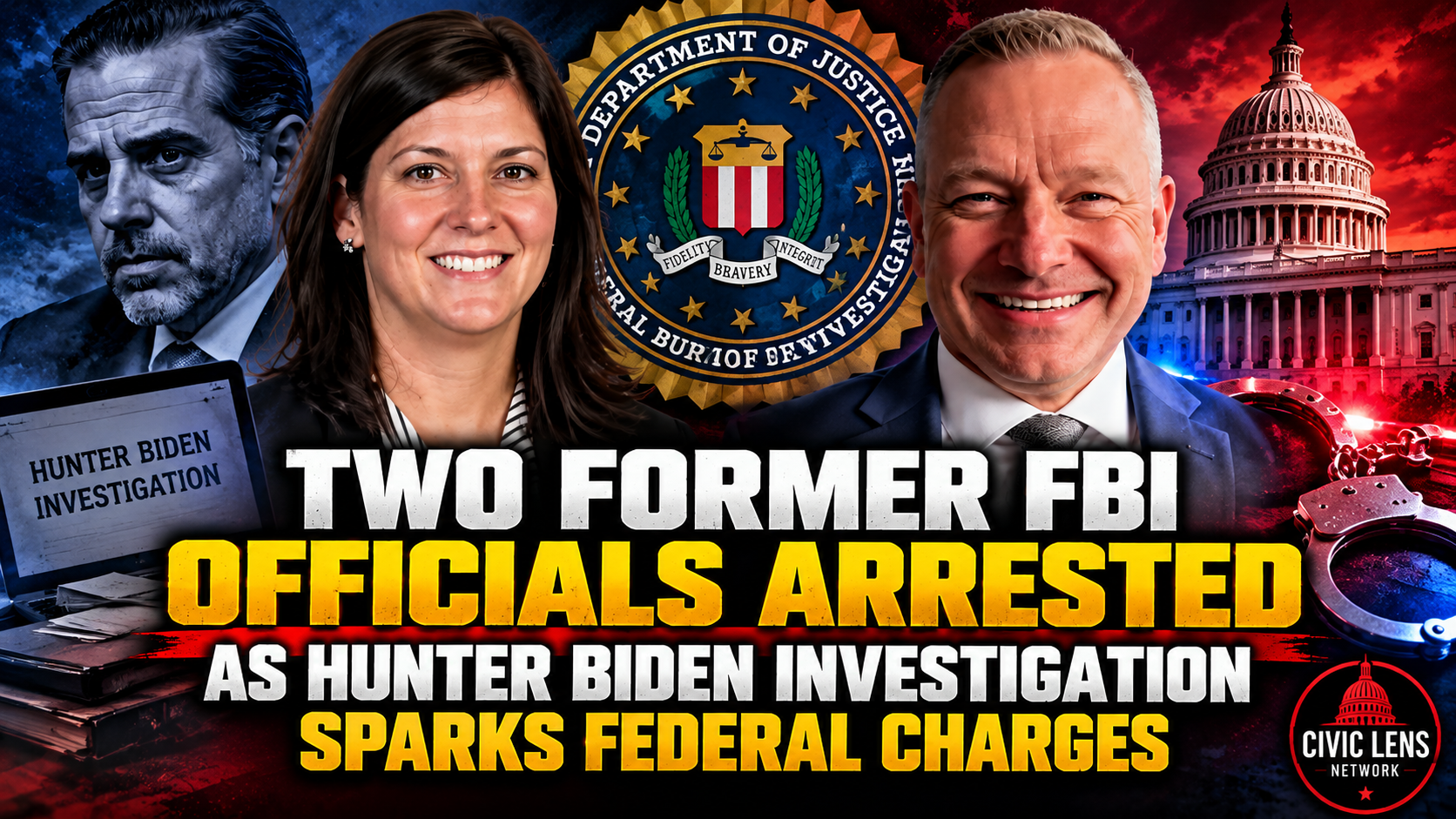
Two former senior FBI officials surrendered Friday on federal arrest warrants after prosecutors charged them with lying to Congress about their roles in investigations involving Hunter Biden, including the bureau’s possession and handling of his laptop in the period surrounding the 2020 presidential election.
Nikki Cole Floris, 46, of Alexandria, Virginia, and Bradley Benavides, 56, of Aiken, South Carolina, each face one count of making a materially false statement in a matter within the jurisdiction of the legislative branch, in violation of 18 U.S.C. § 1001(a)(2). The charges, filed by criminal complaint in the U.S. District Court for the District of Columbia, carry a maximum penalty of five years in prison upon conviction. Both are presumed innocent unless proven guilty beyond a reasonable doubt.
Floris and Benavides turned themselves in on October 23, 2026, following the unsealing of the complaint. They made their initial appearance in federal court in Washington that morning and were released pending further proceedings. U.S.
Attorney Jeanine Ferris Pirro of the District of Columbia announced the charges, stating that “lying to Congress by anyone strikes at the heart of our democratic system, but when senior FBI agents lie to Congress believing they are above the law, it’s time to bring the hammer of justice down on them.” The statute prohibits knowingly and willfully making any materially false, fictitious, or fraudulent statement or representation in any matter within the jurisdiction of the executive, legislative, or judicial branch of the federal government.
Prosecutors allege the statements were material because they impeded the House Judiciary Committee’s investigation into the FBI’s Foreign Influence Task Force (FITF) and its engagement with Hunter Biden matters. In transcribed interviews before the House Judiciary Committee, both officials denied meaningful involvement. Floris appeared on July 19, 2023. According to the criminal complaint and supporting affidavit, she stated that she had not participated in discussions about Hunter Biden while at the FITF and that there had been no such discussions “at least not with me.”
She also claimed no personal knowledge of FITF discussions about him and no contemporaneous knowledge of a September 2020 report by Senators Chuck Grassley and Ron Johnson detailing financial transactions involving Hunter Biden and foreign individuals. Benavides testified on September 28, 2023. Prosecutors say he claimed he first learned that the FBI possessed Hunter Biden’s laptop by reading a Wikipedia article in 2023. Both were warned that lying to Congress is a federal crime.
The 27-page statement of facts filed with the complaint cites documentary evidence, contemporaneous communications, and witness accounts that prosecutors say contradict those statements. The affidavit, sworn by an FBI special agent, asserts that Hunter Biden was a recurring subject of FITF briefings, emails, instant messages, and meetings from late 2019 through 2021.
It states that the FBI’s Baltimore field office obtained the contents of the laptop on December 9, 2019, from a Delaware computer repair shop and that FITF personnel, including the defendants, were aware of it. Specific examples listed include an August 14, 2020, call in which Floris and Benavides participated regarding a defensive briefing script for the Hunter Biden investigative team. On September 23, 2020, Floris circulated the Grassley-Johnson report to colleagues, including Benavides, and messaged about it the morning it was released.
On October 14, 2020—the day the New York Post published its initial story on the laptop—both officials assisted with the FBI’s response to press inquiries and congressional requests. Benavides later sent an Outlook invitation titled “To Discuss Laptop” and met with a Criminal Investigative Division official about the device’s source and contents. Floris continued receiving and forwarding updates on the “Sportsman” investigation (the FBI code name for Hunter Biden) into 2021.
A congressional staffer present at the 2023 interviews told investigators the statements appeared materially untrue. An FBI employee interviewed in October 2026 confirmed that both defendants had routine discussions about the investigations and the laptop. The FITF was established to coordinate the FBI’s efforts to counter foreign malign influence, particularly in the context of U.S. elections. Floris led it as Deputy Assistant Director from mid-2019 through mid-2022.
Benavides served as Section Chief from mid-2019 through the 2020 election. The unit was later dissolved. Prosecutors allege the FITF had oversight involvement in FBI investigations of Hunter Biden and participated in discussions about whether reporting related to him constituted Russian disinformation. The complaint references an internal project known as Round River.
According to the affidavit, in 2019 the FITF informally formed a group of analysts to collect derogatory informant reporting on topics including Hunter Biden, Burisma, and related Ukraine matters, with the aim of examining whether it could be flagged as Russian disinformation. Benavides approved the opening of the Type 3 assessment under which the project operated on August 18, 2020.
On September 24–25, 2020, Floris hosted a “Round River Pre-Brief,” and both she and Benavides were among the officials listed as having reviewed and approved the initial interim report. An FBI employee later confirmed that the project focused in significant part on the Hunter Biden investigations and potential disinformation. These are allegations contained in the government’s filing.
Separate declassifications and congressional inquiries have examined related FBI handling of informant reporting and defensive briefings during the 2020 cycle, but the criminal complaint centers on the defendants’ alleged false statements about their own knowledge and participation. The laptop story broke in mid-October 2020, weeks before the presidential election.
Social media platforms restricted distribution of the New York Post articles for a time, and a letter signed by 51 former intelligence officials described the story as having “all the classic earmarks of a Russian information operation.” Subsequent investigations, including the use of laptop data as evidence in Hunter Biden’s 2024 federal gun trial, have established the authenticity of substantial portions of the device’s contents. The FBI had possessed the laptop for nearly a year before the Post story.
Whether and how FITF activities or internal discussions influenced public or platform responses remains a matter of ongoing debate and prior congressional review; the present charges do not allege a proven conspiracy to alter the election outcome. FBI Director Kash Patel stated on X that the charges arose from an investigation into the dissolved FITF. He noted that both officials “testified that the FITF was not involved in the Hunter Biden investigations” and that “documentary evidence, contemporaneous communications, and witness accounts contradict their testimony.”
Patel added that one of the individuals is on record privately claiming to have been “running a shadow government” during the 2020 election, and he reiterated that “no one is above the law.” Attorney General Todd Blanche said public servants “cannot lie to Congress and get away with it.”
Attorneys for Floris described her as “a patriot” who served nearly 20 years as a dedicated FBI intelligence officer and called the charges “nonsense” brought “on the say-so of politicians, not on the facts,” noting the timing on the eve of the November 3, 2026, midterm elections. Lawyers for Benavides called the case “baseless” and “a disgrace,” asserting he is a patriot whose career protected the country.
At the initial appearance before Magistrate Judge Zia Faruqui, the judge observed that the defendants have otherwise impeccable records, that the underlying events occurred years earlier, and that the use of a criminal complaint rather than a grand jury indictment was unusual. He set a preliminary hearing for the following Tuesday and indicated the government should be prepared to proceed promptly on the serious charge.
The case raises longstanding issues of congressional oversight and the obligation of senior federal officials to provide truthful answers under questioning. False statements statutes exist precisely because lawmakers rely on accurate information from the executive branch to conduct investigations and enact legislation. Whether the evidence ultimately establishes that Floris and Benavides knowingly lied, or whether their statements can be reconciled with the documentary record, will be determined in court.
The timing, just days before midterm elections, has drawn criticism from defense counsel and some observers as potentially political, while supporters of the prosecution view it as overdue accountability for alleged obstruction of oversight into the FBI’s handling of a matter that became central to public debate in 2020.