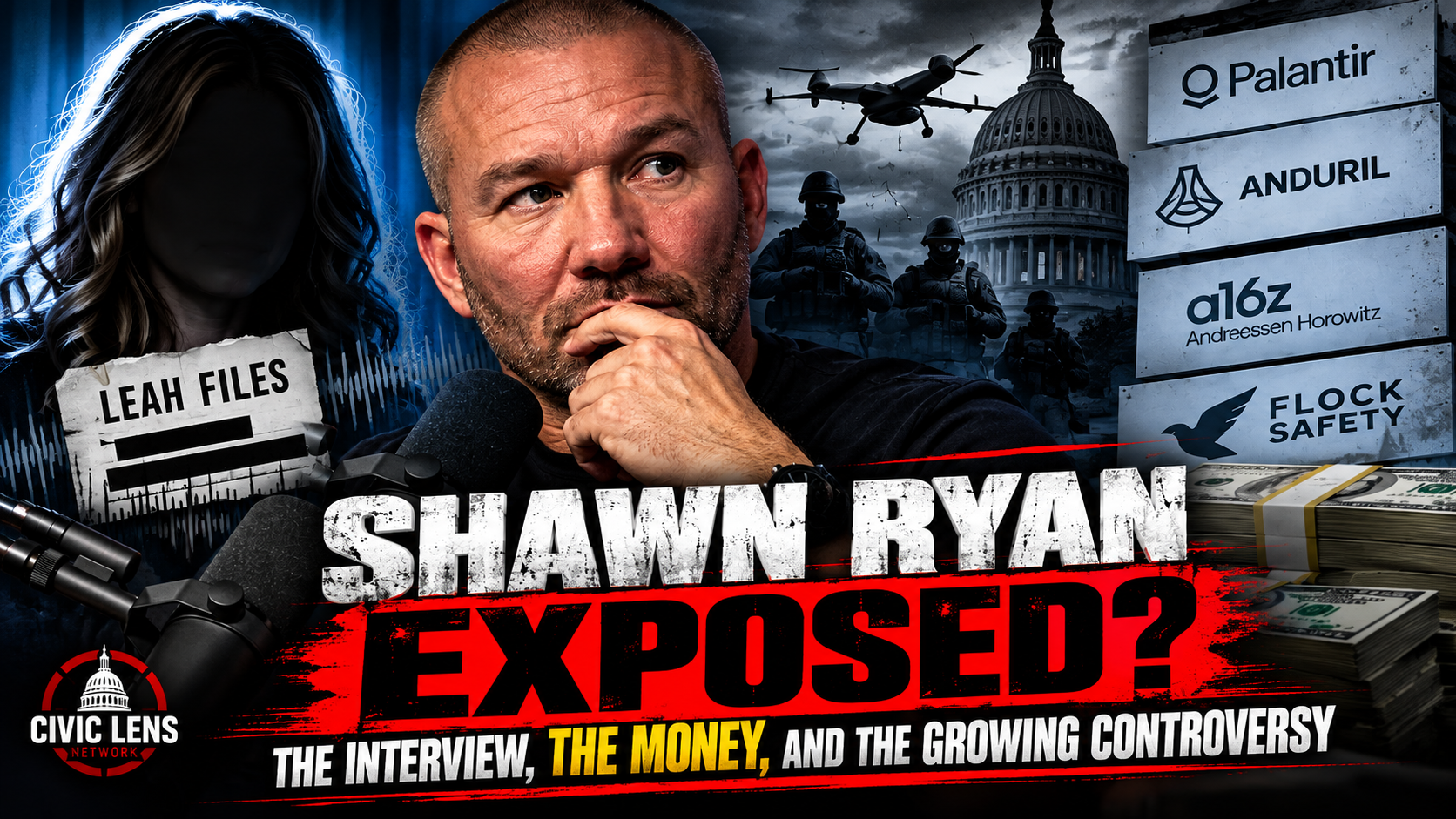
On July 27, 2026, investigative commentator Leah Files, known online as The Leah Files, sat down in the Shawn Ryan Show studio. She had prepared for weeks to discuss Turning Point USA finances, the expansion of license-plate cameras from Flock Safety, and the venture capital networks behind domestic surveillance and defense technology. By her account, the terms changed minutes before cameras rolled.
Ryan, a former Navy SEAL and CIA contractor whose podcast reaches millions with its emphasis on military experience and skepticism of official narratives, ultimately withheld the episode. Months later, after Files publicly described the restrictions, he released the full interview on October 19 under the title “My Unredacted Interview with The Leah Files,” accompanied by a statement that he had “serious concerns about the truthfulness of your statements” and had acted to protect both his platform and, he later added, her reputation.
The release did not end the argument. It sharpened a larger question about independent media: when a host who built an audience as an alternative to corporate journalism holds personal stakes in the industries his guests examine, where does editorial judgment end and financial interest begin? The Interview That Wasn’t Released Files has stated she filmed the conversation on July 27. She expected to name specific funders while tracing money behind Flock Safety’s network of automated license-plate readers and related surveillance tools.
In posts and a Substack note, she wrote that she was told, right before filming, she could not name Andreessen Horowitz or Peter Thiel’s Founders Fund. She said the resulting session felt watered down, that she told the team afterward she did not want it aired in that form, and that she later heard it had been edited.
She also noted that Ryan later appeared on Diary of a CEO and described a woman whose interview he would never release, an account she said did not match her own. Ryan’s public explanation, posted with the October 19 release, was direct: “I chose not to release your episode because I personally had serious concerns about the truthfulness of your statements. I take what I put out on my platform seriously for myself and for my listeners.”
In a short accompanying video he was blunter, calling her a “total fraud” who spent excessive time on polygraph procedures common in intelligence work and who delivered “definitely no money trails,” which he described as her claimed expertise. He said he also withheld the episode partly to help her “save face.” He released both a standard edited version and a continuous stream he said contained “no cuts, nothing got redacted, no names were pulled.” Listeners can now judge the conversation themselves.
The released episode covers her background as an economist and corporate intelligence consultant who has worked with agencies including the NGA, DIA, NSA, and CIA; discussions of nonprofit financial filings and a requested audit connected to Charlie Kirk and Turning Point USA; political influencers and foreign influence; and detailed segments on Flock cameras, license-plate tracking, and broader surveillance concerns, including U.S.-Israel technology links. Whether those segments constitute the full investigation she intended, or a constrained version of it, remains contested.
Allegations of Censorship and the Documented Overlaps Files’ central allegation is that producers instructed her not to name Andreessen Horowitz or Thiel while discussing Flock Safety funding. She has said she possesses evidence of the instruction but has declined to release it, describing the production team as generally professional and declining to “throw them under the bus.” Ryan has not, in the statements reviewed, directly confirmed or denied that specific pre-recording restriction.
He has instead focused on his credibility assessment of her and on the transparency of the eventual full release. What is independently documented is the financial architecture around the topics. Ryan’s public LinkedIn profile lists him as an investor in Anduril Industries beginning October 2025 and in Shield AI beginning November 2025, among other holdings including Sesh and co-founding the privacy application Glacier.
Anduril, which develops autonomous systems and command-and-control software, has long received backing from Thiel’s Founders Fund; Andreessen Horowitz co-led its $5 billion Series H round in May 2026 at a reported $61 billion valuation. Shield AI, focused on AI autonomy for unmanned systems, is also an Andreessen Horowitz portfolio company. Flock Safety, the company at the center of the surveillance discussion, has received substantial funding from Andreessen Horowitz, which led major rounds including a 2021 Series D and a 2025 Series F.
Files further noted that Sesh’s round was led by 8VC, the firm of Palantir co-founder Joe Lonsdale, who had appeared on Ryan’s show in May 2026. These relationships do not prove that any particular editorial instruction was given to protect an investment. They do establish a clear overlap between the funders Files says she was barred from naming and the investors behind companies in which the host has publicly listed stakes.
Ryan has stated that his investments in Shield AI and Anduril are public precisely so audiences can see them, and that he made them solely because he believes the companies develop technology that “equips and protects the American warfighter,” a priority he describes as personal given his service. He has not claimed to hold a stake in Flock Safety itself.
After the controversy, Ryan’s channel released a separate investigative segment on Flock Safety on October 21, examining both the technology’s role in recovering abducted children and documented abuses, including unauthorized searches by federal agencies and misuse by officers. The timing invited further scrutiny of whether the later piece was responsive journalism or damage control; Ryan’s team has framed it as part of an ongoing series on the surveillance state.
Responses, Backlash, and the Limits of Disclosure Ryan’s defense has centered on two points: editorial standards and transparent, values-driven investing. Critics, including comedian and podcaster Jimmy Dore, have argued that the response sidesteps the specific claim about restricted names and that releasing the interview after public pressure does not resolve questions about the original conditions of the conversation.
Circulating reports, including statements attributed to the brother of a former editor and comments from Files, allege that staff members left over the handling of the episode and that some faced pressure not to speak publicly. These remain unverified claims from individuals close to the situation; they have not been independently confirmed through public records or on-the-record statements from the show. The broader reaction among independent commentators and veterans has been mixed.
Some viewers who watched the released episode concluded that Files’ presentation on technical matters such as nonprofit filings contained errors that justified skepticism. Others focused on the optics of a host with defense-tech investments discussing the funding networks of related surveillance companies without clear, contemporaneous disclosure during relevant segments. Ryan’s LinkedIn listings predate the public controversy, and he has pointed to them as evidence of openness.
The practical question for audiences is whether that passive disclosure is sufficient when the same host is interviewing guests on the very sectors in which he invests, or when he later hosts the founders or co-founders of those companies. Independent media figures who position themselves as correctives to corporate capture face a structural tension. Audiences can evaluate corporate journalism by examining ownership, advertising, and documented editorial interventions.
When the medium is a personality-driven podcast, the relevant disclosures are often the host’s own investments, business relationships, and any pre-interview conditions imposed on guests. Ryan has made his major defense-tech holdings public and has released the contested interview in full. He has not, however, provided a detailed public accounting of whether specific names were restricted, why, or how those decisions related to his financial positions. Files has not released the evidence she says she holds of the instruction.
Releasing the episode allows listeners to assess the substance of the conversation. It does not automatically settle whether the conditions under which it was recorded constrained the inquiry Files was invited to conduct, nor whether the host’s financial interests influenced those conditions. The documented overlaps between the funders in question and the companies on Ryan’s public investment list remain. So does his explanation that the investments serve the warfighter and that his credibility concerns were genuine.
Audiences are left to weigh the available record. When a trusted independent media figure becomes part of the controversy, how can the audience determine where editorial judgment ends and personal financial interests begin? The answer, in this case, depends on which parts of the record a listener treats as decisive: the full interview now available, the host’s public investment listings and stated motives, the guest’s account of pre-filming restrictions, or the absence of a direct response to the specific allegation about naming funders.
Each element is now part of the public debate. None of them, on its own, closes the question.