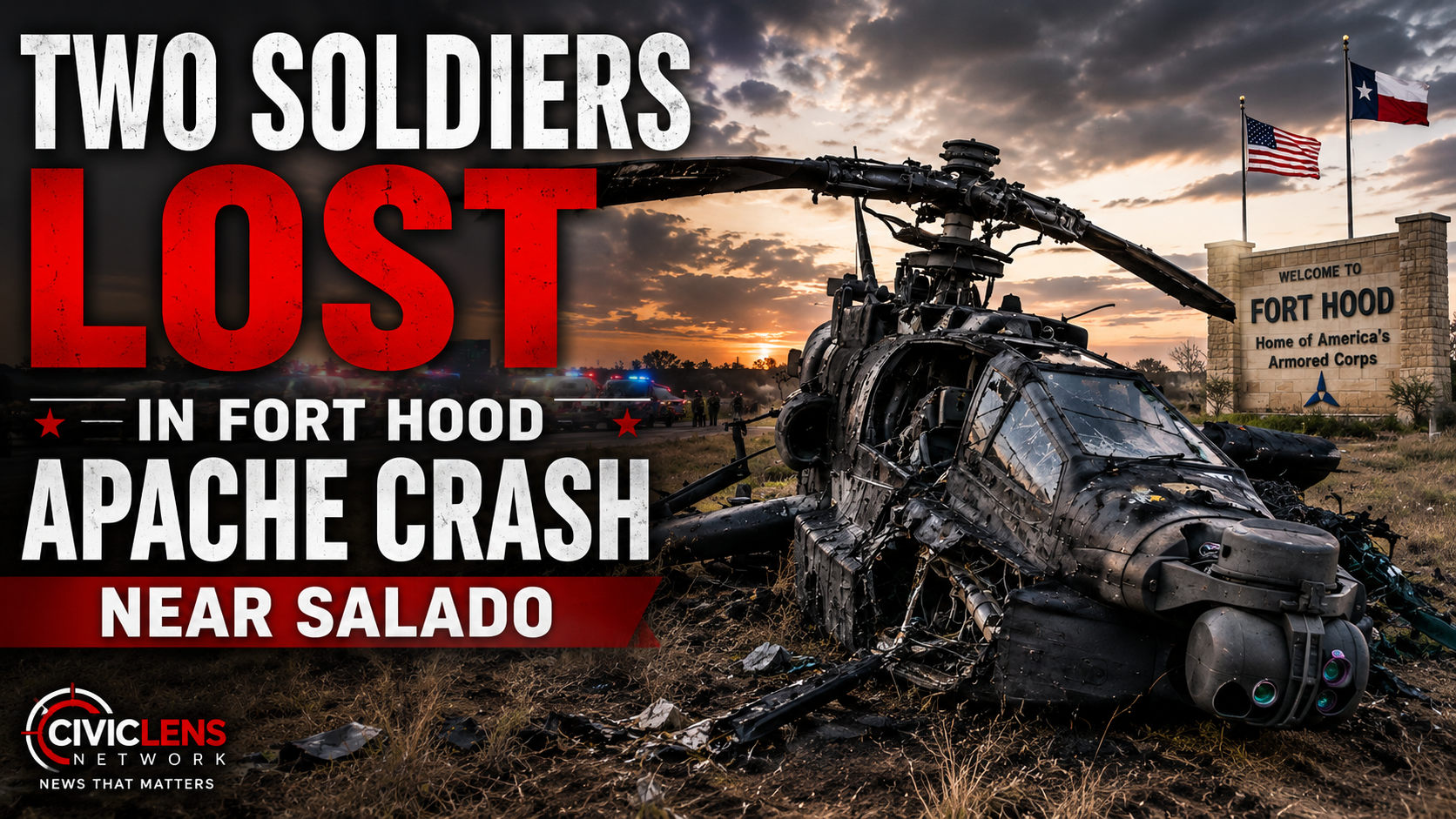
On Wednesday afternoon two United States Army soldiers died when their AH-64 Apache attack helicopter crashed into an open field in Bell County Texas. The aircraft belonged to Fort Hood and went down south of the village of Salado around 1:35 p.m. local time during what officials described as a routine training flight. Bell County Sheriff’s Office received the first 911 calls shortly after 1:30 p.m. reporting a helicopter down and a rapidly growing grass fire.
Deputies arrived to find the wreckage and a blaze that was quickly spreading across the dry field. Cliff Coleman spokesperson for the sheriff’s office later told reporters the impact was clearly violent. Both crew members were pronounced dead at the scene by the Bell County justice of the peace. The helicopter did not strike any homes buildings or people on the ground.
Nearby residents were briefly evacuated as firefighters from several local departments worked to contain the flames. The fire burned roughly one hundred acres before crews brought it under control. Smoke rose for hours from the charred field where emergency personnel and military teams secured the site. Fort Hood confirmed the aircraft was an AH-64 Apache assigned to the post and operated by soldiers from the 1st Cavalry Division.
Brigadier General Ethan Diven acting commanding general of the division released a statement expressing deep sympathy for the families friends and fellow troopers of the fallen. He said the immediate priority was securing the crash site and supporting the response effort while thoughts remained with the crew and their loved ones. Texas Governor Greg Abbott also spoke publicly about the loss.
He noted that an Apache helicopter had crashed in Bell County during Fort Hood operations and taken the lives of two members of the military. The governor asked Texans to join him and his wife in prayer for the families and the entire Fort Hood community. The two soldiers were transported to Carl R. Darnall Army Medical Center on post.
Their names have been withheld pending formal notification of next of kin in keeping with military protocol that requires a waiting period after families are informed. Army investigators from Fort Hood’s criminal investigation division are leading the inquiry into the cause of the crash. No mechanical issues weather problems or other factors have been publicly identified at this stage. The investigation remains active and officials have not released further operational details about the training mission.
The AH-64 Apache is a twin engine four blade attack helicopter designed for armed reconnaissance close combat and support of ground forces. It carries a two person crew with the pilot in the rear seat and the co-pilot gunner in the front. Fort Hood maintains a significant fleet of these aircraft as part of its role as a major training and deployment base for armored and aviation units. The installation covers more than two hundred thousand acres and supports tens of thousands of soldiers.
Local roads near the crash site including sections of Farm to Market Road 2843 were closed for several hours while first responders and military personnel worked the scene. Photographs released by the sheriff’s office showed firefighters moving through blackened grass and examining the remaining debris under plumes of smoke. Community members in Salado and surrounding areas expressed shock at the sudden loss so close to home. The village sits roughly thirty miles southeast of Fort Hood and about fifty to sixty miles north of Austin.
Residents are accustomed to the sight and sound of military aircraft operating in the region yet the crash brought a sobering reminder of the risks service members face even during stateside training. Military aviation accidents though relatively rare still occur during the intensive flight hours required to keep aircrews proficient. Training missions test skills under realistic conditions and the Apache’s complex systems demand constant practice.
Officials emphasize that safety remains a top priority yet the inherent demands of operating advanced attack helicopters mean that risk can never be eliminated entirely. As the investigation continues the focus stays on supporting the families of the two soldiers. Military casualty assistance teams typically provide practical help and counseling in the days and weeks after such a tragedy. Fellow soldiers at Fort Hood are also processing the loss of two of their own.
The crash site remained closed to the public while evidence was collected and the wreckage examined. Fire crews stayed on scene until the last hot spots were extinguished. No secondary explosions or additional hazards were reported beyond the initial grass fire. This incident marks another reminder of the price paid by those who serve.
The two soldiers were performing their duties when the helicopter went down. Their families now face the difficult process of grief while the Army works to determine exactly what happened in the final moments of the flight. Details about the soldiers’ ranks units within the division and years of service will become public once next of kin notifications are complete. Until then the official statements remain limited out of respect for the families.
Emergency responders from Bell County and neighboring departments along with Fort Hood personnel coordinated smoothly throughout the afternoon and evening. Their combined effort prevented the fire from reaching any structures and ensured the crash site was properly secured for investigators. The open field where the Apache came down is typical of the rural landscape surrounding Fort Hood. Dry summer conditions made the grass particularly vulnerable to ignition once the aircraft impacted and burned.
Quick action by local firefighters limited the overall damage. As of the latest updates the cause remains under investigation and no timeline has been given for a final report. The Army will eventually release findings through its standard safety and accident investigation channels. In the meantime the community at Fort Hood and the people of central Texas mourn two soldiers who did not return from a training flight.
The loss underscores the ongoing commitment and sacrifice required of military aviators. Every training hour prepares crews for potential combat operations yet carries its own dangers. The two soldiers lost near Salado joined a long line of service members who gave their lives while preparing to defend the nation.