Wall Street is facing its most serious market downturn in more than a year, with billions of dollars in market value disappearing as investors question whether the historic rally fueled by artificial intelligence has finally reached its breaking point.
The selling intensified Friday, November 20, sending all three major U.S. stock indexes sharply lower and pushing the S&P 500 and Dow Jones Industrial Average into correction territory.
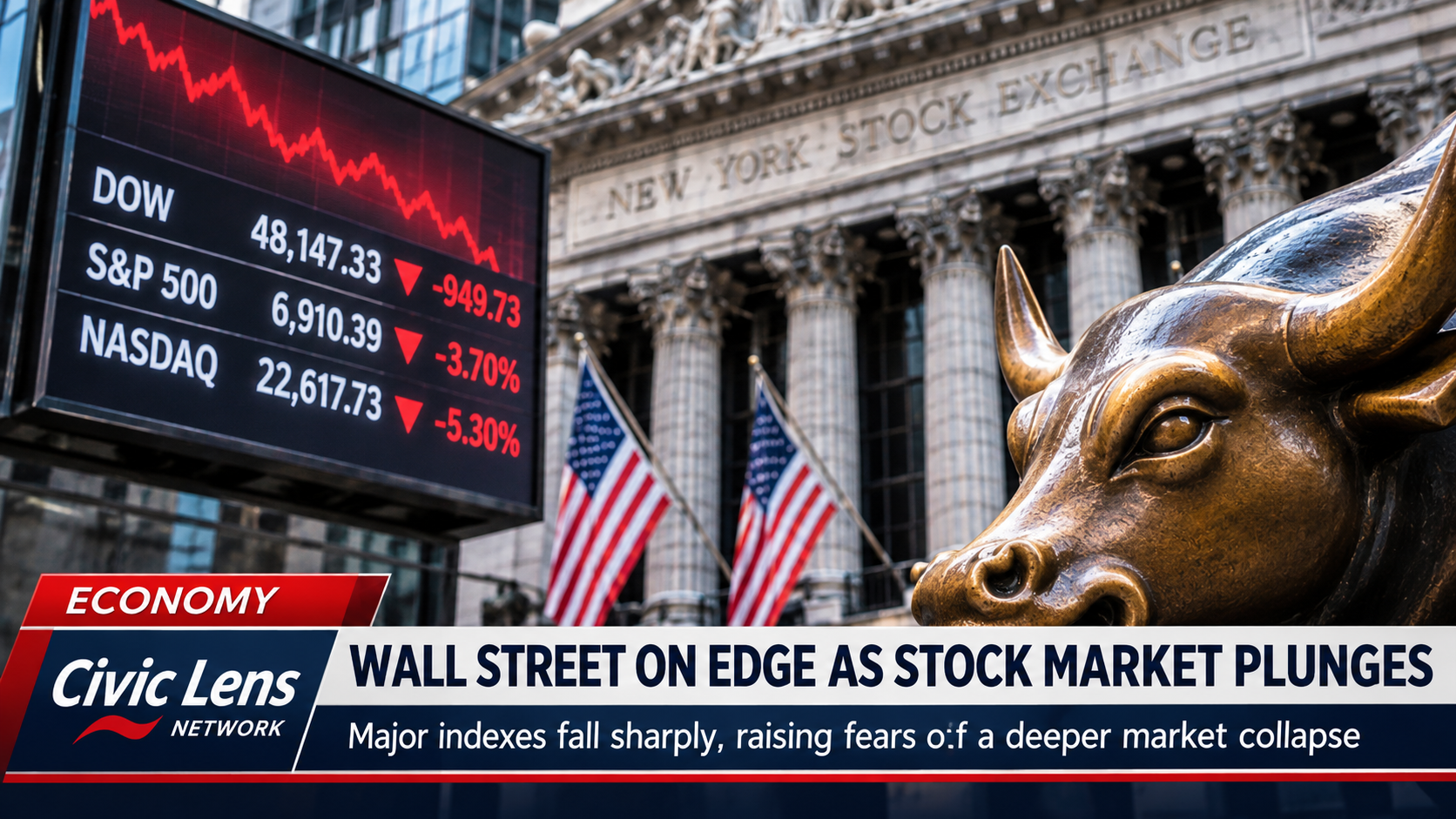
By the closing bell, the Dow had plunged 949.73 points to 48,147.33, while the S&P 500 dropped 3.7% to 6,910.39. The technology-heavy Nasdaq suffered an even more punishing decline, falling 5.3% to 22,617.73.
The losses capped a devastating week for American equities.
The S&P 500 lost 8.6% over five trading sessions, the Dow declined 8%, and the Nasdaq surrendered approximately 10% of its value.
The S&P 500 now sits 11.6% below its October 6 record high, officially meeting Wall Street’s definition of a market correction.
But the question confronting investors is whether this is a temporary retreat or the beginning of something considerably worse.
Artificial Intelligence Boom Faces a Reckoning
Much of the damage has centered on technology companies that benefited from extraordinary investor enthusiasm surrounding artificial intelligence.
For years, investors poured money into semiconductor manufacturers, software developers and corporations building massive AI data centers.
The expectation was straightforward: artificial intelligence would transform the global economy, generating enormous profits for companies positioned to dominate the emerging industry.
Now those expectations are facing a serious test.
Investors are questioning whether the hundreds of billions of dollars being committed to AI infrastructure can produce sufficient financial returns to justify the spending.
Nvidia, one of the biggest beneficiaries of the AI investment boom, suffered a particularly severe setback Friday, with its shares plunging approximately 14%.
The market debut of AI developer Anthropic also failed to restore investor confidence. Its shares fell roughly 9% during their second trading session.
The broader concern is that investors may have assigned extraordinary valuations to companies based on future profits that have yet to materialize.
When those expectations begin to weaken, stock prices can fall rapidly.
Federal Reserve Adds Another Threat
Artificial intelligence is not the only problem facing financial markets.
The Federal Reserve’s return to raising interest rates has introduced another major source of uncertainty.
Higher interest rates increase borrowing costs for businesses and consumers while making some lower-risk investments more attractive relative to stocks.
They can also place additional pressure on technology companies whose valuations depend heavily on profits expected years into the future.
Investors are now looking toward the Federal Reserve’s December 8–9 meeting, when policymakers are expected to consider another quarter-percentage-point increase.
The possibility of additional tightening has raised concerns that the central bank could further weaken economic growth at a time when financial markets are already struggling.
If corporate earnings begin deteriorating while borrowing costs continue rising, the pressure on stock valuations could intensify.
Wall Street’s Fear Gauge Flashes Warning
One of the clearest indications of growing anxiety comes from the Cboe Volatility Index, commonly known as the VIX.
The index, which measures expected stock market volatility, closed Friday at 35.89.
That was its highest closing level since the market turbulence surrounding tariff announcements in April 2025.
A reading above 30 generally indicates unusually elevated expectations for market swings.
Some investment strategists believe the extreme pessimism could eventually create buying opportunities as stock prices become more attractive.
Others warn that the market has not yet experienced the kind of widespread selling exhaustion that frequently accompanies a lasting bottom.
The distinction matters because a stock market correction does not automatically mean the worst is over.
Americans Have More at Stake Than Wall Street
Although the headlines focus on stock traders and major corporations, the consequences of a prolonged market downturn extend well beyond the financial industry.
Millions of Americans hold retirement savings through 401(k) plans, individual retirement accounts and other investments tied to the stock market.
Sharp declines can erase substantial portions of investment gains, particularly for individuals approaching retirement who have less time to recover from major losses.
Businesses can also feel the effects when declining stock prices make raising capital more difficult or weaken confidence in future economic growth.
A prolonged downturn could eventually influence hiring decisions, corporate expansion and consumer spending.
However, falling stock prices alone do not establish that the United States is entering a recession. That would depend on broader economic developments, including employment, business activity and consumer demand.
Could the Market Fall Even Further?
Despite the increasingly negative atmosphere, Wall Street remains divided about what happens next.
Some major financial institutions continue forecasting a substantial recovery in 2027.
Goldman Sachs and Morgan Stanley have projected that the S&P 500 could reach approximately 8,700 by the end of next year.
Other strategists are considerably less optimistic.
Tim Ghriskey, senior portfolio strategist at Ingalls & Snyder, has warned that some stock valuations remain excessive and that the correction may have further to run.
Investors will also be watching semiconductor manufacturer Micron Technology, which is scheduled to report financial results December 17.
Its earnings could provide another indication of whether demand for AI-related hardware remains strong enough to support the industry’s enormous infrastructure investments.
For now, the market faces a critical test when trading resumes Monday, November 23.
A sustained rebound could suggest that investors are beginning to regain confidence after weeks of selling.
Another wave of heavy losses, however, could deepen fears that the market’s problems extend beyond a routine correction.
The immediate danger is not simply that stock prices have fallen. It is that investors are simultaneously questioning technology valuations, corporate spending, interest rates and the durability of the economic expansion.
Whether those concerns prove temporary or develop into a broader financial crisis remains uncertain.
What is already clear is that Wall Street’s confidence has been badly shaken, and the coming weeks could determine whether this historic selloff becomes a recovery opportunity or the beginning of a much deeper market decline.