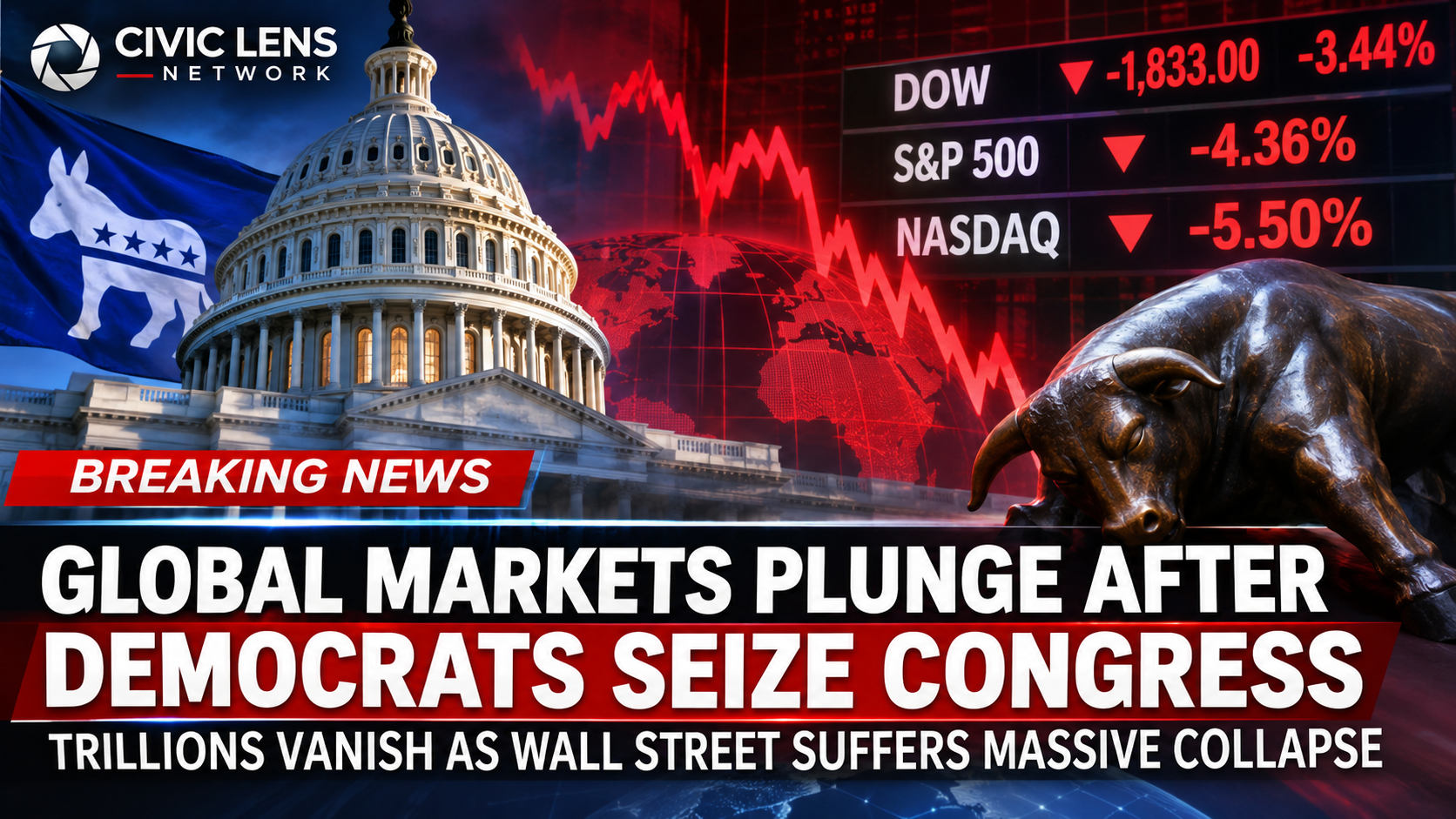
America’s political earthquake has triggered a financial shock wave stretching far beyond Washington, as Democrats’ sweeping victory in the 2026 midterm elections sends investors scrambling and trillions of dollars disappear from the stock market.
What began as a political celebration for Democrats has quickly become a financial nightmare for investors heavily exposed to America’s technology industry.
On Thursday, November 5, Wall Street suffered one of its worst trading sessions in more than a year. The Dow Jones Industrial Average plunged 1,833 points, the Nasdaq Composite collapsed approximately 5.5 percent, and the S&P 500 fell approximately 4.4 percent.
The technology sector was devastated.
Approximately $2.5 trillion in market value vanished from the Nasdaq 100 alone as investors confronted the possibility that newly empowered Democrats could impose restrictions on the artificial intelligence industry, one of the largest engines of American economic growth.
And the damage did not stop at America’s borders.
Financial markets in Asia and Europe also experienced significant selling pressure, raising concerns that America’s political transformation could have consequences for the global economy.
Democrats Win Washington, Wall Street Pays the Price
The connection between the election results and the financial selloff has become a central concern among investors.
Democrats captured control of both chambers of Congress while expanding their influence in state governments across the country.
Their victories included major gains in states that have become critical to the development of artificial intelligence infrastructure.
For technology investors, the results represented more than a change in political leadership.
They raised the possibility of a major change in government policy.
Several Democratic candidates campaigned on restricting or temporarily halting construction of massive data centers, citing electricity costs, water consumption, and concerns from surrounding communities.
Those proposals now carry greater political weight.
The market reaction was swift.
Investors began unloading shares in semiconductor manufacturers, data center operators, electrical equipment suppliers, and other companies whose financial outlooks depend heavily on continued AI infrastructure expansion.
Although markets initially rallied on Wednesday following the election, the optimism disappeared the next day as investors reassessed the implications of Democratic control.
By Thursday’s closing bell, the previous day’s gains had been erased.
Technology Giants Suffer Devastating Losses
Some of America’s most influential technology companies suffered extraordinary losses.
Nvidia, the semiconductor giant that has become one of the biggest beneficiaries of the artificial intelligence boom, lost approximately 9 percent of its market value in a single session.
Advanced Micro Devices plunged more than 17 percent.
SanDisk fell more than 22 percent.
Other technology companies, including Microsoft and Amazon, also experienced declines as selling pressure spread throughout the industry.
The Philadelphia Semiconductor Index collapsed approximately 12 percent, marking one of its most severe single-day declines on record.
The numbers reveal how heavily investors have relied on the expectation that America’s artificial intelligence expansion would continue at an extraordinary pace.
For years, technology companies have committed enormous sums to constructing data centers, purchasing advanced computer chips, expanding electrical infrastructure, and developing increasingly powerful AI systems.
Much of that investment depends on the ability to build new facilities without prolonged regulatory delays.
The Democratic election victories have introduced a new political risk into those calculations.
Investors are now questioning whether the construction projects that helped fuel technology valuations could face restrictions before they are completed.
The Threat to America’s AI Expansion
The United States has spent years positioning itself as the global leader in artificial intelligence.
Technology companies have committed hundreds of billions of dollars to infrastructure intended to support the next generation of computing.
That investment has created opportunities for construction companies, electrical utilities, semiconductor manufacturers, engineers, equipment suppliers, and communities hoping to attract new businesses.
But the political landscape has changed.
Democratic proposals to slow data center construction could directly affect the industry’s growth expectations.
The concern is particularly significant because artificial intelligence investment has become an important source of economic momentum.
If major construction projects are delayed, the financial consequences could extend beyond technology companies.
Equipment orders could slow.
Construction contracts could be postponed.
Energy infrastructure investments could face additional uncertainty.
Companies supplying computer chips, cooling systems, electrical components, and networking equipment could experience weaker demand.
That possibility helps explain why Thursday’s selloff spread across multiple industries rather than remaining confined to a handful of technology stocks.
The issue is no longer simply whether artificial intelligence will continue expanding.
It is whether Washington and newly elected state governments will allow that expansion to proceed at the pace investors previously expected.
Global Markets Feel the Shock
The financial turbulence quickly spread beyond the United States.
Asian markets experienced substantial declines as investors reacted to the American technology selloff.
South Korea’s Kospi fell approximately 5.3 percent during Thursday’s trading, while Japanese stocks also suffered losses.
Taiwanese equities experienced severe weekly pressure, reflecting the region’s enormous exposure to semiconductor manufacturing and technology supply chains.
European markets also declined, although the losses were generally smaller than those experienced by American technology companies.
The international reaction illustrates how deeply interconnected the global economy has become.
American technology companies purchase advanced semiconductors, manufacturing equipment, electrical components, and other products from suppliers around the world.
When investors begin questioning the future of American AI infrastructure spending, the consequences can quickly reach companies thousands of miles away.
A slowdown in American data center development could affect international semiconductor manufacturers, equipment suppliers, energy businesses, and financial institutions.
However, the market declines do not establish that the entire global economy has entered a recession or that every international market is collapsing.
What they demonstrate is that uncertainty surrounding America’s political direction has contributed to a major international financial selloff.
Retirement Accounts and American Investors Face the Fallout
The consequences of a market collapse are not limited to wealthy investors or Wall Street trading firms.
Millions of Americans have retirement savings invested in mutual funds, index funds, pension programs, and employer-sponsored retirement accounts.
Many of those investments hold substantial positions in major technology companies.
When companies such as Nvidia, Microsoft, and other major corporations suffer sharp declines, retirement portfolios with significant exposure to those stocks can lose value.
For Americans already struggling with housing costs, grocery bills, insurance premiums, and other household expenses, sudden financial-market instability adds another source of concern.
A one-day market decline does not necessarily translate into permanent retirement losses.
Nevertheless, the scale of Thursday’s selling demonstrates how quickly political uncertainty can affect household investment balances.
Small businesses could also face consequences if market volatility continues.
Financial uncertainty can make lenders more cautious, discourage corporate investment, and complicate expansion plans.
The danger becomes more serious if falling stock prices develop into a sustained reduction in business investment.
Investors Fear a New Era of Government Restrictions
The financial reaction has also intensified scrutiny of the incoming Democratic Congress.
Democrats will not formally assume control of the new Congress until January 2027, but investors are already adjusting their expectations.
That distinction matters.
The market selloff occurred before the new congressional majority enacted any legislation.
Investors were reacting to what they believe Democratic officials might do once they possess greater political power.
Potential restrictions on data center development have emerged as the most immediate concern.
Additional debates involving corporate taxation, energy policy, federal spending, and regulatory oversight could create further uncertainty as the new Congress prepares to take office.
But those policies have not all been enacted, and their eventual economic consequences will depend on the legislation proposed, the president’s response, and the actions of individual state governments.
President Donald Trump will remain in the White House, creating the possibility of major confrontations between his administration and Democratic lawmakers.
That divided government could complicate efforts to establish a consistent economic policy.
For investors, uncertainty itself can become expensive.
Businesses making multibillion-dollar investment decisions need to know whether projects will receive permits, whether operating costs will increase, and whether government policies will change before construction is completed.
The election has made those questions considerably more difficult to answer.
The AI Boom Was Already Under Pressure
The Democratic victories were a major catalyst for Thursday’s selling, but the artificial intelligence industry was already confronting financial concerns.
Some investors had begun questioning whether technology companies could generate sufficient profits to justify their enormous infrastructure spending.
High borrowing costs, growing corporate debt, and concerns about excessive valuations had also placed pressure on the sector.
The election intensified those fears by introducing the possibility of slower construction and additional government restrictions.
That combination created particularly difficult conditions for companies whose valuations depend on rapid future growth.
The result was a powerful wave of selling that spread through semiconductor stocks, data center operators, utilities, and other businesses tied to artificial intelligence.
The political shift did not create every vulnerability in the technology sector.
But it brought those vulnerabilities into sharper focus at precisely the moment investors were already becoming nervous.
Could the Financial Damage Continue?
The most important question now is whether Thursday’s historic selloff represents a temporary market reaction or the beginning of a more prolonged financial downturn.
The Nasdaq has already entered correction territory, having fallen more than 10 percent from its recent peak.
A correction is not the same as an economic recession, but it reflects a substantial decline in investor confidence.
Further selling could occur if companies begin delaying investment plans or if newly elected officials move aggressively to restrict data center construction.
On the other hand, markets could stabilize if investors conclude that proposed restrictions will be narrower than initially feared.
The outcome will depend partly on the decisions Democratic leaders make over the coming weeks and months.
Investors will be watching for concrete legislative proposals, regulatory announcements, changes in corporate spending, and signs that major infrastructure projects are being delayed.
The Political Victory That Shook Financial Markets
Democrats entered election night promising political change.
They emerged with control of Congress and a stronger position in state governments.
Within days, investors were confronting one of the most severe technology-driven market selloffs in recent memory.
The numbers tell a dramatic story.
The Dow lost more than 1,800 points.
The Nasdaq plunged approximately 5.5 percent.
The S&P 500 suffered its worst session since April 2025.
Trillions of dollars in market value disappeared, and financial pressure spread across international markets.
The immediate market reaction was driven in significant part by fears that Democrats would restrict the AI infrastructure expansion that has supported American technology growth.
Whether those fears ultimately prove justified remains to be seen.
But the financial consequences of the election are already visible.
For the incoming Democratic majority, the challenge will be balancing promises of greater oversight with the economic importance of continued private investment.
For American businesses, investors, and retirement savers, the question is whether the new political environment will support economic expansion or create additional obstacles.
And for global financial markets, the message from Wall Street has been unmistakable.
A political shift in Washington can trigger financial consequences far beyond America’s borders.
The Democrats have won control of Congress.
Now the markets are demanding answers about what that victory will mean for the economy.