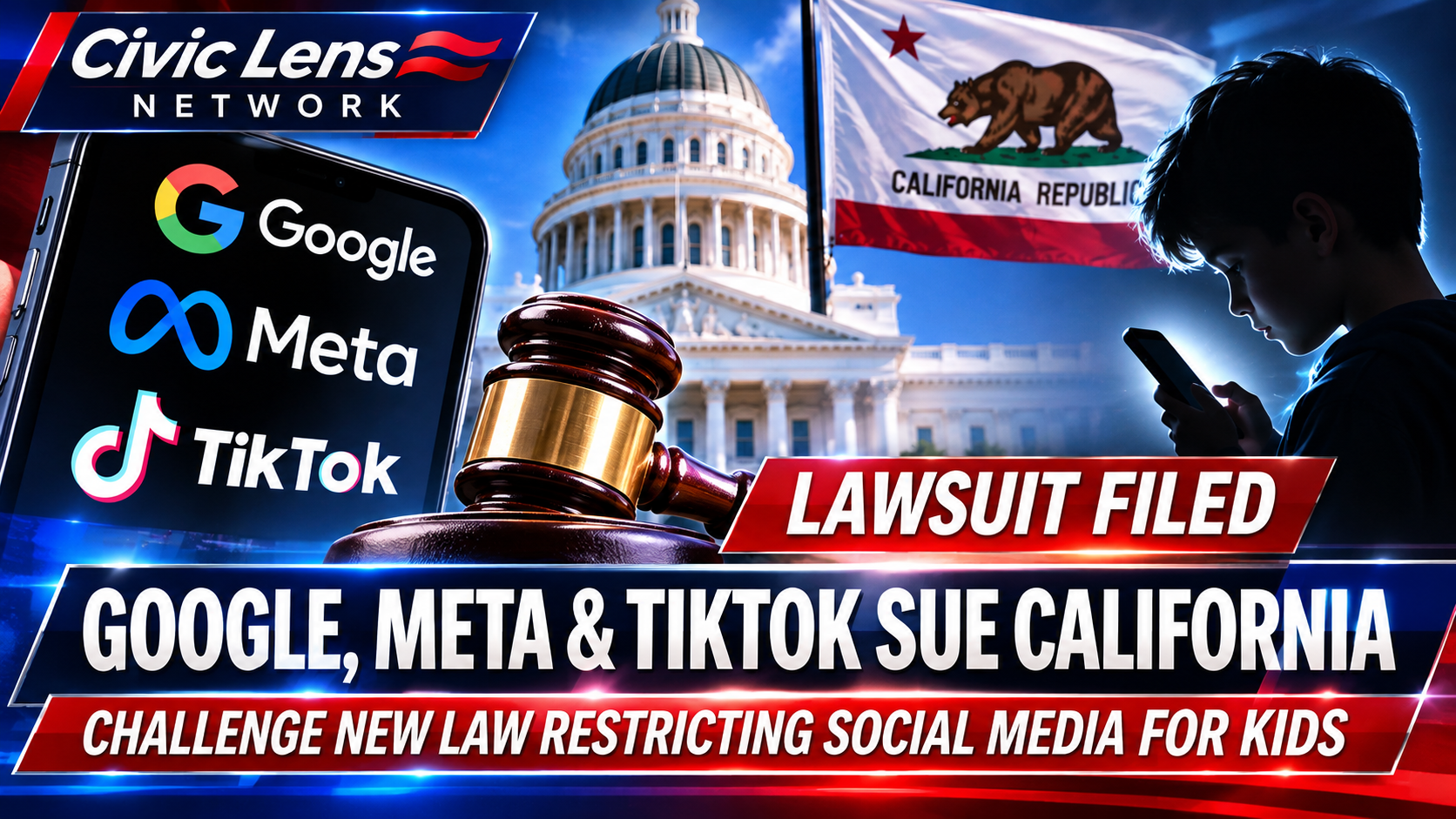
Three of the world’s most powerful technology companies have launched a major legal battle against California after state lawmakers approved sweeping restrictions designed to protect children from potentially addictive social media features.
Google, Meta and TikTok filed separate federal lawsuits on November 4, 2026, seeking to block Assembly Bill 1709, a law that would prohibit certain social media features for children younger than 16.
The legislation targets personalized recommendation feeds, endless scrolling and automatic video playback, features that have become central to how major technology platforms attract and retain users.
The lawsuits raise a fundamental question about the future of the internet: Should technology corporations have the constitutional right to use engagement-driven algorithms on children, or should elected governments have the authority to restrict those features?
California Takes Aim at Social Media Addiction
California Governor Gavin Newsom signed Assembly Bill 1709 into law on September 10, 2026.
The legislation is scheduled to take effect January 1, 2027, unless federal courts intervene.
Under the law, covered social media companies would be prohibited from providing certain addictive features to users younger than 16.
Those restrictions include personalized feeds that use information about individual users to determine what content appears, automatic video playback and features designed to encourage continuous scrolling.
Platforms would also be required to implement reasonable age-verification measures.
Companies that continue providing restricted features to underage users could face significant penalties. The legislation also contains account-deletion requirements when platforms fail to remove prohibited features.
The objective is to reduce children’s exposure to platform designs that critics argue encourage excessive screen time and compulsive engagement.
But three of the world’s largest technology corporations are now asking federal judges to stop the law before it takes effect.
Google, Meta and TikTok Fight Back
Google, which owns YouTube, filed its lawsuit in federal court in San Jose.
Meta, the parent company of Facebook and Instagram, filed its challenge in San Francisco.
TikTok filed its lawsuit in Los Angeles.
All three companies named California Attorney General Rob Bonta as the defendant.
Their legal challenges rely heavily on the First Amendment and Section 230 of the Communications Decency Act.
The companies argue that decisions about how online content is organized, recommended and displayed qualify for constitutional protection.
Meta maintains that California cannot dictate how it organizes and distributes billions of posts.
Google argues that personalized recommendations help younger users discover relevant, age-appropriate educational and entertainment content.
TikTok contends that the government cannot suppress otherwise lawful expression simply because lawmakers believe particular content might be unsuitable for younger audiences.
The companies also argue that the law interferes with parents’ ability to make decisions about their children’s online activities.
Those arguments now face a major legal test.
The Business Model Behind Endless Scrolling
The controversy extends beyond constitutional law.
Social media platforms operate in an intensely competitive environment where user attention is one of their most valuable commercial resources.
Personalized recommendations determine which videos, photographs and posts appear on individual screens.
Autoplay removes the need for users to manually select the next video.
Infinite scrolling allows content to continue appearing without a natural stopping point.
Together, these features can encourage prolonged engagement.
That engagement creates opportunities for advertising revenue, data collection and continued platform growth.
Critics argue that companies have powerful financial incentives to maximize the amount of time users spend on their services, even when those users are children.
The California legislation directly challenges those design practices.
If courts uphold the restrictions, technology companies could be forced to significantly change how their platforms operate for younger users in the nation’s most populous state.
Other states could potentially pursue similar legislation.
For companies whose businesses depend heavily on personalized recommendations and user engagement, the consequences could extend well beyond California.
Meta Already Faces Billions in Child Safety Settlements
The lawsuits arrive during a period of intense legal scrutiny over the effects of social media on younger users.
In August 2026, Meta agreed to a landmark settlement worth up to approximately $18 billion involving claims brought by numerous states over the effects of its platforms on children and teenagers.
The agreement included additional youth safety measures affecting Facebook and Instagram.
TikTok also reached a settlement with Alabama in September concerning allegations involving addictive platform features.
These settlements illustrate the growing legal and financial pressure facing major social media companies.
However, settlements do not automatically establish that every allegation against the companies was proven in court.
Thousands of other lawsuits involving social media companies, schools, families and government entities have also raised questions about platform design and the mental health of younger users.
The central concern is whether technology companies knowingly developed systems that encourage excessive engagement while failing to adequately protect vulnerable users.
California’s new law attempts to address those concerns by regulating the features themselves rather than waiting for individual cases of alleged harm.
A Growing Battle Over Parental Authority
One of the most controversial aspects of the dispute involves parental rights.
Google, Meta and TikTok argue that parents should determine which online services and features their children can access.
Google maintains that existing parental controls and youth safety tools provide families with ways to manage their children’s online experiences.
Meta similarly argues that the legislation could restrict access to online communities and communication tools used by teenagers.
But the companies’ position raises another question.
If parents are ultimately responsible for protecting their children, should technology corporations be permitted to design engagement systems that parents may struggle to understand or control?
Supporters of the California law believe parents should not have to compete against sophisticated recommendation systems specifically engineered to maximize user attention.
At the same time, civil liberties advocates have raised legitimate concerns about government restrictions.
The Electronic Frontier Foundation has criticized the legislation, warning that broad age-verification requirements could undermine online privacy and anonymous speech.
Those concerns create an additional challenge for lawmakers attempting to regulate social media without expanding government surveillance or restricting lawful expression.
California Promises to Defend the Law
California Attorney General Rob Bonta’s office confirmed that it was reviewing the lawsuits and remained committed to defending the state’s child protection legislation.
The legal fight could establish important precedents regarding how far state governments can go when regulating social media platform design.
Federal judges will have to consider whether restrictions on personalized recommendations and autoplay constitute permissible consumer protection regulations or unconstitutional interference with protected expression.
They will also examine whether federal law limits California’s authority to impose these requirements.
As of November 6, the new challenges have not produced a final court ruling.
The legislation remains scheduled to take effect January 1, 2027.
A Fight That Could Reshape Social Media Across America
The outcome could have consequences far beyond California.
If the state successfully defends Assembly Bill 1709, other legislatures may see an opportunity to impose similar restrictions on technology companies operating within their borders.
That could lead to a nationwide shift in how social media platforms serve younger audiences.
If the companies prevail, the decision could limit future attempts by state governments to regulate algorithms, recommendation systems and other engagement-focused platform features.
The dispute also exposes a growing conflict between three powerful interests: corporate freedom, government authority and parental control.
Technology companies argue that their constitutional rights and existing safety systems must be respected.
California argues that protecting children justifies restrictions on potentially harmful platform features.
Privacy advocates warn that even well-intentioned legislation can create new problems when governments require companies to verify the identities and ages of internet users.
Ultimately, the courts must determine where the constitutional boundaries lie.
For American families, however, the larger issue is unlikely to disappear.
As children spend increasing portions of their lives online, the debate over who controls the digital environment surrounding them is becoming one of the most consequential technology policy battles in the country.
And with Google, Meta and TikTok now challenging California in federal court, that battle has entered a decisive new phase.