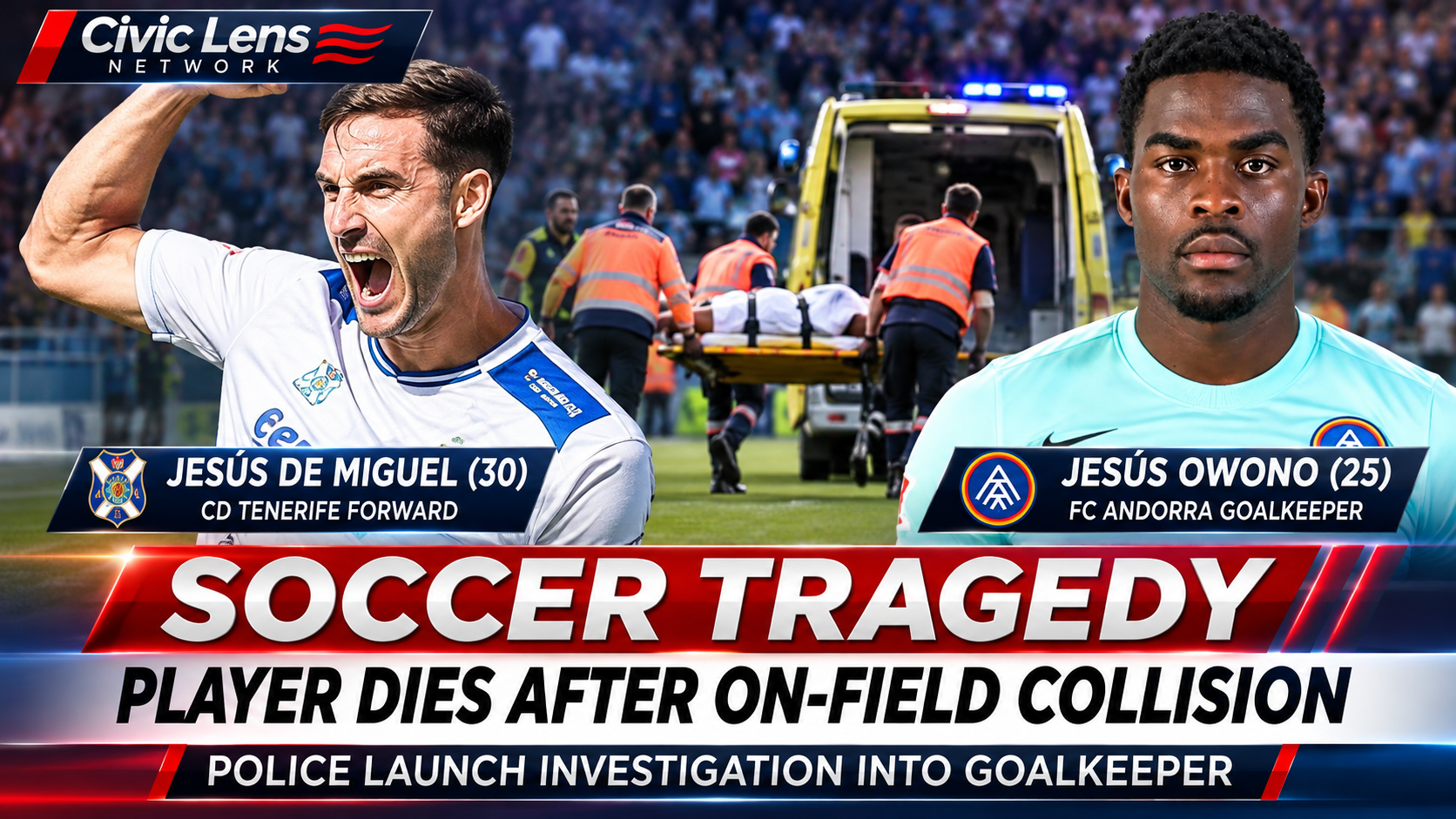
A professional soccer match in Spain has ended in unimaginable tragedy after a 30-year-old striker died following a violent collision with an opposing goalkeeper, triggering a police investigation into possible involuntary manslaughter and raising serious questions about accountability, player safety, and the consequences of dangerous challenges on the field.
Jesús de Miguel, a forward for Spanish second-division club CD Tenerife, died on November 3, 2026, after suffering a devastating collision with FC Andorra goalkeeper Jesús Owono during the final moments of a league match.
What began as a competitive sporting event quickly became a medical emergency. Within hours, a professional athlete had lost his life, two soccer clubs were grieving, and Spanish authorities were examining whether the incident could carry criminal consequences.
A Violent Collision in the Final Minutes
The incident occurred on November 2 at the Estadio Heliodoro Rodríguez López in Santa Cruz de Tenerife.
The match between Tenerife and Andorra was tied 2-2 when the confrontation unfolded during the sixth minute of added time.
Goalkeeper Jesús Owono, 25, rushed far outside his penalty area toward the halfway line to challenge for a loose ball.
De Miguel was also pursuing the ball when the two players collided.
According to the referee’s official report, Owono struck his opponent with excessive force while his leg was raised and the ball was being contested.
The impact left De Miguel critically injured.
The referee immediately issued Owono a straight red card, but the disciplinary decision quickly became secondary to the unfolding medical emergency.
De Miguel collapsed on the field as medical personnel rushed to assist him.
Player Suffers Cardiac Arrest
The situation deteriorated rapidly when De Miguel suffered cardiac arrest following the collision.
Emergency medical personnel performed resuscitation procedures, eventually restoring his pulse.
He was transported to Hospital Universitario Nuestra Señora de Candelaria, where doctors fought to save his life.
Initially, Tenerife reported that the striker was stable despite the seriousness of his condition.
However, subsequent updates revealed that his neurological condition had deteriorated.
On Tuesday morning, November 3, the club announced that De Miguel had died.
The precise medical cause of death has not been publicly disclosed.
De Miguel leaves behind his wife and young daughter.
The devastating announcement sent shock waves throughout Spanish soccer and the international sporting community.
Police Open Investigation Into Possible Involuntary Manslaughter
The tragedy took an extraordinary turn when Spain’s National Police opened an investigation into the circumstances surrounding De Miguel’s death.
The investigation includes the possibility of involuntary manslaughter, a development that immediately raised questions about whether an on-field sporting collision could result in criminal liability.
Under Spanish law, deaths resulting from non-natural causes, including accidents, require judicial examination.
Authorities must establish exactly what happened, examine the available evidence, and determine whether the incident involved criminal negligence or conduct outside the accepted risks of professional competition.
Investigators are expected to examine match footage, the referee’s official report, and testimony from those involved.
The referee’s description of excessive force could be relevant to sporting disciplinary proceedings, although a red card does not automatically establish criminal wrongdoing.
José Luis Sánchez-Jáuregui, the chief prosecutor in Santa Cruz de Tenerife, has indicated that criminal proceedings are unlikely because the collision occurred during active play.
That distinction could become central to the investigation.
The goalkeeper has not been found criminally responsible for De Miguel’s death, and the opening of a police investigation does not establish guilt.
Could a Soccer Player Face Criminal Charges for an On-Field Collision?
The case has brought renewed attention to an extraordinary legal question.
Where does the accepted physical danger of professional sports end, and where does criminal responsibility begin?
Soccer is a contact sport in which players regularly collide while attempting to control or intercept the ball.
Serious injuries can occur even when neither player intends to hurt the other.
However, sporting regulations also prohibit reckless challenges, excessive force, and conduct that endangers an opponent.
Spanish authorities must distinguish between a tragic sporting accident and behavior that could potentially meet the legal standard for criminal negligence.
The Spanish prosecutor has emphasized the longstanding legal principle that injuries occurring during legitimate sporting competition generally do not result in criminal punishment unless the circumstances justify an exception.
The sporting disciplinary process is separate from the judicial investigation.
Owono could face sanctions from soccer authorities regardless of whether prosecutors ultimately pursue criminal charges.
Goalkeeper Faces Intense Backlash
The aftermath has also been devastating for goalkeeper Jesús Owono.
According to Spanish reporting, the goalkeeper was deeply distressed following the collision and remained concerned about De Miguel’s condition.
FC Andorra officials have maintained that Owono did not intend to injure the Tenerife striker.
Nevertheless, the goalkeeper became the target of intense online criticism, including accusations of murder.
His Instagram account was subsequently deactivated.
The situation escalated further when another soccer player with the surname Owono reported receiving racist abuse after social media users apparently confused him with the goalkeeper involved in the incident.
On November 5, Reuters reported that Jesús Owono had been omitted from Equatorial Guinea’s squad for upcoming Africa Cup of Nations qualifying matches.
The goalkeeper described the aftermath as among the most difficult days of his life.
The tragedy has therefore affected not only De Miguel’s family and teammates but also the opposing player whose challenge preceded his death.
Spanish Soccer Comes Together in Mourning
The reaction across European soccer has been overwhelming.
CD Tenerife declared a period of mourning and suspended team activities following the death.
The club also requested the postponement of its upcoming league fixture.
Fans gathered outside Tenerife’s stadium, leaving flowers, scarves, candles, and messages in memory of the fallen striker.
Tributes arrived from major Spanish clubs, including Real Madrid, Barcelona, and Atlético Madrid.
International soccer organizations and prominent players also expressed condolences.
The Spanish soccer federation postponed several domestic cup fixtures, while UEFA arranged moments of silence at European matches.
Former Barcelona defender Gerard Piqué, who is associated with FC Andorra through his ownership interests, publicly expressed his sorrow.
For De Miguel’s teammates, the loss has been especially difficult.
They entered the stadium expecting to compete in a league match and instead witnessed a medical emergency that ended with the death of a colleague and friend.
Club officials acknowledged that players and their families might require professional psychological support.
A Tragedy That Raises Questions About Player Safety
Beyond the police investigation, the incident has renewed concerns about how professional soccer manages potentially life-threatening collisions.
Goalkeepers frequently leave their penalty areas to challenge attacking players, particularly when opponents are advancing toward goal.
These situations can produce high-speed impacts, with little time for either athlete to react.
Although professional soccer has established disciplinary rules and emergency medical protocols, the death of a player during competition demonstrates that serious risks remain.
Questions surrounding dangerous challenges, emergency response procedures, and the responsibilities of players and officials are likely to remain part of the discussion.
The case also highlights the importance of distinguishing sporting discipline from criminal liability.
A referee can determine that a challenge warrants dismissal, while police and prosecutors must apply a separate and considerably different legal standard.
What Happens Next?
Spanish investigators will continue examining the circumstances surrounding the collision and the medical events that followed.
The relevant sporting authorities must also determine what disciplinary action, if any beyond the red card, should be imposed on Owono.
As of November 6, no criminal responsibility has been established.
For Tenerife supporters, however, the central tragedy is already painfully clear.
A 30-year-old professional athlete, husband, and father has lost his life following an incident that occurred while playing the sport he loved.
The final minutes of an ordinary league match have become the subject of a police investigation and an international conversation about player safety.
And while investigators determine whether any laws were broken, the soccer world is left mourning Jesús de Miguel, whose career and life ended far too soon.