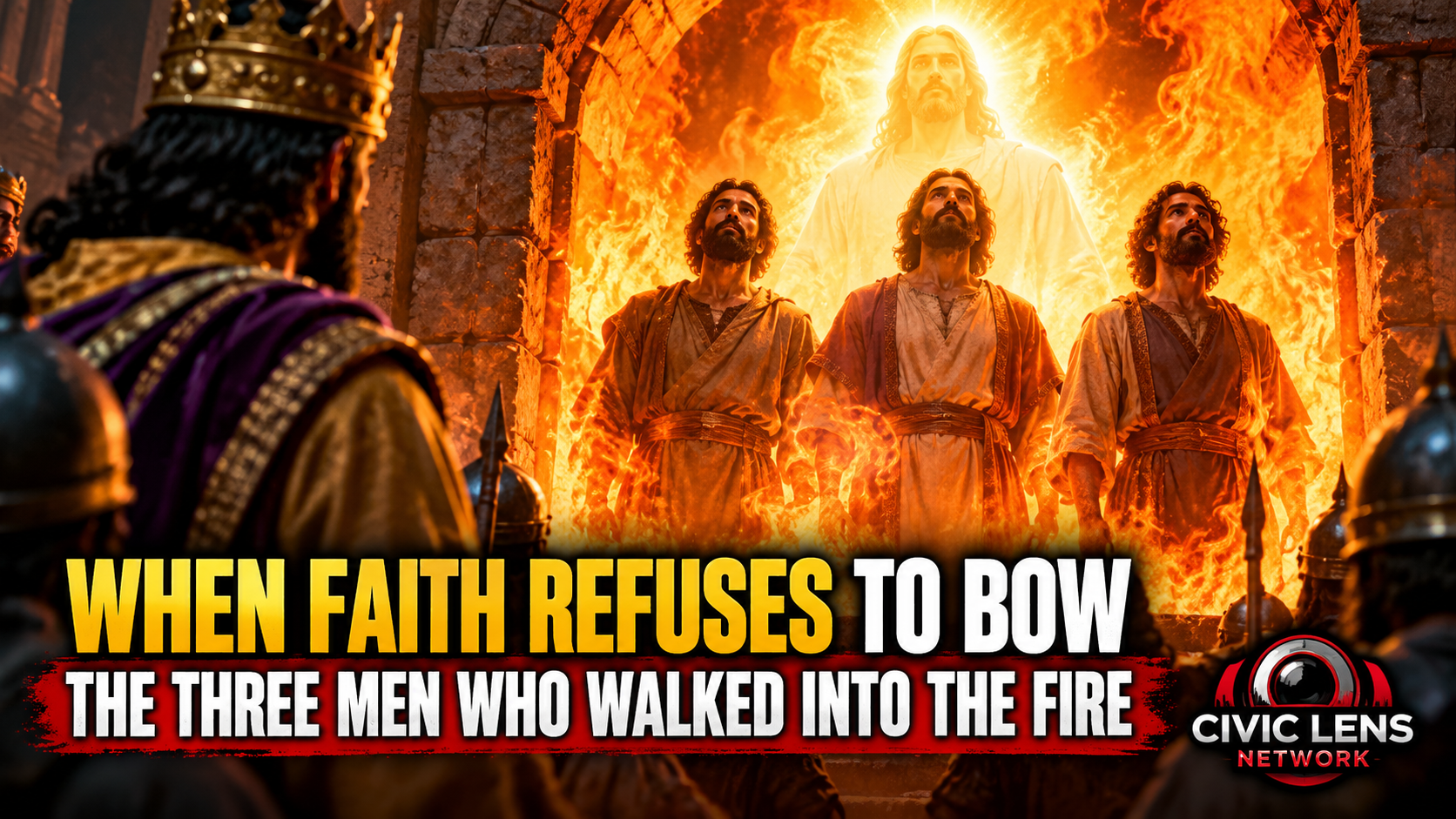
The furnace roared seven times hotter than usual. Flames leaped so fiercely that the soldiers who bound the three men and cast them into the fire were themselves consumed by the heat. Shadrach, Meshach, and Abednego fell bound into the midst of the burning fiery furnace. Moments earlier, they had stood before the most powerful king on earth and refused the one thing he demanded: that they bow to the golden image he had set up on the plain of Dura.
Death by fire was the penalty. They chose the flames. Their answer still echoes across centuries. “If it be so, our God whom we serve is able to deliver us from the burning fiery furnace, and he will deliver us out of thine hand, O king.
But if not, be it known unto thee, O king, that we will not serve thy gods, nor worship the golden image which thou hast set up” (Daniel 3:17-18). They believed God could rescue them. They also made plain that their obedience did not depend on the rescue. Even if He did not deliver them, they would not bow.
This is the story Scripture records in Daniel 3. Nebuchadnezzar had erected an enormous golden image and decreed that all peoples, nations, and languages must fall down and worship it when the music sounded. Refusal meant the furnace. Certain Chaldeans accused the three Jewish officials who had been set over the affairs of Babylon.
They would not serve the king’s gods or worship the image. Brought before Nebuchadnezzar, they offered no elaborate defense. They simply declared the truth of their allegiance. The king’s fury burned hotter than the furnace he ordered prepared.
The three men were bound and thrown in. The soldiers who carried them perished from the heat. Yet when the king looked, he saw not three bound men but four men loose, walking in the midst of the fire, unharmed. “The form of the fourth is like the Son of God” (Daniel 3:25).
He called them forth. The fire had no power on their bodies; not a hair of their heads was singed, their coats were unchanged, and the smell of fire had not passed on them. Nebuchadnezzar then blessed the God who “hath sent his angel, and delivered his servants that trusted in him” (Daniel 3:28). These three men refused to compromise because they served the living God who had revealed Himself to Israel.
They were not careful to answer the king in this matter; the issue was already settled in their hearts. Worship belongs to God alone. The golden image demanded what they could not give. Their refusal was not political rebellion or cultural stubbornness.
It was loyalty to the God who had brought their people out of Egypt, preserved them through exile, and forbidden idols. Facing execution, they still would not serve other gods or bow. The power of their declaration lies in the “but if not.” They affirmed God’s ability and His willingness to deliver.
Then they set their obedience above any outcome. Many people will follow God when the path is safe or the results look promising. These men committed themselves to obedience even if the fire became their end. Scripture does not record them bargaining, hedging, or waiting for a sign.
They knew God could act. They also knew that His action did not determine whether they would obey. That willingness to yield their bodies rather than worship any other god is precisely what the king later acknowledged. Genuine faith trusts God’s character and commands whether or not the circumstances turn favorable.
Faith that collapses when rescue is uncertain is something else entirely. It is conditional loyalty dressed as devotion. Scripture is careful about the fourth figure. The king saw four men walking loose in the fire, unharmed, and described the form of the fourth as like the Son of God.
Later he attributed the deliverance to the God of the three men who had sent His angel. The text reports both statements. Christian readers through the centuries have often seen in this presence a manifestation of the divine, sometimes identifying the figure with the pre-incarnate Christ who walks with His people in the fire. Others understand the king’s words as pointing to a heavenly messenger sent by God.
What the account itself establishes is that God was present with them in the furnace. The fire that killed the executioners had no power over those who trusted Him. They walked free while bound men died outside. Their courage draws a sharp line between authentic faith and faith that depends on favorable circumstances.
The three men did not say they would serve God only if He delivered them. They said He is able, He will deliver them out of the king’s hand, and even if not, they still would not bow. Many today measure God’s goodness by whether He removes the threat, restores the job, heals the illness, or silences the opposition. When the outcome remains uncertain or turns painful, that kind of faith falters.
The furnace reveals a different kind of trust: obedience that stands even when the heat rises and the end is not yet clear. It is the same trust that later carried Daniel into the lions’ den and that has sustained believers facing every form of pressure. Christians today face different furnaces. Cultural expectations, professional risks, family pressure, and public hostility can demand a quiet bow to what Scripture forbids.
The temptation is rarely a golden statue and a literal fire. It is more often the request to soften a conviction, stay silent on a biblical truth, or adjust language so that no one is offended. The three men show that the issue is not whether the pressure is life-threatening. The issue is whether allegiance to God remains absolute when the cost becomes real.
Their example does not promise that every trial will end in spectacular rescue. It does demonstrate that God is able to preserve His people, that He is present with those who refuse to compromise, and that faithfulness itself becomes a witness. The king who once raged against them later declared that no other God could deliver in this way. The three men had yielded their bodies rather than serve or worship any god except their own.
Their refusal, their survival, and the fourth figure in the fire turned a death sentence into a public testimony. Remaining faithful through suffering does not always produce immediate honor or promotion, as it did for these men. It does, however, display the reality of the God who is served. Others see that the believers’ hope is not merely in favorable outcomes but in the God who is worthy of obedience whether the fire is quenched or not.
That kind of testimony cannot be manufactured. It is forged when people choose to stand. The furnace still burns in different forms. The question remains the same.
Will we trust that our God is able, and will we still refuse to bow if He does not remove the heat? Shadrach, Meshach, and Abednego walked into the fire with that settled conviction. They came out unbound, unharmed, and accompanied. Their story does not guarantee every believer the same visible deliverance.
It does assure us that the God they served is still able, still present, and still worthy of undivided loyalty even when the outcome stays uncertain. Faith that refuses to bow is faith that can walk through the fire.