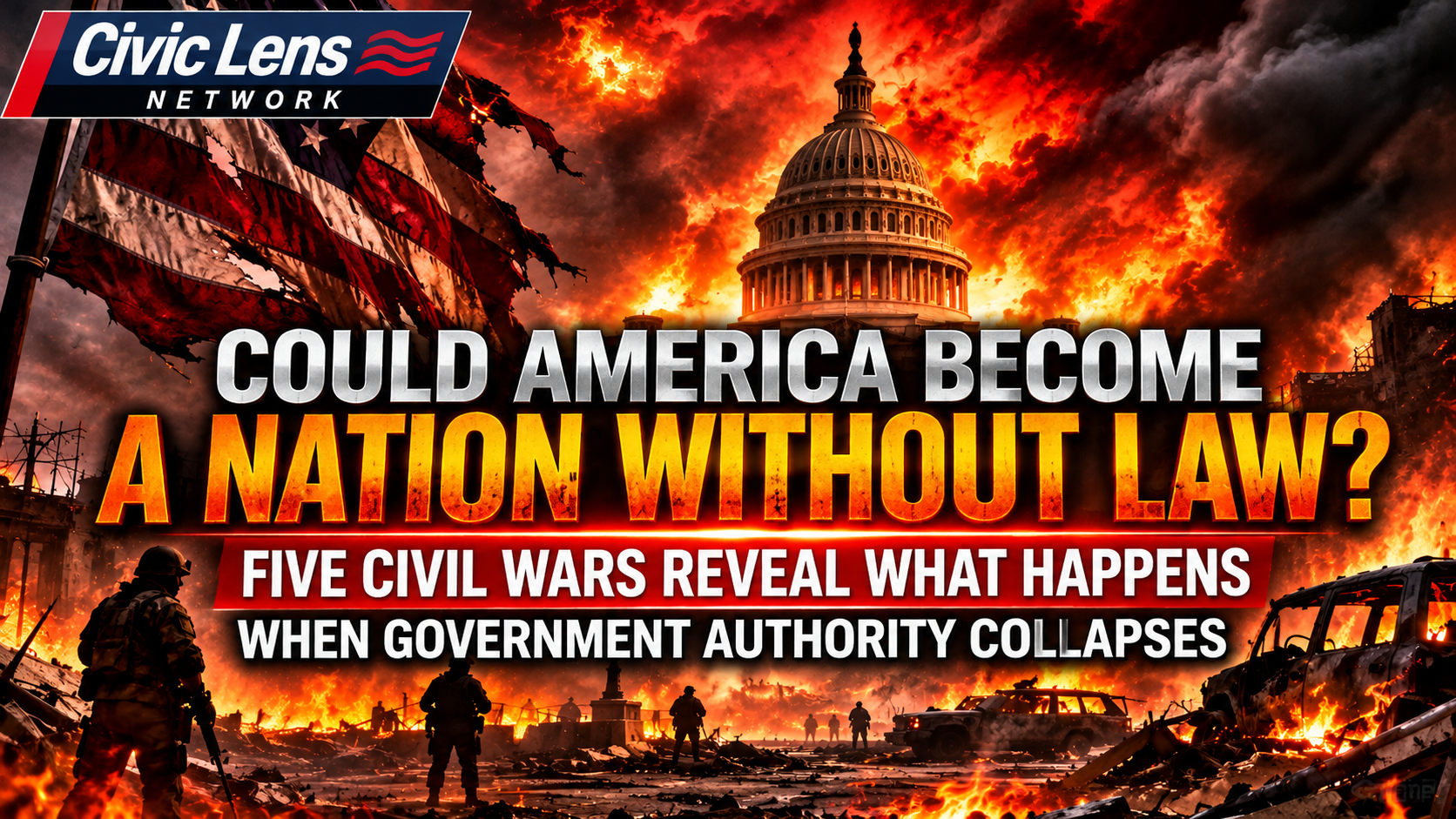
History has repeatedly demonstrated a frightening reality about civil war. When a nation descends into sustained internal conflict, the laws written in its constitution and criminal codes may remain on paper while the institutions responsible for enforcing them begin to disappear.
Police departments can lose control of entire communities. Courts can become inaccessible. Government officials can flee. Armed factions can establish competing authorities, leaving ordinary citizens uncertain about who actually controls the streets.
It has happened in Somalia, Liberia, Sierra Leone, Lebanon, and Syria.
And it raises an uncomfortable question for the United States.
Could America experience a similar collapse of legal authority if political divisions ever escalated into a prolonged civil war?
The historical evidence shows that such breakdowns are possible. But it also reveals something important: civil war does not automatically eliminate the law. The danger emerges when governments lose the ability to enforce it.
Somalia: When the Government Itself Disappeared
Somalia provides one of the clearest modern examples of what happens when national authority collapses.
In 1991, the government of President Siad Barre fell, plunging the country into years of conflict among competing armed factions.
Without an effective central government, national policing and judicial institutions disintegrated. Armed groups exercised control over different territories, and communities increasingly depended on local authorities, customary justice systems, and militia arrangements.
The country’s written laws had not magically vanished. What disappeared was the national government’s ability to enforce them consistently.
For Americans, Somalia illustrates the distinction between having laws and having functioning institutions capable of applying them.
A constitution cannot arrest a criminal. A statute cannot protect a neighborhood without people and institutions willing and able to enforce it.
Liberia: Laws Existed, but Enforcement Collapsed
Liberia’s civil wars, fought between 1989 and 2003, offer another warning.
As rival armed factions fought for territory, the country’s justice system deteriorated. Government authority became fragmented, and civilians frequently found themselves subject to the demands of whichever armed group controlled their community.
The United States Department of State documented how constitutional protections and criminal laws remained formally in place even while meaningful enforcement broke down.
This distinction is essential.
A government can still claim legal authority while lacking the practical ability to exercise it.
Imagine an American county where police officers could no longer respond safely, prosecutors could not bring cases, and judges could not hold hearings because armed conflict had made their work impossible.
The laws would still exist. Their enforcement could nevertheless become severely compromised.
That is the danger Liberia’s history demonstrates.
Sierra Leone: When Constitutional Government Was Suspended
Sierra Leone experienced a devastating civil war from 1991 to 2002.
In 1997, a military junta seized power and suspended constitutional government. Political parties were banned, and the country’s legal institutions suffered further disruption.
Judges, lawyers, and police officers fled during the upheaval. The justice system could no longer provide reliable protection to the population.
This example demonstrates that a breakdown in legal authority can involve more than overwhelmed police departments.
It can involve the destruction or suspension of the political and constitutional institutions that establish the rules themselves.
In the United States, the Constitution establishes separate branches of government, an independent federal judiciary, and a division of authority between Washington and the states.
Those arrangements create important safeguards.
But Sierra Leone demonstrates why the survival of constitutional government depends partly on institutions continuing to function during a crisis.
Lebanon: A Country Divided Among Armed Factions
Lebanon’s civil war lasted from 1975 until 1990.
During the conflict, armed militias controlled different neighborhoods and territories. Competing political and military organizations exercised authority over civilian populations, while the central government struggled to maintain control.
The result was not simply a country without rules.
It was a country where different armed organizations could impose different rules depending on the territory they controlled.
That distinction could become particularly important in any hypothetical American conflict.
The United States already has a decentralized system of government, with federal, state, county, and municipal authorities exercising different responsibilities.
Under normal circumstances, these institutions operate within an established constitutional framework.
In a severe internal conflict, however, disputes over authority could become more dangerous if armed groups attempted to replace lawful institutions with their own systems of control.
Lebanon’s experience demonstrates how territorial fragmentation can undermine the idea of a single, consistently enforced national legal order.
Syria: When Different Territories Operated Under Different Laws
The Syrian civil war, which began in 2011, offers another example of competing legal authorities.
As the conflict developed, government forces and different armed organizations controlled separate territories.
Judicial systems and legal protections varied dramatically depending on the controlling authority.
United States government human rights reporting documented how some opposition-controlled areas used local judicial arrangements, religious courts, or other governing systems that differed from those operating elsewhere in the country.
In some territories, civilians faced arbitrary detention, unfair proceedings, and punishment without meaningful legal safeguards.
Syria demonstrates that a country can retain an internationally recognized government while large areas operate outside its effective legal control.
The lesson for America is not that the same outcome is inevitable.
It is that prolonged armed conflict can fracture the institutions that normally guarantee consistent legal protections.
Could the Same Thing Happen in the United States?
America is not Somalia, Liberia, Sierra Leone, Lebanon, or Syria.
It has a long-established constitutional system, extensive law enforcement institutions, independent courts, state governments, and a professional military operating under civilian authority.
These differences matter enormously.
Nevertheless, American institutions are not immune to the pressures that have damaged governments elsewhere.
Princeton University’s Bridging Divides Initiative reported in April 2026 that political violence risks had increased during 2025, including threats against public officials and concerns about escalating confrontation.
The Council on Foreign Relations also identified growing political violence and unrest in the United States as a significant contingency in its 2026 conflict assessment.
Neither finding establishes that an American civil war is imminent.
But both demonstrate that political violence and institutional stability are legitimate subjects of national security research.
The most serious danger would emerge if isolated violence escalated into sustained, organized armed conflict and government institutions began losing effective control over territory.
At that point, the problem would extend far beyond ordinary political disagreement.
What Happens When Police and Courts Can No Longer Function?
Consider the consequences of a prolonged conflict that severely disrupted government operations across several American regions.
Police departments might struggle to respond to emergencies. Courts could suspend proceedings because of security threats. Witnesses might refuse to testify. Prosecutors could have difficulty obtaining evidence or securing defendants.
Businesses might close, transportation could be interrupted, and public services could deteriorate.
Residents could face growing uncertainty about whether lawful authorities could protect their homes and communities.
These are hypothetical possibilities, not descriptions of present conditions across the United States.
But similar institutional failures have been documented in countries devastated by civil war.
The crucial threshold would not simply be widespread anger or protests.
It would be the sustained inability of legitimate institutions to maintain public order and administer justice.
Would the Constitution Still Matter?
Yes.
Even during a civil war, the United States Constitution and federal and state laws would not automatically cease to exist.
An armed conflict would not, by itself, legally abolish constitutional protections or grant individuals unlimited authority to use violence.
International humanitarian law would also apply if hostilities reached the legal threshold of a non-international armed conflict.
The International Committee of the Red Cross explains that organized armed groups and government forces remain subject to legal obligations during such conflicts, including protections for civilians and people no longer participating in hostilities.
However, the practical ability to enforce legal protections could become severely limited in areas where government authority had collapsed.
That is precisely what makes the historical examples so significant.
A law can remain legally valid while becoming nearly impossible to enforce.
America’s Greatest Protection Is Institutional Continuity
The United States has already experienced one civil war, from 1861 to 1865.
That conflict demonstrated the enormous consequences of divided national authority, while also showing that legal institutions can continue operating in territory controlled by an established government.
Modern America possesses additional communications, emergency management, and law enforcement capabilities that distinguish it from many historical cases of state collapse.
Those systems provide substantial resilience.
But their effectiveness ultimately depends on public cooperation, constitutional legitimacy, professional security institutions, and the continued operation of government.
The five international examples reveal that once armed factions begin replacing legitimate authorities, restoring a functioning legal system can take years or decades.
The Final Warning: Laws Are Only as Effective as the Institutions Behind Them
Somalia demonstrated how national authority can collapse.
Liberia showed how written legal protections can become practically unenforceable.
Sierra Leone revealed how constitutional government and judicial institutions can be suspended or destroyed.
Lebanon illustrated the dangers of competing armed authorities controlling separate territories.
Syria demonstrated how civilians can become subject to entirely different justice systems within the same country.
Together, these cases establish a historical reality that Americans should understand.
Civil war is not merely a confrontation between opposing political factions. It can become a struggle over whether the institutions of government retain the authority and capacity to enforce the law.
The United States possesses powerful constitutional and institutional safeguards, and there is no evidence that nationwide legal collapse is inevitable.
But history offers no guarantee that any nation’s institutions will remain effective under every possible circumstance.
The most dangerous moment for a country is not necessarily when its laws are repealed. It is when those laws remain written on paper, but the institutions responsible for enforcing them can no longer do so.
That is the warning history offers America.