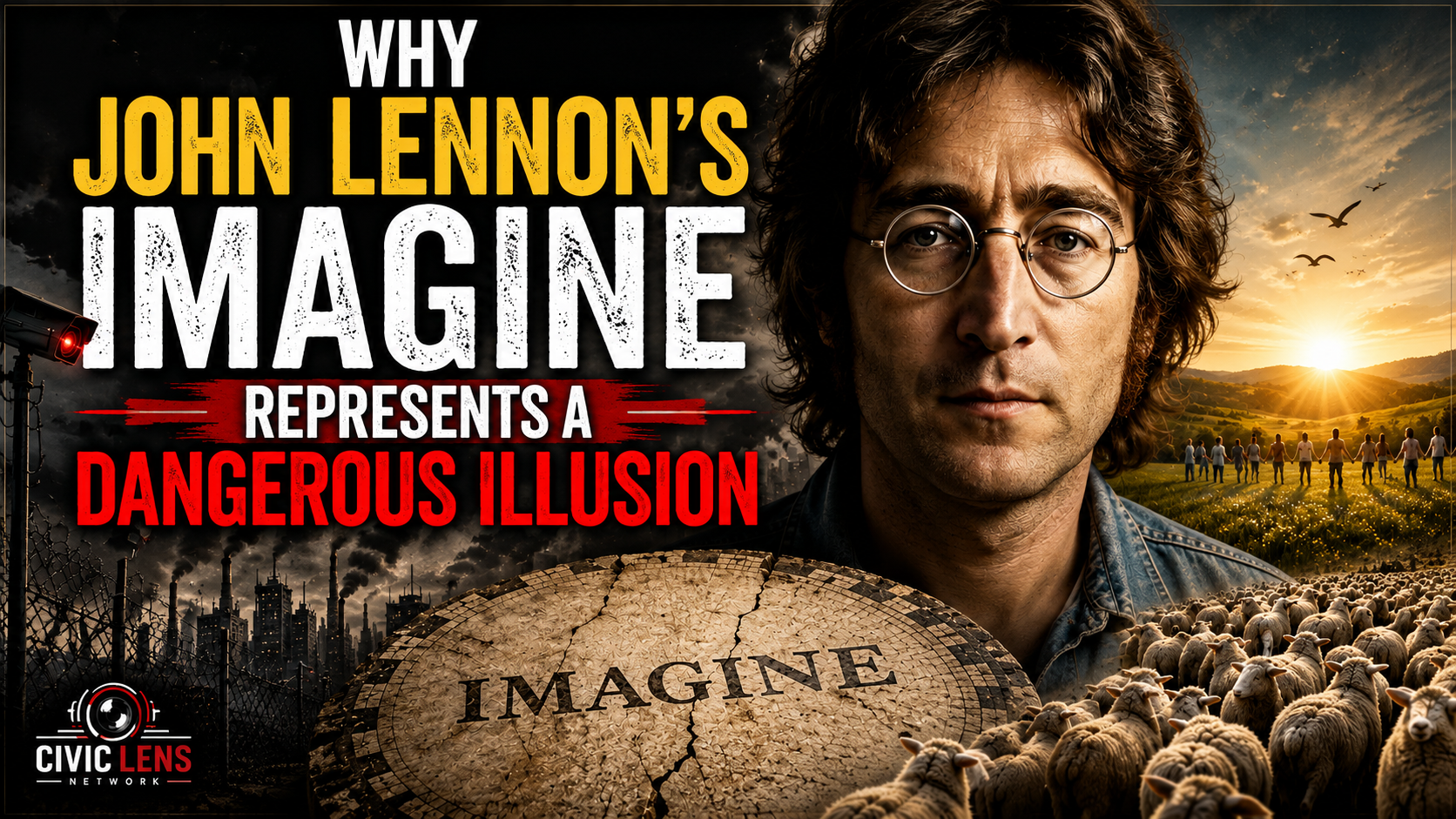
John Lennons song Imagine has enjoyed decades of praise as an anthem for peace and brotherhood. The 1971 track invites listeners to picture a borderless world free of religion and private ownership where everyone shares everything and lives as one. The melody soothes and the lyrics sound noble on the surface. Yet those same ideas collapse under real world scrutiny.
A perspective that values proven traditions national strength personal responsibility and ordered liberty sees the vision as a recipe for decline rather than harmony. Consider first the call for no countries. Nations form because people share language history customs and mutual obligations. Borders allow a people to govern themselves protect their security and preserve the culture that sustains them.
Remove those lines and the result is not instant brotherhood but competition for scarce resources and rising disorder. Countries that have loosened controls on entry have watched social trust erode public services strain and parallel communities form that reject the host societys norms. Strong sovereign nations such as the United States at its best have delivered prosperity and safety precisely because they decide who enters and on what terms. Dissolving that authority does not end conflict.
It simply hands power to the strongest or most aggressive groups while ordinary citizens lose the ability to shape their own future. The dismissal of religion fares no better. Lennon treats faith as a source of division that must vanish for peace to arrive. In truth religion has supplied the moral framework that undergirds much of Western achievement.
Belief in a higher authority beyond the state encourages personal conscience charity and limits on government power. The American founding drew from those roots to affirm rights that no ruler may revoke. When faith recedes societies often replace it with secular ideologies that demand total loyalty. Twentieth century experiments that suppressed churches and temples produced surveillance states mass graves and cults of personality.
Voluntary religious communities still build families schools and mutual aid networks that no bureaucracy can match. Erasing them leaves a vacuum filled by coercion rather than genuine goodwill. Most destructive is the dream of no possessions. Sharing all the world sounds generous until one examines the record of systems that tried it.
Private ownership ties effort to reward. A person who can keep the fruit of labor has reason to innovate save and improve. When property belongs to everyone in theory it belongs to the political class in practice. Production falls incentives vanish and shortages become permanent.
The Soviet experiment China under collectivization and more recent cases in Latin America all followed the same path from lofty rhetoric to empty shelves and secret police. Market economies grounded in secure property rights have raised living standards for billions by harnessing self interest for broader gain. A world without possessions is not one of abundance. It is one of enforced equality in poverty where a new elite still lives well while the rest wait in line.
The final plea to live as one overlooks human variety. People differ in talents ambitions and moral priorities. Forcing uniformity requires constant pressure and punishment of dissent. Lasting order arises instead from clear laws that protect life liberty and property while allowing individuals to pursue their own paths.
Societies that respect those boundaries generate the wealth and stability that make voluntary cooperation possible. Utopian unity has repeatedly required gulags and walls not open arms. Supporters often reply that the song is merely a dream not a policy manual. Cultural messages shape expectations nonetheless.
Generations raised on the idea that borders faith and ownership are the root of all evil become more receptive to policies that weaken each of those pillars. The practical fruits appear in strained public finances declining social cohesion and rising calls for central control. A sounder approach builds on what has worked. Secure borders defend the common good.
Faith traditions cultivate virtue and restraint. Private property fuels the innovation that lifts people out of want. These are not obstacles to peace. They are its necessary foundations.
Imagine therefore does not point toward a better future. It romanticizes conditions that history shows produce scarcity conflict and loss of freedom. Better to defend the institutions that have delivered real progress than to chase a vision that dissolves them.