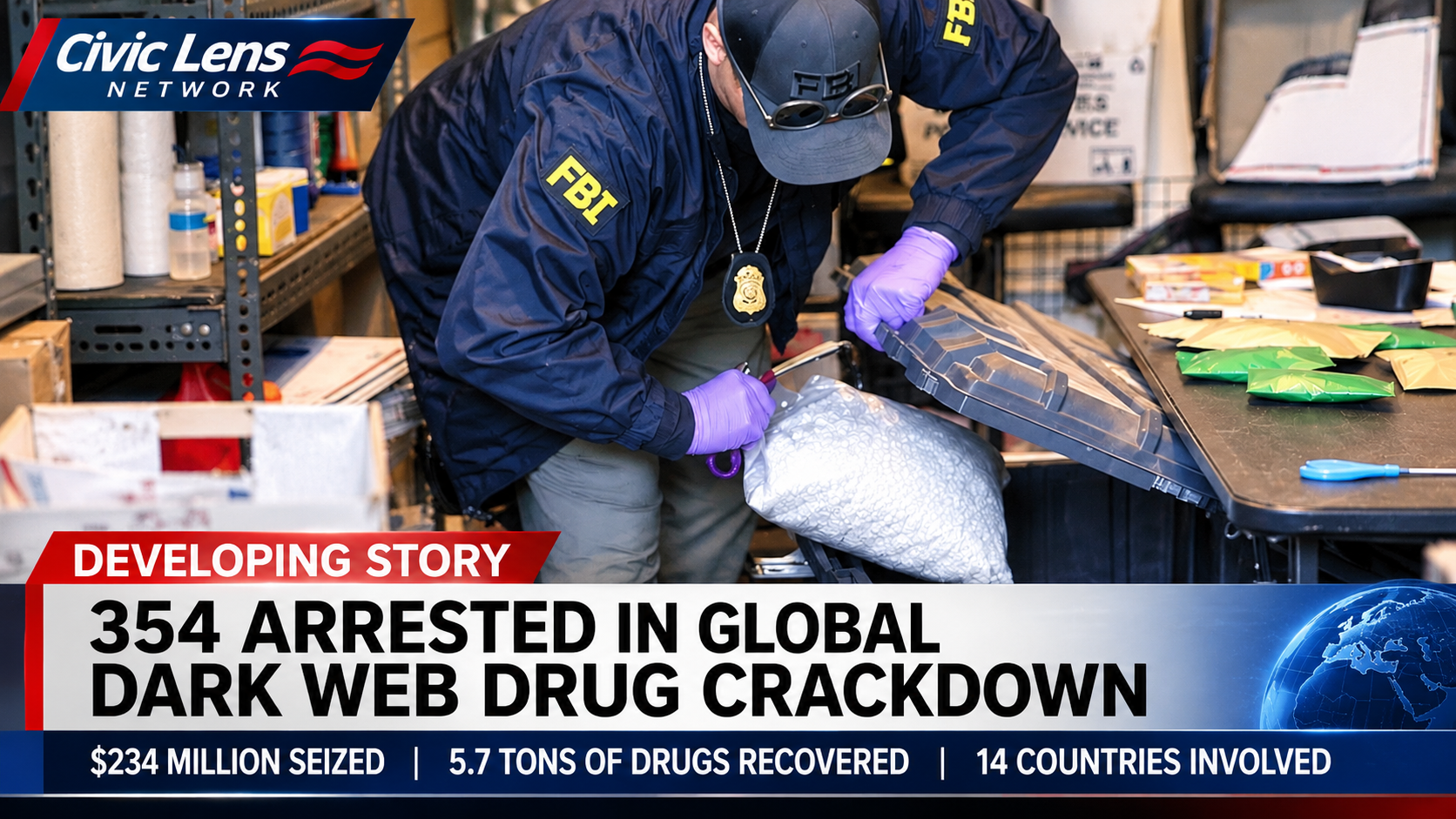
Federal authorities have announced one of the largest international crackdowns on dark web drug trafficking ever conducted, revealing that 354 suspects were arrested worldwide and more than $234 million in cash and cryptocurrency was seized during a sweeping operation targeting online narcotics networks.
The U.S. Department of Justice announced the results of Operation TorNado on November 12, describing it as the most extensive coordinated enforcement action undertaken by the Joint Criminal Opioid and Darknet Enforcement initiative, known as JCODE.
The operation involved law enforcement agencies across 14 countries, with investigators targeting online marketplaces allegedly responsible for distributing fentanyl, heroin, methamphetamine, cocaine, counterfeit prescription medications, and other dangerous substances.
Authorities also seized approximately 5.7 metric tons of illicit drugs, 209 firearms, and 38 pill presses used in illegal drug manufacturing.
The investigation stretched from May 2025 through October 2026, bringing together American federal agencies, Europol, and international law enforcement partners.
Hundreds Arrested Across Multiple Countries
According to the Justice Department, 132 suspects were arrested in the United States.
Another 59 arrests occurred in the United Kingdom, followed by 45 in Hungary, 41 in Germany, and 23 in France.
Additional arrests took place in Australia, Austria, Czechia, Finland, Ireland, the Netherlands, New Zealand, and Slovenia.
Investigators focused on identifying the real individuals operating behind anonymous usernames on dark web marketplaces.
These hidden websites allow users to conceal their identities and conduct transactions using cryptocurrency, making them attractive to criminal organizations seeking to distribute illegal drugs across international borders.
Federal officials say the operation targeted vendors and buyers associated with several notorious marketplaces, including Archetyp, Bohemia, Nemesis, Kingdom, and Tor2Door.
Authorities had previously disrupted several of those platforms, obtaining information that helped investigators identify additional suspects and pursue separate criminal investigations.
The latest operation demonstrates how information recovered from seized criminal marketplaces can continue producing arrests long after the websites themselves have been shut down.
More Than $234 Million Taken From Criminal Networks
One of the most significant results involved the seizure of money and digital assets.
Investigators confiscated more than $234 million in cash and cryptocurrency allegedly connected to illegal activity.
The financial investigation was a central part of the operation.
Dark web drug trafficking organizations frequently rely on digital currencies to receive payments while attempting to conceal their identities and financial transactions.
However, investigators have increasingly developed methods for tracing cryptocurrency transfers, identifying suspicious transactions, and connecting digital wallets to individuals.
IRS Criminal Investigation participated in the operation alongside the FBI, Drug Enforcement Administration, Homeland Security Investigations, and other federal agencies.
Authorities say the financial evidence helped expose networks that believed their online transactions could remain hidden.
The seizures represent a substantial financial blow to the organizations targeted by investigators.
Ohio Investigation Linked to Two Overdose Deaths
Among the American cases highlighted by the Justice Department was an investigation involving a North Carolina man accused of operating an online drug trafficking organization connected to two overdose deaths in southern Ohio.
Alexander Green, 32, of Jacksonville, North Carolina, was arrested in June in connection with an alleged dark web operation known as STARLABS.
Federal prosecutors say the organization distributed illegal narcotics, including fentanyl, through the DrugHub marketplace.
The operation allegedly accepted payments using Monero, a cryptocurrency designed to provide greater transaction privacy.
Investigators linked the organization to two overdose deaths in the Southern District of Ohio.
During the June enforcement action, authorities seized approximately 200 grams of methamphetamine and more than two kilograms of counterfeit pharmaceutical pills containing fentanyl.
Green faces federal charges involving conspiracy to distribute controlled substances and distribution of fentanyl and methamphetamine.
If convicted, he could face up to 20 years in federal prison.
The charges remain allegations, and Green is presumed innocent unless proven guilty.
Brothers Accused of Mailing Dangerous Counterfeit Pills Nationwide
Another investigation involved two brothers arrested in Florida.
Stanislav Chernyshov, 30, a Russian national, and Vladislav Chernyshov, 35, a naturalized American citizen, are accused of operating a dark web vendor account known as BarbaraWhite.
Federal prosecutors allege the brothers manufactured and distributed counterfeit oxycodone pills containing nitazenes.
Nitazenes are powerful synthetic opioids, some of which can equal or exceed the potency of fentanyl.
Investigators say the alleged operation shipped more than 1,000 packages to customers across 49 states.
Authorities connected the operation to multiple fatal and nonfatal overdoses involving recipients of the products.
The brothers have been charged with conspiracy to distribute synthetic opioids in the Eastern District of Virginia.
Each faces a maximum sentence of 20 years if convicted.
The case illustrates a particularly dangerous aspect of the counterfeit prescription drug trade.
Customers purchasing pills advertised as legitimate medications may instead receive substances containing highly potent synthetic opioids.
The resulting uncertainty can create a deadly risk for users who do not know what the pills contain.
California Suspect Accused of Nationwide Drug Distribution
Federal investigators also identified Jonatan Gonzales, 35, of South Bakersfield, California, as the alleged operator of a dark web narcotics account called SpeedyPharma.
Prosecutors say the account distributed methamphetamine, black tar heroin, cocaine, and other illegal substances to customers throughout the United States.
Following a search of his residence, authorities reported seizing 48 pounds of methamphetamine, 588 grams of cocaine, 386 grams of black tar heroin, and smaller quantities of fentanyl and carfentanil.
Investigators also recovered $40,565 in cash.
Gonzales faces a federal charge involving possession with intent to distribute at least 50 grams of methamphetamine.
If convicted, he could face a maximum sentence of life imprisonment.
His criminal responsibility has not been established by a conviction.
International Cooperation Exposes Hidden Drug Markets
Operation TorNado involved extensive cooperation between American and European investigators.
Europol coordinated intelligence sharing and helped national authorities identify suspects whose activities crossed international borders.
Investigators used digital forensic analysis, financial tracing, and information recovered from previously seized marketplaces to connect online accounts to suspected operators.
In Europe, authorities reported seizing approximately 950 kilograms of illicit drugs, 57 firearms, and more than €60 million in cash and cryptocurrency.
American authorities reported seizing more than 4.8 metric tons of drugs, 152 firearms, and approximately $166 million in cash and cryptocurrency.
The international operation also exposed the continuing evolution of online criminal marketplaces.
According to Europol, criminal vendors increasingly operate through smaller specialized websites, private shops, and encrypted messaging platforms rather than relying exclusively on large centralized marketplaces.
That shift creates new investigative challenges because criminal activity can quickly migrate to alternative platforms after enforcement operations.
Federal Officials Promise Continued Crackdowns
Attorney General Todd Blanche described Operation TorNado as a major step toward dismantling international drug trafficking networks.
FBI Director Kash Patel emphasized the scale of the arrests and seizures, while DEA Administrator Terrance Cole pointed to the danger posed by online fentanyl distribution.
Federal officials say the investigation demonstrates that criminals using anonymous accounts and encrypted financial systems can still be identified through coordinated law enforcement operations.
The Justice Department confirmed that additional investigations remain underway as authorities continue working to identify individuals behind dark web vendor accounts.
Federal prosecutions connected to the operation are proceeding across more than 20 judicial districts, including districts in Ohio, Florida, California, Pennsylvania, New Jersey, and other states.
Operation TorNado represents a significant disruption of international online drug trafficking, but authorities acknowledge that the underground marketplace continues to evolve.
The 354 arrests, massive drug seizures, and hundreds of millions of dollars recovered mark a major enforcement achievement.
Whether the operation produces a lasting reduction in online drug trafficking will depend on the prosecutions that follow and investigators’ ability to identify the criminal networks that emerge to replace those dismantled.
For communities affected by fentanyl overdoses and counterfeit prescription drugs, the investigation provides a stark reminder that the consequences of online trafficking extend far beyond the internet.
Behind anonymous usernames and cryptocurrency transactions are real shipments, real criminal investigations, and families facing the devastating consequences of dangerous illegal drugs.