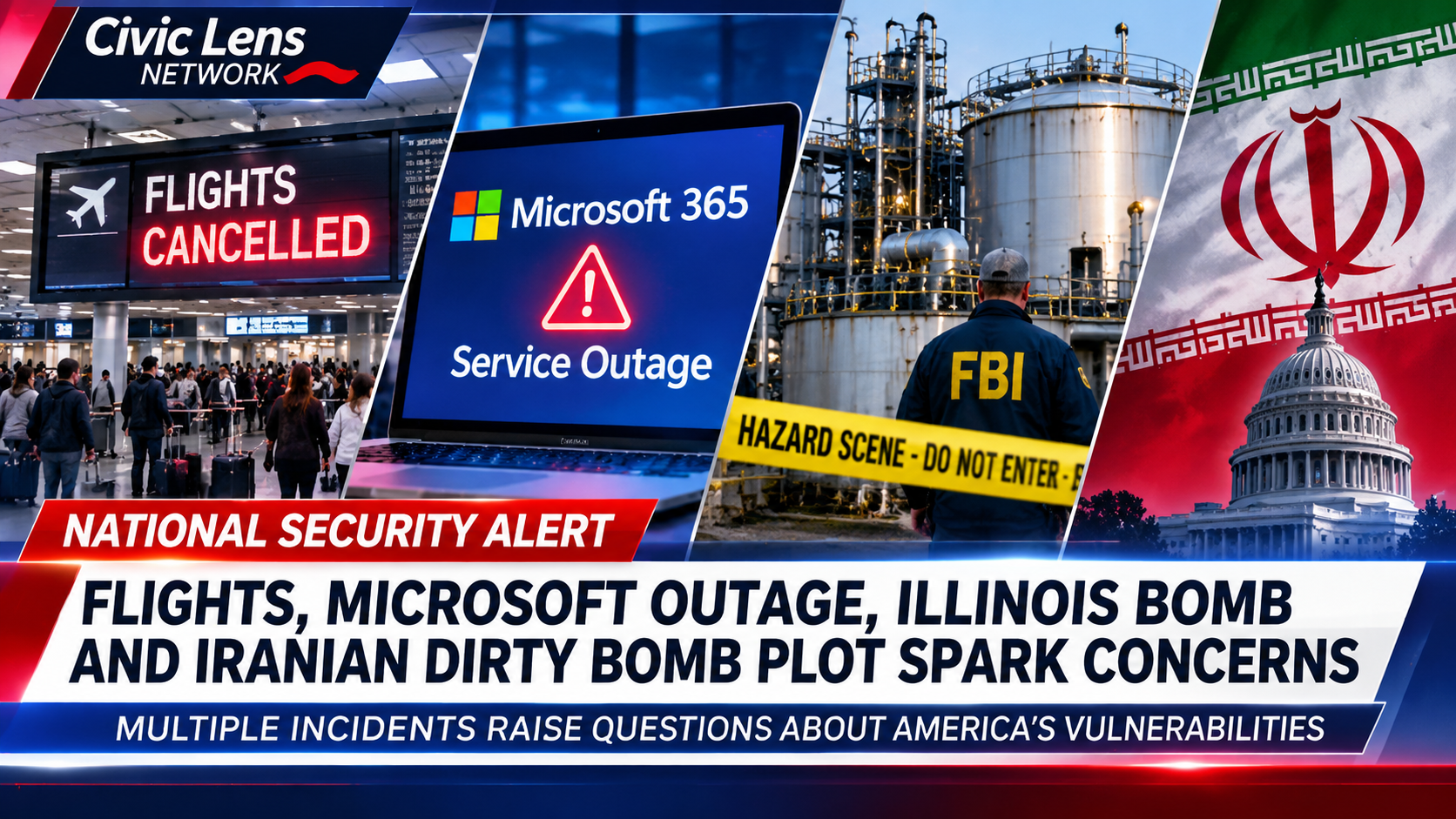
Americans have witnessed a disturbing series of events in recent days: a nationwide aviation shutdown, a massive Microsoft outage, an explosive device discovered at an Illinois industrial facility, and now intelligence reporting that Iran has been developing plans for a possible radioactive or chemical attack in Washington, D.C.
Federal officials insist the major technology failures were accidental and unrelated. Investigators have not established a connection between those disruptions and the separate security threats.
But the timing has raised an uncomfortable question that deserves serious scrutiny: How many critical systems can fail, and how many security threats can emerge, before Americans demand a comprehensive accounting of what is happening?
The concern is not simply whether these incidents were coordinated. It is whether the United States has become dangerously vulnerable to disruptions that can paralyze transportation, interfere with communications, threaten industrial facilities and expose weaknesses in national security.
Nationwide Aviation Shutdown Exposes a Frightening Vulnerability
On November 13, the Federal Aviation Administration ordered a nationwide ground stop after serious technical problems disrupted air traffic control communications and radar information.
The emergency measure lasted more than four hours, leaving thousands of passengers stranded and throwing airline schedules into chaos.
According to the FAA, instability affected 17 of the nation’s 22 Air Route Traffic Control Centers before spreading into additional facilities.
The agency reported approximately 12,462 flight cancellations on November 13, including 9,082 cancellations by major airlines, although it acknowledged that not every cancellation was directly caused by the ground stop.
Federal officials attributed the disruption to excessive network traffic overwhelming aging telecommunications equipment.
The FAA disclosed that its network was receiving approximately 1,000 connection attempts every four to five seconds. Investigators identified possible sources of the excessive traffic at facilities in Amarillo, Texas, and El Dorado, Arkansas.
Contractor L3Harris had been performing equipment work at the Arkansas location, including deploying a new router.
Officials say they found no evidence of a cyberattack or malicious outside interference.
But their explanation raises another serious concern.
If routine equipment work can destabilize air traffic control communications across most of the country, how resilient is America’s aviation infrastructure against an actual coordinated attack?
The FAA says the system was stabilized and flights resumed safely. Its investigation into the underlying failure continues.
Microsoft Outage Adds to the Growing Anxiety
While airlines struggled, another technological disruption was unfolding.
Microsoft 365 experienced widespread service problems affecting Outlook, Teams, Copilot and other services relied upon by businesses, government agencies and millions of ordinary Americans.
The outage began before the nationwide aviation shutdown and continued into the following day, creating an extraordinary period of simultaneous technological disruption.
Microsoft attributed its problems to a network-capacity upgrade issue and reported no indication of malicious cyber activity.
The company said services had been restored by Saturday, November 14.
Federal officials also stated that the Microsoft disruption was unrelated to the FAA emergency.
That distinction matters. There is currently no verified evidence establishing a coordinated cyberattack against the two systems.
Nevertheless, the incidents demonstrated how heavily American society depends on interconnected digital infrastructure.
An aviation failure can strand passengers across the country. A cloud-services failure can disrupt communications and business operations around the world.
Both events occurring within the same period naturally generated public suspicion.
The government should not dismiss those concerns merely because investigators have identified technical explanations. Americans deserve detailed findings explaining what failed, why safeguards were insufficient and how similar disruptions will be prevented.
Explosive Device Discovered at Illinois Industrial Facility
As the country dealt with technological chaos, authorities in Peoria, Illinois, were confronting an entirely different emergency.
On November 13, an explosive device was discovered at BioUrja Renewables, an ethanol production facility containing highly combustible materials.
Authorities established an evacuation zone extending approximately one mile from the plant, forcing nearby residents to leave their homes while bomb technicians investigated.
The device was rendered safe, and investigators found no additional suspicious explosives during their search.
The FBI confirmed that it had taken the lead in the investigation, working alongside local police, Illinois authorities and federal explosives investigators.
By November 16, authorities had taken a person of interest into custody for questioning. Officials had not publicly established a motive or announced evidence connecting the incident to international terrorism.
The discovery nevertheless raises troubling questions about security at American industrial facilities.
Ethanol plants, chemical-processing operations, fuel terminals and other industrial sites contain materials that can create serious dangers when exposed to fire or explosions.
An intentional attack against such a facility could threaten workers, surrounding neighborhoods and essential economic operations.
Unlike the FAA and Microsoft disruptions, the Illinois incident involved an actual explosive device.
Determining who placed it, what the intended target was and whether anyone else participated must remain a priority for investigators.
Intelligence Reports Point to Possible Iranian Dirty Bomb Plot in Washington
Perhaps the most alarming development emerged on November 16.
According to a CNN report citing seven American officials, U.S. intelligence indicates that Iran has been developing plans that could involve detonating a radioactive dirty bomb or using a chemical weapon against senior Trump administration officials in Washington, D.C.
The intelligence reportedly includes discussions of specific locations and targets.
A dirty bomb differs from a nuclear weapon. It uses conventional explosives to disperse radioactive material, potentially contaminating an area and creating widespread fear and disruption.
The reported Iranian planning has prompted American officials to consider contingency measures.
However, intelligence sources cautioned that the planning may represent options Iran is developing rather than an imminent operation.
The White House stated that it was monitoring potential threats but that there were no credible threats to the homeland at that time.
That is an important distinction: intelligence concerning possible hostile planning does not establish that an attack has been approved, launched or is about to occur.
Still, the prospect of a foreign adversary considering a radioactive or chemical attack in the nation’s capital is an extraordinarily serious national security matter.
Iran has long been a focus of American counterterrorism and intelligence operations. Any credible information involving unconventional weapons and potential attacks against senior U.S. officials warrants intense scrutiny.
The American public deserves to know that federal agencies are taking every reasonable precaution.
Are These Events Connected?
The most important question is also the one that cannot currently be answered with certainty.
Federal officials have said the FAA and Microsoft failures were unrelated and have reported no evidence of malicious interference in either incident.
The Illinois bombing investigation has not publicly established a connection to Iran, the aviation shutdown or Microsoft’s problems.
The Iranian intelligence reporting concerns a separate potential threat, not a confirmed operation tied to the other incidents.
There is therefore no verified basis to declare that all four events were part of a coordinated campaign.
But there is a legitimate reason to examine them together: they reveal several different ways American security and daily life can be disrupted.
One involves aging aviation infrastructure. Another concerns dependence on centralized technology services. A third involves physical security at potentially hazardous industrial facilities. The fourth involves reported hostile foreign planning against the nation’s political leadership.
These are distinct vulnerabilities, but each deserves public attention.
And while coincidence is possible, coincidence should never become an excuse to avoid investigating whether security failures are being properly identified and addressed.
Americans Deserve Answers, Not Just Reassurances
Government officials have a responsibility to prevent unnecessary panic. They also have an obligation to provide transparent explanations when serious disruptions occur.
Those responsibilities are not mutually exclusive.
Congress should demand a complete accounting of the FAA failure, including the network activity that overwhelmed its equipment, the contractor work underway at the time and the safeguards that failed to contain the disruption.
Microsoft should provide a detailed technical explanation of its outage and the measures taken to prevent a recurrence.
Federal investigators should identify the person or people responsible for placing the explosive device at the Illinois facility and determine whether broader threats exist.
And intelligence agencies must continue evaluating the reported Iranian plans while ensuring appropriate protection for potential targets in Washington.
The public does not need unsupported claims that America is under a coordinated attack. It needs evidence, transparency and accountability.
The greatest danger may not be a secret connection between these incidents. It may be the demonstrated reality that multiple essential American systems and facilities can face serious disruptions or threats within the same few days.
Americans have every right to question official explanations, especially while investigations remain incomplete.
They also deserve answers grounded in evidence rather than speculation.
Whether these events ultimately prove unrelated or investigators uncover new connections, one conclusion is already difficult to dispute: America’s critical infrastructure and national security defenses cannot afford complacency.
The country needs more than assurances that everything is under control.
It needs proof that the weaknesses exposed this week are being corrected before the next emergency arrives.