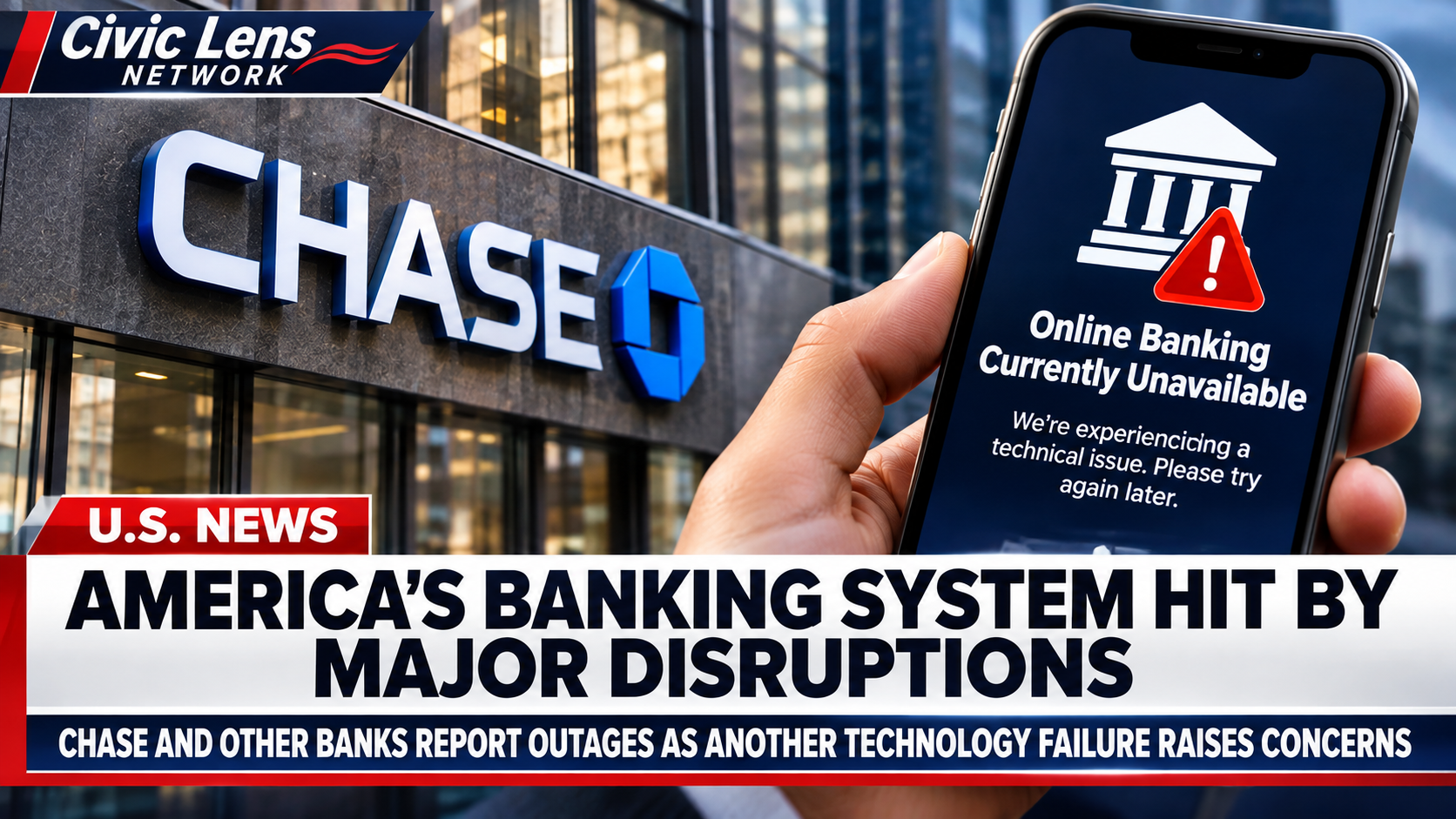
America’s financial system suffered another alarming technology disruption Monday, November 16, as thousands of banking customers across the United States reported problems accessing accounts, transferring money and completing transactions.
The trouble centered on JPMorgan Chase, the nation’s largest bank, but its effects reached customers at other major financial institutions, raising fresh concerns about how dependent Americans have become on interconnected computer systems that can experience widespread disruptions when something goes wrong.
The banking problems came just days after separate technology failures disrupted Microsoft services worldwide and temporarily brought American commercial aviation to a standstill.
For millions of Americans who depend on digital banking to pay bills, receive wages and manage their finances, the latest incident raises an increasingly important question: How reliable is the technology infrastructure supporting everyday life?
Thousands Report Banking Problems
Customers began reporting banking difficulties Monday morning, with complaints increasing dramatically throughout the afternoon.
According to outage-monitoring service Downdetector, nearly 4,800 Chase customers had reported problems by approximately 2 p.m. Eastern Time.
Reports also appeared involving Bank of America, Wells Fargo, U.S. Bank, Truist, Capital One and the popular money-transfer service Zelle.
Customers described difficulty signing into banking applications, checking account balances, transferring money and completing financial transactions.
Some Chase customers encountered notifications explaining that certain services were temporarily unavailable.
At least one customer in Dallas reported being unable to complete a check deposit at a Chase branch after being informed that the banking system was experiencing problems.
However, reports involving multiple banks did not necessarily mean that each institution had suffered an independent outage.
Bank of America and Capital One said their systems were operating normally, while U.S. Bank confirmed that its own systems had not been directly affected.
The distinction is important because transactions between financial institutions can be delayed when one participating bank experiences technical problems.
JPMorgan Chase Identifies Software Bug
JPMorgan Chase acknowledged the disruption and identified a software bug affecting hardware systems operated within the company.
The bank said the problem was delaying certain transactions but emphasized that customers retained access to their accounts and funds.
Chase also stated that it had found no evidence of a cyberattack.
According to the bank, the problem was not a systemwide banking failure. Other institutions could experience delays when processing transactions involving Chase.
That explanation highlights a significant vulnerability in modern banking: Financial institutions do not operate independently of one another.
Banks rely on interconnected payment networks, transaction-processing systems and electronic communications to move money between accounts.
When a major institution encounters problems, customers at otherwise functioning banks may experience consequences.
Monday evening, Chase confirmed that transactions were processing normally again.
Although the immediate disruption was resolved, the incident demonstrated how quickly a technical malfunction at one major financial institution can affect customers elsewhere.
Zelle Payments Also Affected
The problems extended to customers attempting to transfer money through Zelle, one of America’s most widely used digital payment services.
Zelle allows customers at participating financial institutions to send money directly between bank accounts, often within minutes.
Its operator, Early Warning Services, said the Zelle network itself remained operational.
However, transactions involving financial institutions experiencing technical difficulties could be delayed.
That distinction illustrates another weakness of interconnected financial services.
A payment network can function properly while individual customers remain unable to complete transactions because one participating institution is experiencing problems.
For Americans who use electronic transfers to pay rent, reimburse family members or handle urgent expenses, even temporary disruptions can create serious complications.
Banking Problems Follow Nationwide Technology Failures
The timing of Monday’s banking disruption is particularly troubling.
Only days earlier, Microsoft experienced a major global outage that affected Outlook, Teams and other services used by businesses, government agencies and individuals.
The disruption interfered with communications and business operations around the world.
Microsoft attributed the incident to a technical problem associated with a system upgrade and reported no indication of malicious activity.
Then came another major failure involving America’s air traffic control infrastructure.
On Friday, a malfunctioning router overwhelmed parts of the Federal Aviation Administration’s aging computer systems, prompting a nationwide ground stop that disrupted thousands of travelers.
Airlines struggled with cancellations and delays as the aviation system worked to recover.
On Monday, United Airlines experienced a separate widespread computer outage affecting departures before announcing that the problem had been resolved.
These incidents involved different organizations and different technical failures. There is no verified evidence that they were coordinated or caused by a common attacker.
Nevertheless, their occurrence within such a short period raises legitimate concerns about the resilience of systems Americans rely on every day.
America’s Growing Dependence on Fragile Technology
The United States possesses one of the world’s most advanced financial and technological infrastructures.
Yet that sophistication comes with enormous complexity.
Banks, airlines, communications providers and government agencies depend on networks containing countless interconnected components.
A malfunction in one critical system can quickly affect services far beyond the original point of failure.
The consequences are not limited to inconvenience.
Businesses may struggle to process payments. Travelers can become stranded. Employees may lose access to essential communications. Families may temporarily find themselves unable to complete financial transactions.
Technology specialists have warned that the increasing complexity of these networks can magnify the consequences of seemingly isolated technical failures.
The problem is especially concerning when major institutions depend on centralized systems with limited alternatives during an outage.
While digital infrastructure offers speed and convenience, reliability becomes just as important when millions of people depend on those services functioning continuously.
Where Is the Accountability?
Monday’s disruption also raises questions about the responsibility of major financial institutions to maintain dependable systems.
Banks increasingly encourage customers to conduct transactions through mobile applications and websites rather than traditional branches.
Many consumers now receive their paychecks electronically, pay bills automatically and rarely carry significant amounts of cash.
That dependence creates an expectation that financial institutions will invest adequately in maintenance, backup systems, testing and disaster recovery.
A software bug may explain what happened at Chase, but it does not eliminate questions about why the malfunction disrupted transactions or how similar incidents can be prevented.
Financial institutions should be prepared to explain what safeguards failed, how quickly problems were identified and what improvements will follow.
The same scrutiny should apply to critical government and transportation systems.
Americans should not have to accept repeated major technology disruptions as an unavoidable consequence of modernization.
A Warning Washington Should Take Seriously
The banking incident, Microsoft outage and aviation disruptions do not establish evidence of a coordinated attack against American infrastructure.
What they do establish is that critical systems can experience serious failures with consequences reaching across the country.
That reality deserves attention from federal regulators, technology executives and congressional leaders responsible for overseeing essential infrastructure.
The central question is whether enough is being done to ensure that these systems remain operational when hardware malfunctions, software fails or unexpected problems arise.
Americans have become increasingly dependent on digital infrastructure, often without practical alternatives when services suddenly stop working.
Monday’s banking disruption has been resolved, but the larger concern remains.
A country capable of operating the world’s most sophisticated financial and technological systems must also be capable of keeping those systems reliable.
After a week of major disruptions affecting banking, aviation and communications, Americans have every reason to demand answers about the resilience of the infrastructure on which their daily lives depend.