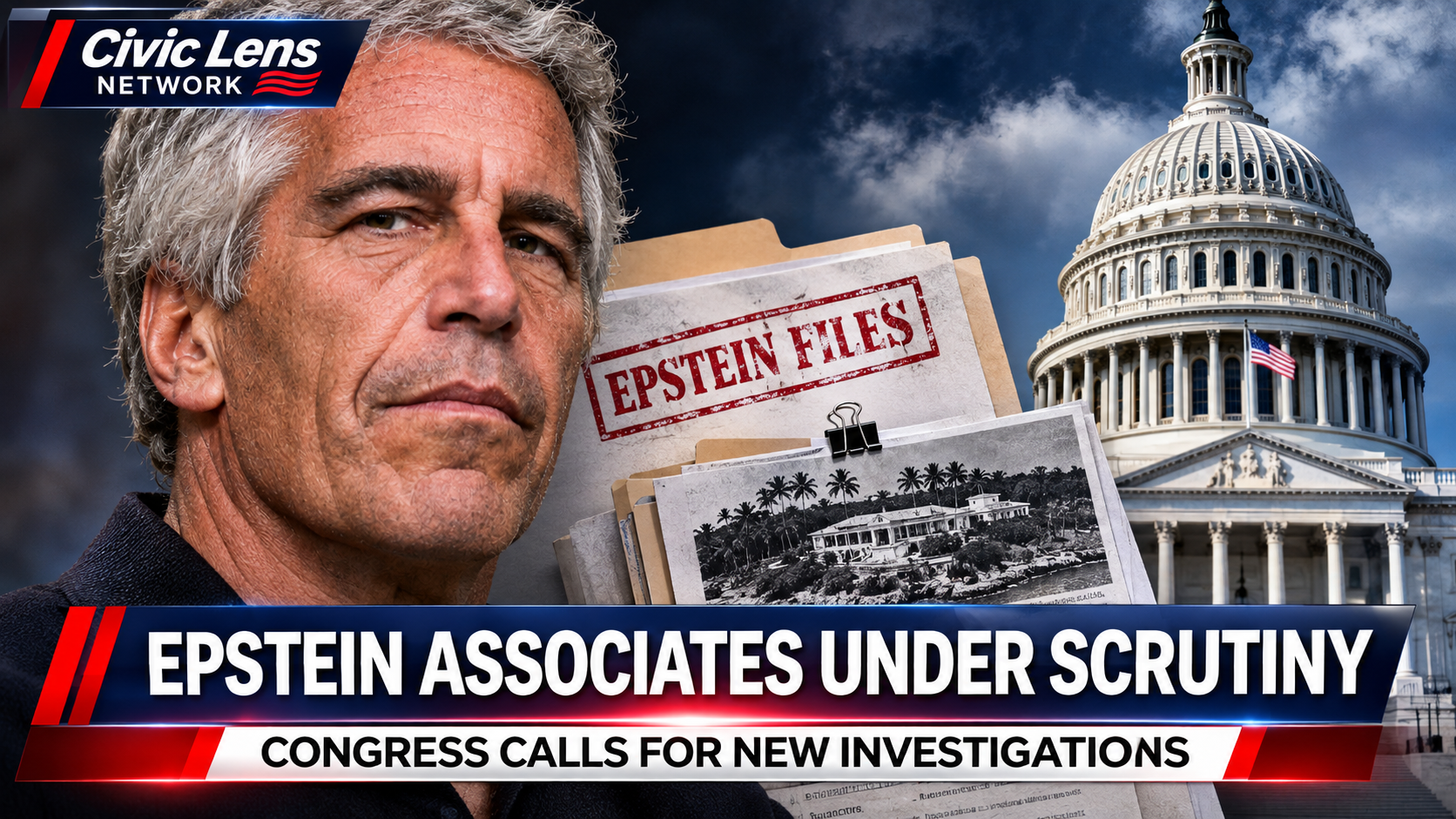
More than seven years after Jeffrey Epstein died in a federal jail cell, the scandal surrounding his powerful network of associates is far from over. A sweeping new congressional investigation has brought renewed attention to prominent businessmen, political figures, former employees, financial institutions and government officials whose relationships with the convicted sex offender are once again under scrutiny.
The Republican-led House Oversight Committee released its findings on November 10, 2026, following a 15-month investigation that included 19 witness interviews and depositions, financial records, government documents and materials obtained from Epstein’s estate.
The findings raise disturbing questions about how Epstein operated for decades, how individuals around him may have facilitated his activities, and why federal authorities repeatedly failed to stop him.
Among the most significant developments are renewed demands for investigations involving former Miami Beach Mayor Philip Levine, celebrity hairstylist Frédéric Fekkai and longtime Epstein assistant Lesley Groff.
Other individuals, including former Barclays executive Jes Staley, Epstein attorney Darren Indyke and accountant Richard Kahn, have also faced scrutiny over their connections to the disgraced financier.
The central question is no longer simply how Epstein committed his crimes. It is how a wealthy, politically connected sex offender managed to maintain an extensive network of influential relationships while allegations of sexual exploitation continued to emerge.
Former Miami Beach Mayor Philip Levine Faces Serious Allegations
One of the most prominent names highlighted in the congressional report is Philip Levine, the former Democratic mayor of Miami Beach, Florida, who served from 2013 until 2017.
Levine was named in allegations made by Sarah Kellen, a former Epstein assistant who testified before congressional investigators in May 2026.
Kellen alleged that Levine sexually assaulted her during a trip to Saint-Tropez, France, while she was traveling with Epstein and Ghislaine Maxwell.
Levine has denied the allegation.
The allegations were serious enough that House Oversight Chairman James Comer and several Republican lawmakers formally requested that the Department of Justice investigate.
The committee renewed that recommendation in its November report.
Levine’s political background makes the allegation particularly noteworthy. He served as mayor of one of Florida’s most prominent cities and later pursued higher political office.
However, his public position does not establish wrongdoing, and the allegation remains unproven. No new criminal charge against Levine was confirmed in the reporting reviewed for this article.
Congressional investigators are asking federal authorities to determine whether sufficient evidence exists to pursue the matter further.
Celebrity Hairstylist Frédéric Fekkai Accused of Abuse
Another prominent figure identified in the congressional findings is Frédéric Fekkai, the French celebrity hairstylist whose name became associated with luxury salons, fashion and wealthy clients.
According to Kellen’s testimony, Fekkai allegedly assaulted her in the early 2000s before she began working for Epstein.
Kellen described meeting Fekkai while pursuing modeling opportunities. She alleged that he invited her to Hawaii under the pretense of attending a fashion event.
According to her account, the promised event did not materialize, and she was left in a vulnerable situation without the resources to arrange alternative accommodations.
She alleged that Fekkai subsequently sexually assaulted her.
Fekkai, through a representative, has denied the allegations and denied participating in illegal activity or having knowledge of Epstein’s trafficking operation.
The congressional report also examined how Epstein used connections to the modeling and fashion industries to gain access to young women.
Investigators concluded that Epstein and Fekkai worked together in recruiting aspiring models, a finding that warrants further scrutiny but is not itself a criminal conviction.
The committee has urged federal prosecutors to investigate Kellen’s allegations.
The significance of the Fekkai allegations extends beyond one prominent individual. They raise questions about whether Epstein’s access to the fashion industry provided additional opportunities to approach vulnerable young women who believed they were pursuing legitimate careers.
Lesley Groff: The Assistant Who Organized Epstein’s Daily Life
Perhaps one of the most consequential figures identified in the congressional investigation is Lesley Groff, who worked as Epstein’s executive assistant for nearly two decades.
Unlike prominent social acquaintances who encountered Epstein occasionally, Groff occupied a position that gave her extensive exposure to his daily schedule, travel arrangements and visitors.
According to the congressional report, Groff arranged massage appointments, coordinated travel and lodging, and handled logistical arrangements involving women visiting Epstein’s properties.
Investigators questioned how someone performing those duties for years could have remained unaware of Epstein’s sexual exploitation.
Groff testified that she did not suspect Epstein was sexually abusing women and girls.
The committee challenged that explanation.
Investigators also raised questions about Groff’s familiarity with Epstein’s contact directory, commonly known as his Black Book, and her ability to recall the identities of individuals associated with appointments.
The report recommended that the Justice Department question Groff again and investigate her possible knowledge of or involvement in facilitating Epstein’s criminal activities.
Groff has not been convicted of participating in Epstein’s sex-trafficking operation.
Nevertheless, her position inside his organization makes her testimony particularly important to understanding how the operation functioned.
Epstein’s crimes required access to properties, transportation, scheduling and a continuous flow of people. Determining who knowingly helped arrange those activities remains a central investigative question.
Jes Staley and the Banking Connections
Former Barclays chief executive Jes Staley is another prominent figure whose relationship with Epstein has drawn extensive scrutiny.
Staley previously held senior positions at JPMorgan Chase, where Epstein maintained important banking relationships.
Their communications and professional association have been examined in civil litigation, regulatory proceedings and congressional investigations.
The House Oversight Committee interviewed Staley in July 2026 as part of its broader inquiry.
Investigators examined his communications with Epstein, including unusual references in emails that raised questions about the nature of their relationship.
Staley has denied criminal wrongdoing involving Epstein’s abuse.
His connection to the scandal illustrates a broader issue: Epstein did not operate solely within wealthy social circles. His relationships extended into major financial institutions that provided services and access to the banking system.
Those relationships matter because investigators have repeatedly examined whether financial institutions recognized warning signs associated with Epstein’s activities and whether they responded appropriately.
The question is not whether every banker who encountered Epstein was involved in his crimes. It is whether institutions and individuals with access to suspicious information ignored warning signs that should have triggered closer examination.
Darren Indyke and Richard Kahn: The Men Handling Epstein’s Affairs
Two other figures whose roles remain important are Darren Indyke, Epstein’s longtime attorney, and Richard Kahn, his accountant.
Both men were involved in managing significant aspects of Epstein’s financial and legal affairs.
Their responsibilities placed them close to the complex financial arrangements surrounding his properties, business interests and estate.
In October 2026, New Mexico filed a civil lawsuit alleging that Indyke and Kahn helped facilitate and conceal Epstein’s criminal activities.
Both men have denied wrongdoing and denied knowingly participating in his abuse.
The allegations remain subject to litigation and should not be confused with criminal convictions.
Congressional investigators interviewed Kahn in March 2026 and also questioned Indyke as part of their examination of Epstein’s network.
One particularly troubling issue involved computer equipment and hard drives reportedly removed from Epstein’s Palm Beach residence before authorities searched the property in 2005.
According to the congressional report, investigators received testimony that Epstein directed an assistant to remove electronic equipment.
Indyke testified that he later learned the hard drives were in the possession of private investigators.
The committee found that federal investigators had identified a potential lead involving the equipment but abandoned that investigative avenue before Epstein’s controversial non-prosecution agreement was finalized.
The circumstances raise obvious questions about what information the devices contained, who had access to them and whether potentially important evidence was lost or overlooked.
The report does not establish that Indyke or Kahn destroyed evidence or committed a crime in connection with the equipment.
It does, however, identify another investigative opportunity that authorities failed to pursue fully.
The Prosecutors Who Allowed Epstein to Escape Federal Charges
The congressional investigation also examined the actions of federal prosecutors involved in Epstein’s original Florida case.
In 2007, federal prosecutors entered into a non-prosecution agreement that allowed Epstein to avoid federal prosecution in exchange for pleading guilty to lesser state offenses.
Epstein ultimately received an 18-month jail sentence and served approximately 13 months.
Even that punishment came with extraordinary privileges.
According to the congressional findings, Epstein was allowed to leave jail for as long as 12 hours per day, six days per week, under a work-release arrangement.
He traveled in private vehicles, had access to paid off-duty deputies and was permitted to meet visitors with limited supervision.
The committee reported that survivors alleged Epstein continued abusing women during the period when he was supposedly serving his sentence.
For an ordinary American convicted of serious sexual offenses, such privileges would be difficult to imagine.
Yet Epstein, a wealthy financier with influential connections, received an arrangement that allowed him to maintain substantial freedom.
Former U.S. Attorney Alexander Acosta, whose office approved the agreement, has faced years of criticism over the decision.
A previous Justice Department professional-responsibility review concluded that Acosta exercised poor judgment but did not establish prosecutorial misconduct.
The congressional report also examined potential conflicts involving former federal prosecutors Matthew Menchel and Bruce Reinhart.
Investigators raised questions about Menchel’s previously undisclosed romantic relationship with attorney Lilly Ann Sanchez, who later represented Epstein.
A Justice Department review found that Menchel had failed to disclose that relationship to supervisors, although it did not find evidence of prosecutorial misconduct.
Reinhart’s subsequent representation of Epstein associates also received scrutiny.
These circumstances do not prove that prosecutors participated in a criminal conspiracy.
They do, however, reinforce concerns about conflicts of interest, professional judgment and whether Epstein received treatment unavailable to ordinary defendants.
Financial Institutions Under Fire
One of the report’s most significant findings concerns the financial infrastructure surrounding Epstein’s operation.
The committee concluded that financial institutions failed to respond adequately to indicators of human trafficking and immigration fraud.
American Express was specifically identified in connection with travel arrangements involving foreign women.
According to the committee, company agents allowed Epstein to use refundable bookings, decoy flights and other arrangements that facilitated international travel to his properties.
The report also examined how financial institutions handled suspicious transactions and compliance warnings.
Investigators found that institutions possessed information about Epstein’s criminal history and financial activities that should have prompted heightened scrutiny.
In some instances, suspicious activity was not reported until years later, following Epstein’s 2019 arrest.
The committee recommended that the Treasury Department and Financial Crimes Enforcement Network review whether institutions were meeting their legal obligations to identify and report potentially suspicious activity.
This is a critical distinction in understanding Epstein’s operation.
Sex trafficking does not function in isolation from financial systems.
Travel requires money. Properties require financing and maintenance. Employees and contractors receive payments. Financial transactions can leave records that investigators may use to identify patterns of criminal conduct.
When institutions fail to respond to warning signs, the consequences can extend far beyond regulatory violations.
Ghislaine Maxwell and the Inner Circle
No examination of Epstein’s associates would be complete without Ghislaine Maxwell.
Maxwell was convicted in federal court in 2021 for her role in recruiting and grooming underage girls for Epstein’s sexual abuse.
She received a 20-year federal prison sentence in 2022.
Her conviction established that Epstein’s crimes were not carried out entirely alone.
The congressional report examined how Maxwell helped maintain the network of contacts and relationships surrounding Epstein.
Investigators found that Maxwell originally created Epstein’s contact directory, which other assistants could subsequently access and modify.
The report also described how Epstein and Maxwell used promises of employment, financial support, gifts and professional opportunities to establish control over vulnerable young women.
Some women were recruited through offers involving modeling. Others entered Epstein’s orbit through jobs described as personal-assistant positions or massage appointments.
The committee found that these arrangements created financial, emotional and professional dependencies that made exploitation easier.
Maxwell’s conviction remains the clearest criminal demonstration of how Epstein’s abuse involved more than one person.
Whether additional individuals can be prosecuted depends on evidence establishing their personal knowledge, actions and criminal responsibility.
Powerful Political and Business Figures Questioned
The congressional investigation extended well beyond Epstein’s immediate employees.
Among those interviewed were former President Bill Clinton, former Secretary of State Hillary Clinton, Commerce Secretary Howard Lutnick, Microsoft co-founder Bill Gates, billionaire investor Leon Black and former Victoria’s Secret owner Leslie Wexner.
Their appearances before investigators demonstrate the extraordinary reach of Epstein’s social and professional network.
However, being interviewed by Congress or appearing in Epstein-related records does not establish criminal involvement.
Investigators examined how Epstein used relationships with wealthy and influential people to establish credibility, attract additional contacts and reinforce his image as a legitimate financier.
The committee reported that Wexner had not authorized Epstein to represent himself as a Victoria’s Secret model scout, despite Epstein’s use of that supposed connection to approach aspiring models.
Lutnick’s relationship with Epstein also attracted scrutiny after he acknowledged visiting Epstein’s private island for lunch with his family in 2012, despite earlier statements suggesting he had ended their association years before.
Lutnick denied wrongdoing.
The congressional report also addressed President Donald Trump.
Republican investigators stated that the witnesses they interviewed did not identify Trump as having participated in Epstein’s crimes and that the documents reviewed by the committee did not implicate him in criminal activity involving Epstein and Maxwell.
That conclusion reflects the Republican majority’s findings from the material it reviewed, rather than a judicial determination concerning every possible allegation or record.
The committee’s findings underscore why investigators must distinguish between social association, questionable judgment and actual criminal conduct.
A person’s name appearing in Epstein’s address book, flight records or correspondence is not proof of participation in sexual abuse.
At the same time, influential connections should never shield credible allegations from investigation.
The Justice Department’s Failure to Protect Victims
The congressional report delivered some of its strongest criticism to the federal government itself.
Investigators concluded that Epstein’s crimes after 2005 could have been prevented if authorities had acted more decisively when allegations first emerged.
Instead, the federal government allowed a controversial plea agreement, failed to notify victims properly and permitted Epstein to continue operating within wealthy social circles.
The committee also criticized the handling of records released under the Epstein Files Transparency Act.
According to the report, the Justice Department failed to communicate adequately about disclosures and mishandled some redactions, exposing sensitive personal information belonging to survivors.
That failure is particularly troubling because victims who had already endured years of exploitation were placed at risk of additional harm through the government’s handling of their records.
The committee recommended establishing a process allowing survivors and their legal representatives to obtain unredacted versions of records concerning their own experiences.
It also supported legislation intended to prevent nondisclosure agreements from being used to silence victims of sexual abuse.
The proposed Survivor’s Voice Protection Act would strengthen protections for individuals seeking to report abuse, even when confidentiality agreements have previously been signed.
Could More Epstein Associates Face Criminal Charges?
The most important question now is whether the congressional findings will lead to additional criminal investigations or prosecutions.
The committee has specifically recommended further investigation of allegations involving Levine and Fekkai, as well as renewed questioning of Groff.
It has also called for federal investigators to pursue additional leads and examine potential criminal activity involving Epstein associates.
The Justice Department has indicated that the case remains open and that investigators will pursue additional information.
That does not mean criminal charges are imminent.
Congressional investigators can identify evidence, question witnesses and recommend prosecutions, but they cannot determine criminal guilt or compel prosecutors to file charges.
Federal authorities must independently evaluate the evidence and determine whether it meets the legal requirements for prosecution.
Still, the fact that Congress is calling for additional investigations years after Epstein’s death is significant.
The central criminal case may have ended with Epstein’s death in 2019, but questions about individuals who may have knowingly facilitated his activities remain unresolved.
The American Public Deserves Answers
The Epstein scandal has exposed a disturbing combination of wealth, influence, institutional failures and missed opportunities to protect vulnerable young women.
The latest congressional report adds new detail to that history while identifying individuals and institutions that investigators believe deserve additional scrutiny.
Some of the allegations involve prominent public figures. Others concern employees who worked directly inside Epstein’s organization, attorneys and financial advisers who handled his affairs, and institutions responsible for identifying suspicious activity.
Not everyone associated with Epstein committed a crime. Some individuals named in the investigation have denied allegations, and several have not been charged with criminal offenses.
But those distinctions should not become an excuse for avoiding legitimate investigations.
For decades, Epstein benefited from a justice system that repeatedly failed to stop him. The 2007 agreement, the extraordinary jail privileges and the failure to pursue important investigative leads are documented examples of that breakdown.
The American people have every reason to demand that the remaining evidence be examined thoroughly and that credible allegations receive the same scrutiny regardless of a suspect’s wealth, political connections or public standing.
If prosecutors uncover evidence sufficient to establish criminal responsibility, those responsible should face prosecution.
If investigations clear individuals of wrongdoing, those findings should also be made public wherever legally appropriate.
What should no longer be acceptable is a system in which powerful connections create the appearance that some people operate under a different set of rules.
Epstein is dead. Maxwell is in prison. But the larger question surrounding his network remains unanswered:
How many people knew what was happening, who helped make it possible, and why did it take so long for the government to act?