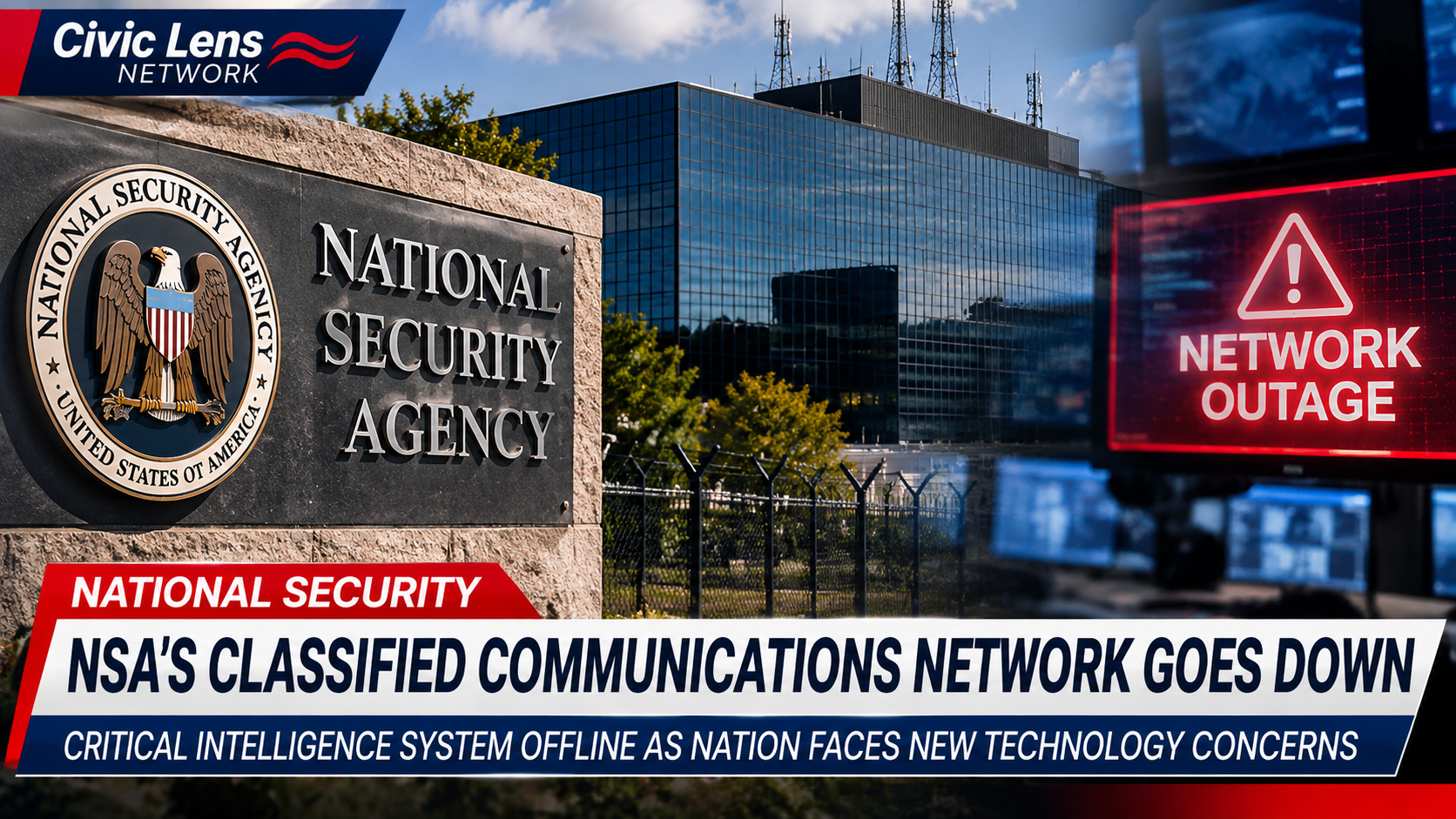
One of the United States government’s most sensitive classified communications networks has reportedly gone offline, disrupting an internal system used by the National Security Agency to exchange secret intelligence.
The failure comes during an extraordinary series of technology disruptions affecting American aviation, banking institutions and major communications platforms, raising increasingly urgent questions about the reliability of systems the country depends upon for national security and everyday operations.
According to reporting published November 17, 2026, six individuals familiar with the situation confirmed that NSA Net, the agency’s highly classified internal communications network, was experiencing an outage.
The National Security Agency, headquartered at Fort Meade, Maryland, is responsible for collecting foreign signals intelligence and helping protect American national security systems against cyber threats.
Now, one of the agency’s own classified networks is experiencing a significant technical failure.
Classified Intelligence Communications Disrupted
NSA Net is not an ordinary government computer network.
It allows authorized intelligence personnel to exchange classified information within one of America’s most secretive intelligence organizations.
Unlike commercial email systems, the network handles sensitive government communications that cannot be transmitted over ordinary public infrastructure.
The reported outage has forced the agency to adjust employee arrival schedules while officials investigate the extent of the disruption.
Personnel have reportedly been instructed to arrive at staggered times, an unusual operational adjustment that suggests the agency is attempting to manage the consequences of the network failure.
Officials have not publicly disclosed when the problem began, how many employees are affected or when normal operations might resume.
The agency has also not confirmed whether the disruption extends beyond internal communications to other classified systems.
Those unanswered questions are particularly important given the NSA’s responsibilities involving foreign intelligence collection, cybersecurity and support for American military operations.
White House Intelligence Communications Reportedly Protected
Despite the seriousness of the outage, current and former American officials have indicated that the disruption should not prevent the government from delivering urgent intelligence to President Donald Trump.
The president is currently traveling in Asia, where secure communications are essential for receiving classified briefings and responding to international developments.
Officials familiar with government communications procedures say multiple backup systems exist to maintain secure contact with the president.
Those redundant networks are designed to prevent a single technical failure from completely isolating America’s commander in chief.
The existence of those safeguards is reassuring, but it does not eliminate concerns about the underlying failure affecting the NSA.
A classified network becoming unavailable is a problem that demands answers, even when alternative communications channels remain operational.
Another Major Failure Following Nationwide Aviation Shutdown
The NSA disruption follows a nationwide aviation emergency that grounded flights across the United States on November 13.
The Federal Aviation Administration experienced a major systems failure that forced aircraft to remain on the ground, disrupting thousands of flights and leaving travelers stranded.
Federal officials subsequently traced the aviation disruption to a router in Arkansas.
The failure demonstrated how a problem involving a single critical component could produce consequences throughout the national transportation system.
The incident also exposed the enormous dependence of American aviation on interconnected computer infrastructure.
Aviation authorities have said they found no indication that the shutdown resulted from a cyberattack.
Nevertheless, the consequences were substantial, affecting airlines, passengers, airports and businesses dependent on commercial air transportation.
Now, only days later, another important American government network is experiencing a disruption.
The two incidents have not been shown to share a common cause.
Microsoft and Banking Systems Also Hit
The problems extend beyond federal agencies.
Microsoft recently experienced a major service disruption affecting Outlook and Teams, interfering with business communications and productivity services used by organizations worldwide.
Microsoft attributed its disruption to technical problems rather than malicious cyber activity.
American banking customers have also experienced serious interruptions.
JPMorgan Chase reported problems affecting transactions and account services, leaving customers temporarily unable to complete certain banking activities.
The financial institution identified a software bug as the cause and reported that the issue had been resolved.
Other banking disruptions have added to public frustration over the reliability of digital financial services.
Although the incidents occurred across different industries and systems, their close timing has attracted attention.
Millions of Americans depend on these services for transportation, financial transactions, employment and communication.
When several major systems experience problems within days of one another, questions about infrastructure resilience become unavoidable.
No Evidence of a Cyberattack, Investigators Say
Despite growing public concern, officials and sources familiar with the incidents have not identified evidence establishing that the NSA outage was caused by a cyberattack.
Similar statements have been issued concerning the FAA and Microsoft disruptions.
That distinction matters.
A network failure can result from faulty hardware, software defects, configuration mistakes, maintenance problems or other technical issues without any hostile involvement.
The fact that several disruptions occurred close together does not establish that they were coordinated.
However, determining whether the failures resulted from unrelated technical weaknesses or reveal broader infrastructure vulnerabilities remains an important question.
The American public deserves clear explanations about how critical systems failed and what safeguards are being implemented to prevent similar disruptions.
National Security Implications Cannot Be Ignored
The NSA occupies a central position in America’s intelligence and cybersecurity operations.
Its responsibilities include collecting foreign communications intelligence, supporting military and national security decision-making, and helping defend sensitive government systems.
Any significant disruption involving its classified infrastructure deserves serious scrutiny.
The agency has not publicly detailed whether intelligence collection, military support or other operational responsibilities were affected by the NSA Net outage.
There is also no confirmed evidence that classified information was stolen, exposed or accessed by unauthorized parties.
Still, the inability to use an important classified communications network highlights the importance of reliable infrastructure within America’s intelligence community.
Backup systems may preserve essential operations, but they cannot substitute for understanding why the primary network failed.
Washington Faces Growing Questions
The latest incident presents federal officials with an increasingly difficult challenge: explaining why multiple important American technology systems have experienced serious disruptions within such a short period.
From grounded aircraft and interrupted banking transactions to malfunctioning communications platforms and now a classified intelligence network, the failures have demonstrated how heavily modern America relies on complex digital infrastructure.
The central issue is not whether every outage represents an attack. There is currently no verified evidence supporting that conclusion.
The more immediate concern is whether critical government and private-sector systems possess sufficient safeguards to withstand unexpected failures without widespread consequences.
For a nation that spends enormous resources on defense, intelligence and cybersecurity, the reliability of its most sensitive networks should be a fundamental priority.
As investigators work to restore NSA Net and determine what went wrong, Americans are left waiting for answers about an incident involving one of the country’s most important national security organizations.
The cause of the outage remains unknown, its full operational impact has not been publicly established, and the NSA has not announced a timetable for restoration.
Until those questions are answered, the disruption will remain another troubling example of how quickly essential American systems can become unavailable.