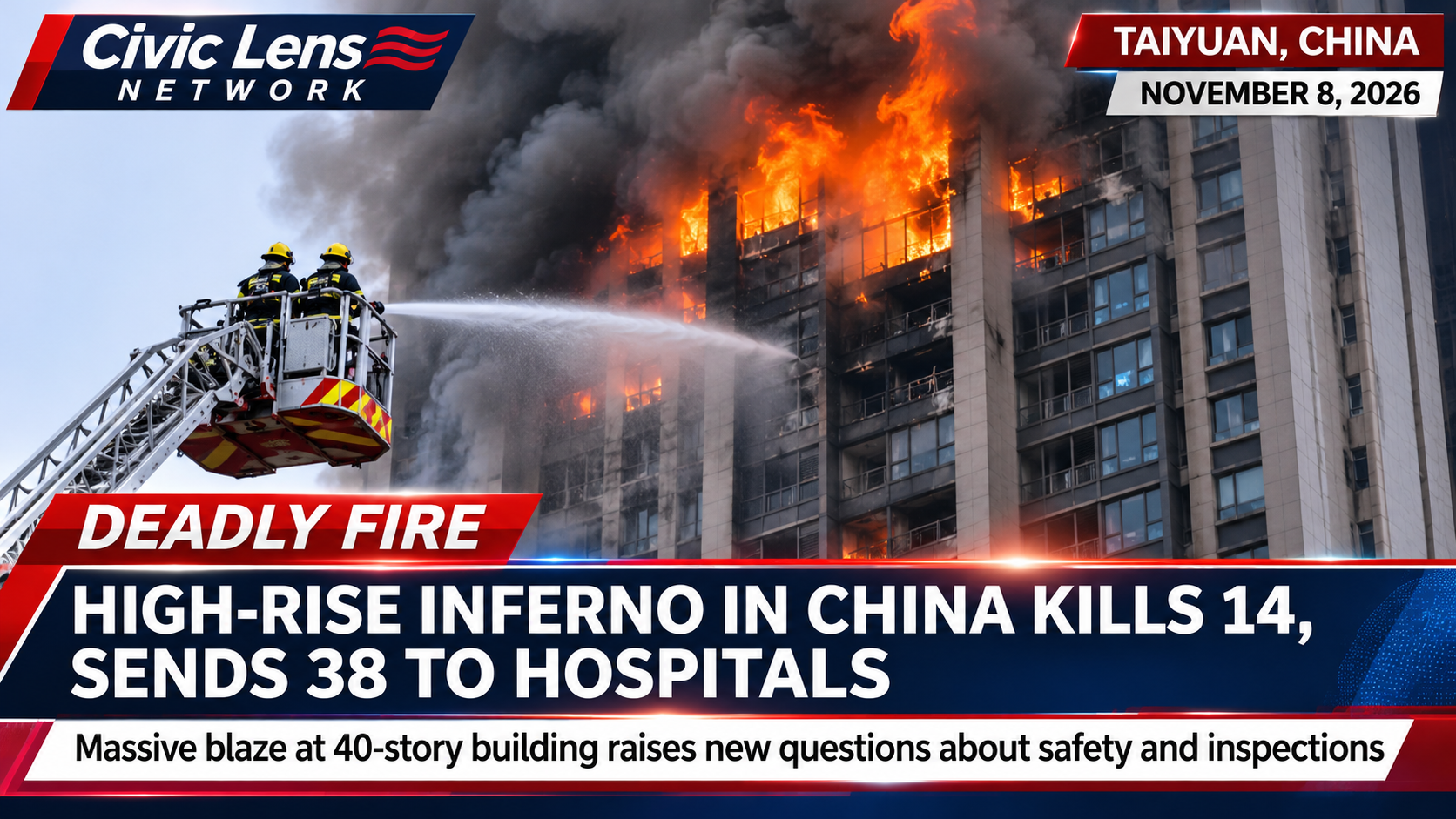
A devastating fire tore through a high-rise building in northern China, killing at least 14 people and sending 38 others to hospitals in a disaster that has raised urgent questions about fire safety, emergency evacuation and the dangers of densely occupied buildings.
The blaze erupted on November 8 in Taiyuan, the capital of China’s Shanxi Province, transforming a busy mixed-use building into the scene of a deadly emergency.
According to Chinese state media, firefighters received the alarm at approximately 4:59 p.m. local time. Emergency crews rushed to the building as flames and thick smoke spread through parts of the structure.
By the time rescue operations concluded, authorities had confirmed 14 fatalities. Thirty-eight people had been transported to hospitals, including nine reportedly suffering serious injuries.
The cause of the fire remains under investigation.
The tragedy has once again drawn attention to the potentially catastrophic consequences of fires in tall buildings, particularly those containing a mixture of residential accommodations, businesses and public facilities.
A Fire That Turned Deadly Within Hours
The emergency began during the late afternoon, when the building was potentially occupied by residents, employees and visitors.
Initial reporting indicated that the fire originated near the fourth floor of a lower section of the building before spreading toward higher levels.
The larger complex was described as a 40-story structure containing multiple types of accommodations and commercial spaces.
The property reportedly included hotel facilities, short-term apartments, offices and businesses.
This combination of uses can complicate emergency evacuation because occupants may be unfamiliar with the building’s exits or emergency procedures.
Firefighters arrived with specialized equipment designed to reach elevated floors.
Images and accounts from the scene described flames and smoke emerging from the building as emergency personnel worked to control the blaze.
The fire was extinguished approximately two hours after it began.
Rescue operations continued as emergency workers searched affected areas and assessed the condition of people who had escaped or been removed from the building.
Authorities later announced that rescue operations had concluded.
Death Toll Climbs to 14
Early reports from the disaster indicated that five people had died.
As emergency teams continued their work and officials gathered information from hospitals and rescue personnel, the reported death toll increased.
By November 9, Chinese state media reported that 14 people had been killed.
Thirty-eight others had been taken to hospitals.
Nine of those hospitalized were reportedly seriously injured.
Authorities have not publicly provided a complete breakdown of the victims’ identities, ages or circumstances.
It is also unclear how many people were inside the affected sections of the building when the fire began.
Officials have not established whether the victims died from burns, smoke inhalation or other injuries.
That distinction is important because smoke and toxic gases can become deadly even in areas that flames have not directly reached.
The full medical condition of the hospitalized survivors may become clearer as authorities release additional information.
Questions About How the Fire Spread
One of the most important unanswered questions concerns how flames and smoke traveled through the building.
Investigators will need to determine where the fire began, what initially ignited it and whether structural features contributed to its spread.
In high-rise buildings, stairwells, ventilation systems, elevator shafts and other openings can potentially allow smoke to move between floors if protective systems fail or are compromised.
Fire doors, smoke barriers and properly maintained ventilation systems are designed to reduce those risks.
Investigators may also examine whether combustible materials were present in the area where the blaze originated.
However, there has been no verified finding that any particular construction material, safety system or building defect caused the Taiyuan disaster.
Those possibilities remain matters for investigation rather than established explanations.
Officials will also need to establish whether the building’s fire alarms and evacuation systems functioned properly.
The presence of working fire detection equipment can make a critical difference when occupants have only minutes to escape.
The Challenge of Evacuating Tall Buildings
High-rise fires present challenges that are significantly different from emergencies in smaller structures.
People occupying upper floors may have to travel down numerous flights of stairs.
Elevators generally cannot be relied upon during a fire unless specifically designed and authorized for emergency evacuation.
Smoke can make stairwells difficult or dangerous to use.
Firefighters must also transport equipment and personnel through the building while attempting to reach trapped occupants.
In some circumstances, emergency crews use aerial ladders or elevated platforms to reach people near windows or balconies.
However, such equipment has practical height limitations.
This makes internal fire protection systems and protected evacuation routes especially important.
A building containing apartments, hotel rooms and businesses can present additional complications.
Hotel guests may not know the layout.
Short-term residents may be unfamiliar with emergency exits.
Employees and visitors may be spread across different floors and sections of the property.
These general hazards illustrate why investigators must reconstruct the events of the Taiyuan fire carefully.
They do not, by themselves, establish that any particular evacuation failure occurred.
A Mixed-Use Building Under Scrutiny
The reported presence of hotels, short-term apartments, businesses and tutoring facilities has drawn attention to the property’s design and operation.
Mixed-use buildings are common in rapidly growing urban centers.
They can provide convenient access to housing, offices and commercial services within a single complex.
However, different activities may require different fire safety arrangements.
Areas used for overnight accommodations can present particular risks because occupants may be asleep when an emergency begins.
Commercial premises may contain equipment, furnishings or stored materials that require appropriate fire protection.
Public-facing businesses may also receive visitors unfamiliar with the building.
Investigators will need to examine the property’s approved uses and determine whether its actual operations complied with applicable safety requirements.
There is currently no confirmed public finding that the Taiyuan building violated those requirements.
Any conclusion about negligence or regulatory failure must await evidence.
China’s Continuing High-Rise Fire Safety Concerns
China has experienced several deadly building fires in recent years, prompting public concern about fire prevention and emergency preparedness.
Rapid urban development has produced enormous numbers of residential towers, commercial complexes and mixed-use buildings.
As cities expand vertically, fire departments face the challenge of protecting large populations living and working high above street level.
Fire safety depends on several overlapping systems.
These include building design, maintenance, fire detection, sprinklers where required, emergency exits, inspections and effective emergency response.
A failure in one area can sometimes be compensated for by another protective measure.
When multiple safeguards fail, however, the consequences can become catastrophic.
Major fires frequently lead to investigations into construction practices, property management and enforcement of safety regulations.
The Taiyuan tragedy is likely to renew attention to those issues.
Yet it would be premature to conclude that regulatory violations caused this particular disaster.
The investigation must first establish the facts.
Why Smoke Can Be as Dangerous as Flames
One of the greatest threats in a building fire is not always direct contact with flames.
Smoke can spread rapidly through enclosed spaces and reduce visibility.
It may contain toxic gases produced by burning furnishings, plastics and other materials.
Exposure can impair judgment, cause disorientation and make escape more difficult.
In a tall building, smoke movement can create dangerous conditions far from the original fire.
The ability of stairwells and other protected routes to remain usable is therefore crucial.
Firefighters must often balance efforts to extinguish flames with the urgent need to locate occupants who may be trapped in smoke-filled areas.
The confirmed reports from Taiyuan do not establish the precise medical causes of the fatalities.
Nevertheless, understanding smoke movement will likely be an important part of any comprehensive investigation.
Authorities Face Demands for Answers
With 14 people dead and dozens hospitalized, the investigation carries serious implications for local authorities and building management.
Among the central questions is whether the fire could have been prevented.
Investigators must determine whether the ignition source involved an accident, equipment malfunction, electrical problem or another cause.
They will also need to assess the building’s fire protection systems and whether emergency procedures were followed.
The timing of the alarm, arrival of emergency personnel and evacuation of occupants may become important elements of the inquiry.
Authorities may examine inspection records and maintenance documentation.
They may also interview survivors, employees, firefighters and witnesses.
At this stage, officials have not publicly announced a confirmed cause or identified individuals responsible for the disaster.
There is no verified evidence that the fire was deliberately started.
Speculation about arson or criminal wrongdoing should not be treated as fact.
Families Await Information
For relatives of the victims, the tragedy is far more than a question of building codes and emergency procedures.
Fourteen people lost their lives.
Dozens more required hospital treatment.
Survivors may face physical injuries, emotional trauma and uncertainty about their homes or workplaces.
Authorities have not released comprehensive identifying information about the deceased.
The circumstances of individual victims therefore remain largely unknown in the confirmed reporting.
As the investigation continues, families will be seeking answers about how the fire began and whether their loved ones had an opportunity to escape.
Those questions deserve a thorough and transparent examination.
What Happens Next?
Chinese authorities are expected to continue investigating the cause of the fire and the circumstances surrounding the fatalities.
The condition of the hospitalized survivors remains an important concern, particularly for those reported to have serious injuries.
Investigators must establish whether the building’s design, operation or emergency systems contributed to the disaster.
Any verified safety violations could have consequences for building operators and relevant authorities.
However, no such findings should be assumed before the investigation is completed.
The Taiyuan fire stands as another reminder of the enormous responsibility involved in protecting people inside densely occupied urban buildings.
A fire that began during an ordinary afternoon left 14 people dead and 38 others in need of hospital treatment.
The flames were extinguished within hours, but the consequences will continue for families, survivors and the surrounding community.
The most urgent questions now concern the cause of the blaze, the effectiveness of the building’s safety systems and whether lessons from this tragedy can prevent another deadly high-rise disaster.
For the victims and their families, those answers cannot come soon enough.