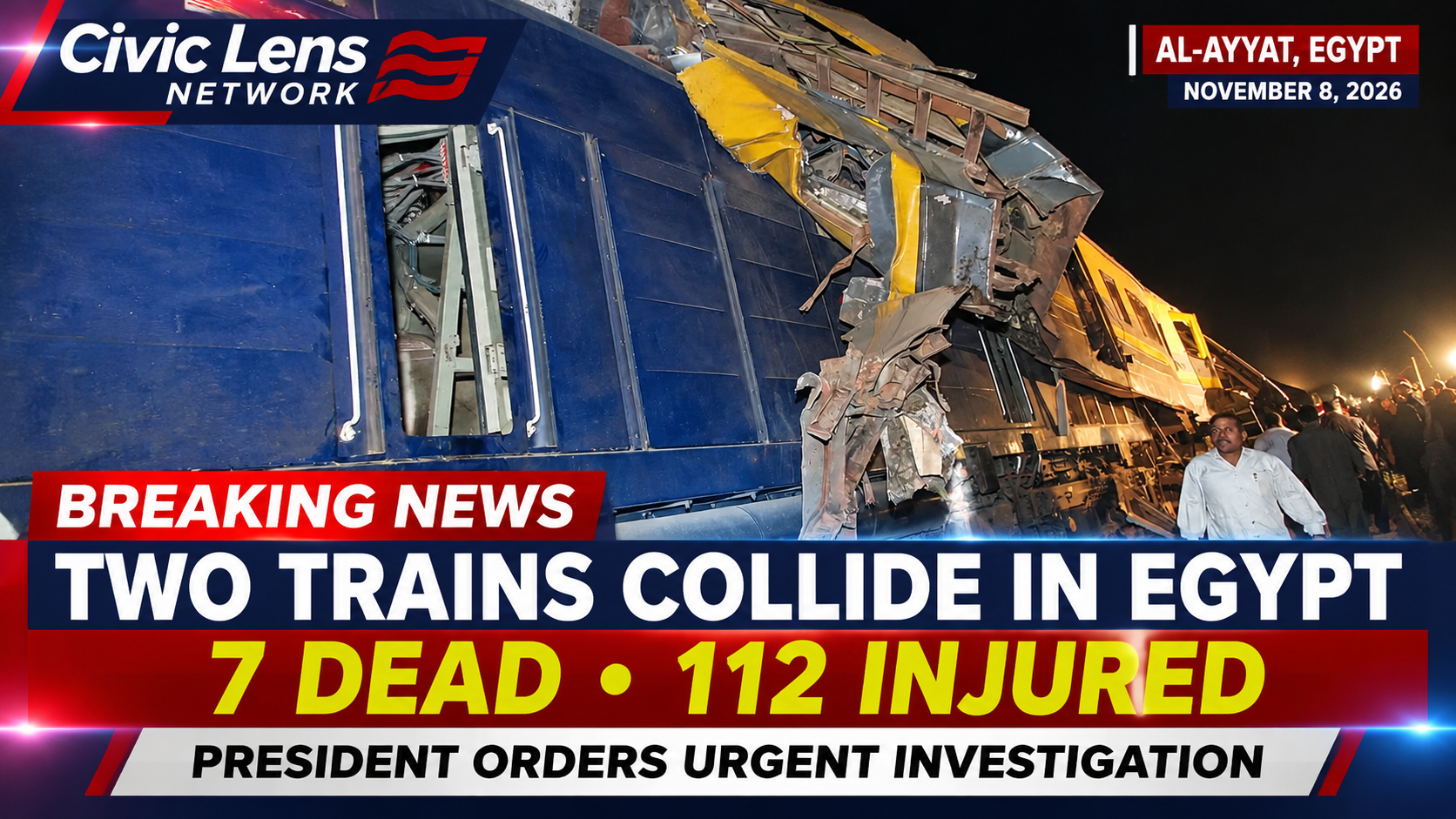
A catastrophic collision between two passenger trains in Egypt has left at least seven people dead and 112 injured, triggering a massive emergency response and renewed concerns about the safety of the country’s aging railway system.
The disaster occurred in the Al-Ayyat district of Giza province, south of Cairo, when a passenger train traveling from Giza toward Fayoum slammed into the rear of another train heading from Cairo to Aswan.
The impact derailed several railway carriages, leaving twisted metal, overturned coaches and injured passengers scattered across the accident scene.
Egypt’s Ministry of Health and Population confirmed that seven people had died and 112 others were injured in the collision.
The death toll increased throughout the day as authorities gathered additional information from hospitals and emergency responders.
President Abdel Fattah el-Sisi ordered an immediate investigation and demanded accountability for anyone found responsible for negligence.
The cause of the crash remains under investigation.
Two Passenger Trains Collide South of Cairo
According to Egypt’s National Railways, train No. 134, operating between Giza and Fayoum, collided with the rear of train No. 2010, which was traveling from Cairo toward Aswan.
The crash occurred between the Kafr Ammar and Al-Raqqa railway stations in the Al-Ayyat area.
Both trains were traveling along one of Egypt’s important railway corridors, which connects the capital with communities throughout Upper Egypt.
The force of the collision caused multiple carriages to leave the tracks.
Images from the scene showed damaged passenger coaches, sections of wreckage and emergency personnel working among the overturned carriages.
Some passengers were trapped inside damaged compartments as rescuers rushed to reach them.
Local residents also joined rescue efforts, helping survivors escape and alerting emergency services.
The full sequence of events leading to the collision has not yet been established.
Investigators are examining why the two trains were on the same section of railway and whether signaling, communications, mechanical problems or human error played a role.
Authorities have not confirmed any specific cause.
Death Toll Rises as Hospitals Treat the Injured
Initial reports from Egypt’s Health Ministry confirmed four deaths and 88 injuries.
Those figures were subsequently revised as emergency teams and hospitals continued documenting casualties.
The ministry’s latest reported update placed the toll at seven dead and 112 injured.
Among the fatalities was a railway conductor, according to reporting on the disaster.
Medical teams transported injured passengers to hospitals throughout the Giza area, where emergency departments were placed on heightened alert.
Health officials confirmed that 45 injured patients had been discharged after receiving treatment and showing improvement.
Others remained hospitalized.
Authorities have not released a complete public breakdown of the victims’ injuries or the conditions of all those still receiving medical care.
The rising casualty figures reflect the difficulty of assessing a major transportation disaster while rescue operations and hospital admissions are continuing.
Families seeking information about loved ones have been left waiting for updates as authorities work to identify victims and establish the full human cost.
Massive Emergency Response Mobilized
Egyptian authorities deployed 72 ambulances as part of the response to the collision.
Emergency medical personnel worked alongside railway crews, civil defense teams and local residents to evacuate passengers.
Heavy lifting equipment and cranes were brought to the scene to move damaged carriages and clear the railway.
The collision severely disrupted train operations along the Cairo to Upper Egypt corridor.
Railway officials began organizing alternative transportation arrangements for affected passengers while crews worked to restore service.
The Ministry of Transport arranged buses between affected railway stations to help travelers continue their journeys.
Health and Population Minister Khaled Abdel-Ghaffar instructed hospitals in Giza and Beni Suef governorates to maintain emergency readiness and provide necessary treatment.
Prime Minister Mostafa Madbouly also monitored the response, communicating with officials responsible for medical assistance, transportation and support for victims’ families.
The government said it was coordinating assistance across multiple agencies.
President Demands Answers and Accountability
President Abdel Fattah el-Sisi expressed concern over the disaster and offered condolences to the families of those killed.
He directed authorities to investigate the collision urgently and ensure that anyone found responsible for negligence would be held accountable.
The president also ordered the provision of medical assistance to injured passengers.
Egypt’s Public Prosecution opened an investigation into the technical circumstances surrounding the crash.
Investigators are expected to examine the operation of both trains, railway signaling systems, communications between crews and traffic controllers, and the circumstances that allowed the collision to occur.
Determining responsibility will require establishing whether safety procedures were followed and whether any equipment or operational failures contributed to the disaster.
No official finding of negligence has been announced.
The president’s demand for accountability nevertheless places significant pressure on railway authorities to explain how two passenger services collided on a heavily used route.
A Troubling History in Al-Ayyat
The location of the latest disaster has intensified public concern because Al-Ayyat has witnessed some of Egypt’s deadliest railway accidents.
In 2002, a devastating fire swept through an overcrowded passenger train traveling south of Cairo.
More than 360 people died in what remains the deadliest railway disaster in Egyptian history.
The tragedy exposed serious weaknesses in passenger safety and emergency preparedness.
In 2009, another major railway collision in the Al-Ayyat area killed dozens of people.
The district has experienced additional railway accidents in subsequent years.
In September 2026, two freight trains collided at Al-Balyada station in Al-Ayyat, injuring a driver and his assistant and derailing railway equipment.
The recurrence of serious accidents in the same general area has raised questions about whether previous investigations and safety improvements have adequately addressed the risks.
However, authorities have not established any technical connection between Sunday’s collision and earlier incidents.
Each disaster requires its own investigation.
Egypt’s Railway Safety Under Scrutiny
Egypt operates one of Africa’s largest railway networks.
Millions of passengers depend on trains for daily travel, employment, education and transportation between major cities.
The network is especially important for connecting Cairo with communities in Upper Egypt.
For decades, however, Egypt’s railways have faced criticism over aging equipment, maintenance problems, operational weaknesses and repeated deadly accidents.
The government has invested heavily in modernization, including railway infrastructure, new trains and improvements to transportation systems.
Officials have described the modernization program as one of the largest in the country’s history.
Yet serious accidents continue to occur.
According to official Egyptian statistics, the country recorded 170 train accidents in 2025, compared with 220 in 2024.
Although that represented a decline, the number of incidents remained substantial.
The latest collision demonstrates that modernization spending alone cannot eliminate the need for effective operating procedures, maintenance and consistent safety oversight.
Investigators must determine whether the systems intended to prevent trains from occupying the same track failed or whether other circumstances caused the crash.
Questions About Railway Signaling and Operations
One of the most important questions concerns how a train traveling toward Fayoum struck the rear of another passenger train heading toward Aswan.
Railway safety systems are designed to maintain appropriate separation between trains and reduce the risk of collisions.
Those protections may include signals, centralized traffic control, communications procedures and automatic train protection equipment.
Investigators will need to establish which systems were operating on the affected section of railway and whether they functioned as intended.
They must also examine whether the train crews received appropriate instructions and warnings.
The available information does not establish whether the collision resulted from a signaling malfunction, a mechanical problem, operational error or another cause.
Assigning blame before investigators complete their work would risk obscuring the actual safety failures, if any, that contributed to the tragedy.
The critical issue is determining exactly what happened and identifying measures that could prevent another collision.
Compensation and Assistance for Victims
Egyptian financial regulators have directed authorities responsible for railway accident insurance to expedite compensation for victims and their families.
The Railway and Metro Accident Insurance Pool is increasing compensation for deaths and permanent total disability from 30,000 Egyptian pounds to 50,000 Egyptian pounds.
Officials have called for prompt communication with affected families and accelerated processing once required documentation is submitted.
The government has also directed social assistance teams to provide support to victims and their relatives.
For families who lost loved ones, however, financial compensation cannot undo the consequences of the disaster.
Many survivors may also face medical expenses, recovery periods and lasting physical or emotional effects.
The long-term needs of the injured will become clearer as hospitals complete treatment and rehabilitation assessments.
A National Transportation Crisis Demanding Answers
The deadly collision has once again placed Egypt’s railway system under intense scrutiny.
Seven people have lost their lives, 112 have been injured and families across the country are confronting the aftermath of a disaster that occurred during an ordinary passenger journey.
The fact that the crash took place in an area already associated with devastating railway tragedies makes the questions surrounding the incident particularly urgent.
Egyptian authorities must now determine what caused the collision, whether existing safety measures were sufficient and whether warning signs were missed.
The government’s investigation will be judged not simply by whether individuals are held responsible, but by whether its findings produce meaningful improvements in passenger safety.
For millions of Egyptians who rely on trains, confidence in the railway system depends on knowing that every reasonable precaution is being taken to prevent another tragedy.
As rescue and recovery operations continue, the immediate focus remains on treating the injured, supporting grieving families and establishing the facts.
The larger challenge will be ensuring that the lessons from this disaster are not forgotten before the next train leaves the station.