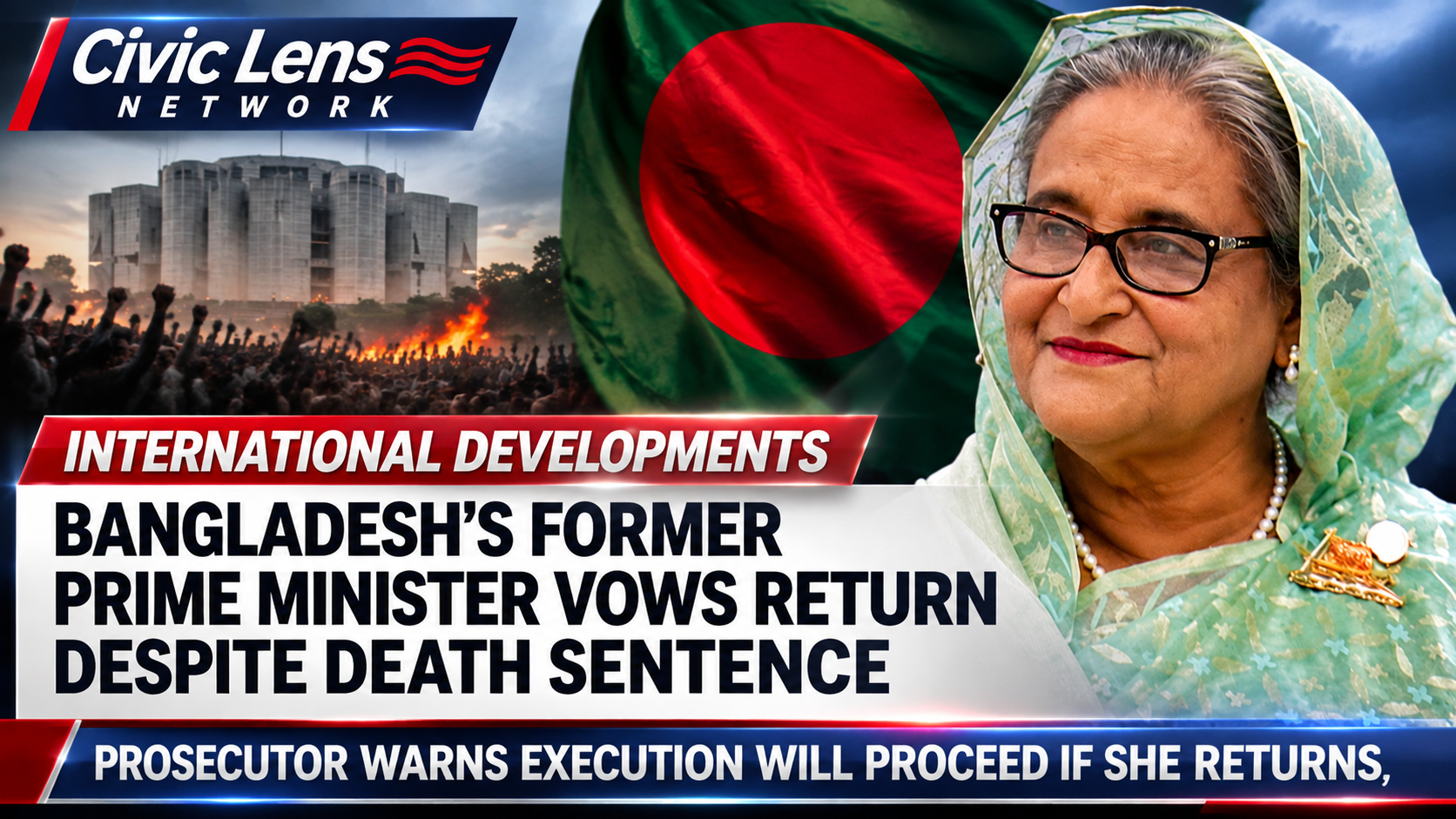
Former Bangladesh Prime Minister Sheikh Hasina is preparing to return from exile in India despite facing a death sentence for crimes against humanity, prompting a warning from prosecutors that she could be executed upon arrival.
The 79-year-old former leader plans to return in December, more than two years after a deadly uprising ended her 15-year rule. Her lawyers have requested new travel documents, but Bangladesh’s government has rejected the move and insists she must be returned through formal extradition procedures.
On November 10, International Crimes Tribunal Chief Prosecutor Md Aminul Islam declared that Hasina had exhausted her legal options after failing to appeal her conviction within the required 30-day period.
The announcement creates a serious legal and diplomatic confrontation involving Bangladesh, India and one of South Asia’s most prominent former political leaders.
Death Sentence Stems From Deadly 2024 Uprising
Hasina was sentenced to death in absentia in November 2025 after Bangladesh’s International Crimes Tribunal convicted her of crimes against humanity connected to the violent suppression of student-led protests.
The demonstrations began over government employment quotas but expanded into nationwide opposition to her administration.
According to United Nations estimates, as many as 1,400 people were killed during the uprising. Security forces and supporters of Hasina’s Awami League were implicated in many of the deaths.
The protests ultimately forced Hasina from power on August 5, 2024, when she fled to neighboring India.
Hasina has denied ordering unlawful killings and maintains that the proceedings against her were politically motivated.
The tribunal, however, found her responsible for the crackdown.
Prosecutor Aminul Islam says the former prime minister had an opportunity to challenge the verdict but failed to exercise that right within the statutory deadline.
He also questioned why Hasina had not returned to face trial before her conviction.
His position is that the existing sentence remains enforceable, leaving Hasina facing the possibility of execution if Bangladesh obtains custody of her.
Bangladesh Rejects Request for New Passport
On November 9, lawyers from London-based Matrix Chambers contacted Bangladesh’s diplomatic mission in New Delhi requesting a replacement passport and national identity card for Hasina.
Her previous documents had been revoked following her removal from power.
The lawyers argued that her Bangladeshi citizenship and applicable human rights obligations supported the issuance of replacement documents.
Bangladeshi officials rejected that position.
The chief prosecutor cited the Bangladesh Passport Order of 1973, which restricts the issuance of passports to individuals convicted of certain criminal offenses.
Government officials also raised questions about the authorization accompanying the legal firm’s request.
Bangladesh maintains that Hasina cannot simply obtain a new passport and return as an ordinary traveler.
Instead, authorities want India to surrender her under the extradition treaty between the two countries.
The dispute leaves an important practical question unanswered: how Hasina intends to enter Bangladesh without valid travel documents or cooperation from its government.
Her aides have indicated that a specific return date will be announced once arrangements are completed.
India Faces a Difficult Diplomatic Decision
Hasina’s continued presence in India has complicated relations between New Delhi and Bangladesh’s current government.
During her years in power, Hasina maintained close political and strategic ties with India, making her a significant regional ally.
Following her removal, India allowed her to remain in the country despite repeated demands from Bangladesh for her extradition.
Returning Hasina would place her in the custody of authorities who have publicly stated their intention to enforce her death sentence.
Continuing to shelter her risks prolonging tensions with Bangladesh, an important neighbor with which India shares extensive economic, security and border interests.
India’s Ministry of External Affairs has described extradition as a legal matter that must proceed through appropriate procedures.
The Indian government has not announced an agreement to surrender Hasina.
Until the two countries resolve the dispute, her ability to return voluntarily remains uncertain.
A Political Party Shut Out of Power
Hasina’s possible return also raises questions about the future of Bangladesh’s political system.
Her Awami League dominated national politics for more than 15 years before the 2024 uprising.
During that period, Bangladesh experienced substantial economic development, particularly in manufacturing and infrastructure.
However, Hasina’s government also faced allegations of suppressing political opposition, restricting press freedom and using state institutions against critics.
Her administration rejected many of those accusations.
Following her removal, the Awami League was banned from political activity and excluded from the February 2026 national elections.
The Bangladesh Nationalist Party subsequently formed a government under Prime Minister Tarique Rahman.
The exclusion of Hasina’s party remains a major political controversy.
Supporters of the ban point to the violence committed during the former administration’s final months and argue that accountability must come before political rehabilitation.
Awami League supporters maintain that excluding their party prevents a significant portion of the electorate from participating through its preferred political organization.
Hasina’s return could bring those disagreements directly into the streets, particularly if party members attempt to organize demonstrations around her arrival.
Is Her Return a Political Strategy?
Hasina has indicated that she intends to surrender before a court after returning to Bangladesh.
She has also expressed a willingness to die in her homeland rather than remain permanently in exile.
Her declaration comes at a time when the Awami League is struggling to operate openly, with numerous senior figures imprisoned, in exile or facing criminal proceedings.
A return could provide the party with a powerful political rallying point.
It could also expose Hasina to immediate detention and the enforcement of her sentence.
Some political observers believe her announcement is intended to revive support for the Awami League and challenge the government that replaced her.
That interpretation remains an assessment of her possible strategy, not proof of her intentions.
The former prime minister has not publicly established how she would overcome the legal and logistical obstacles preventing her return.
The Unresolved Questions Surrounding Her Conviction
Hasina’s case also presents important questions about the administration of justice following a violent change of government.
The families of those killed during the 2024 uprising have demanded accountability for the security crackdown.
The scale of the deaths, documented by United Nations investigators, provides a substantial basis for examining the conduct of officials who directed the response.
At the same time, Hasina disputes the legitimacy of the proceedings that resulted in her conviction.
Because she was tried and sentenced in absentia, the case raises questions about legal representation, appeal procedures and whether she would have any remaining opportunity to challenge the judgment after entering custody.
Bangladesh’s chief prosecutor maintains that the appeal deadline has expired.
The government’s stated intention to enforce the sentence makes those legal questions especially consequential.
International attention would likely intensify if authorities moved toward carrying out the execution of a former head of government.
What Happens Next?
Hasina’s announced December return now depends on several unresolved developments.
Bangladesh has refused to issue replacement travel documents, while India has not agreed to extradite her.
Her legal representatives must determine whether another avenue exists for securing her entry into Bangladesh.
Meanwhile, the government led by Tarique Rahman faces the challenge of maintaining political stability while pursuing accountability for the deadly uprising.
The former prime minister’s return could bring a prolonged diplomatic standoff to an end, but it could also trigger renewed political confrontation.
For now, Hasina remains in India, her death sentence stands, and Bangladesh’s chief prosecutor insists that the time for appealing her conviction has passed.
Whether she actually returns in December remains uncertain. What is clear is that the legal consequences of her decision could extend well beyond her personal fate, affecting Bangladesh’s political future and its relationship with India.