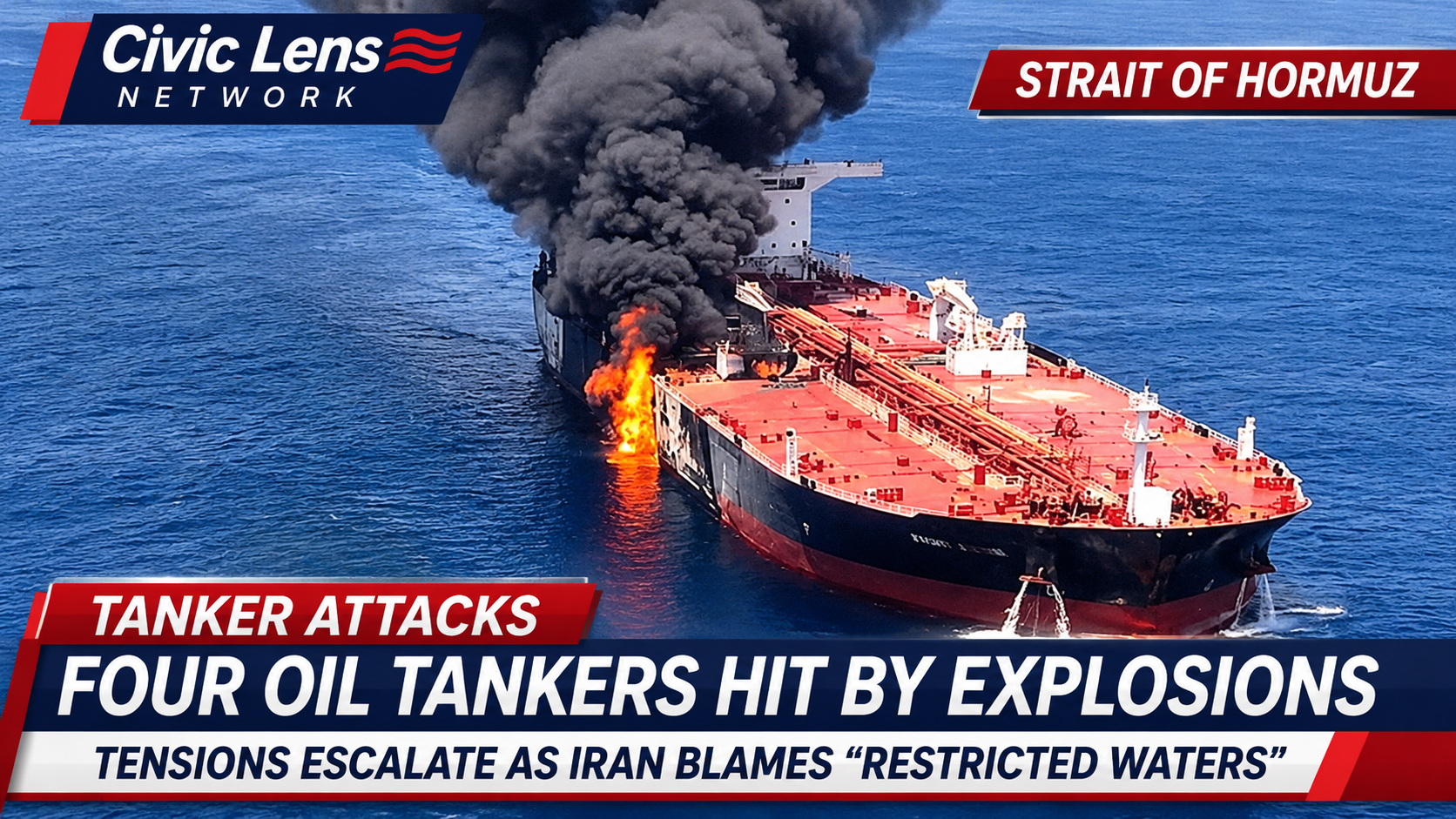
Four oil tankers have reportedly been struck by explosions in the Strait of Hormuz, escalating fears over the safety of one of the world’s most important shipping routes as tensions between Iran and the United States remain dangerously high.
Iran’s military announced Thursday that two additional tankers had suffered explosions in the eastern section of the strait, following similar incidents involving two supertankers Wednesday night.
According to Iranian authorities, the vessels ignored repeated warnings and entered waters that Tehran considers restricted. Iranian state television reported that the ships struck naval mines, with the two vessels involved Thursday subsequently catching fire.
The Iranian account has not been independently verified, and authorities have not established whether all four explosions were caused by mines.
Iran’s Islamic Revolutionary Guard Corps Navy said the two supertankers involved Wednesday were carrying a combined cargo exceeding four million barrels of oil.
The Revolutionary Guards accused the vessels of attempting to navigate unauthorized shipping routes despite warnings from Iranian naval forces.
Tehran has increasingly asserted control over sections of the strategic waterway, warning commercial vessels against traveling through designated areas without authorization.
Iranian officials have also accused ships of disabling navigation equipment while attempting to cross the strait under American military protection.
Those accusations remain unverified.
The United Kingdom Maritime Trade Operations agency separately reported that a commercial vessel was struck by an unidentified projectile approximately 14 nautical miles northwest of Ras Al-Khaimah in the United Arab Emirates.
The impact reportedly caused a fire in the vessel’s engine room. Firefighting operations were launched, and the crew was evacuated safely.
It remains unclear whether that incident corresponds to one of the four explosions described by Iranian authorities.
The latest developments come amid months of dangerous confrontations involving commercial shipping, Iranian military forces and American naval operations.
The conflict between Iran and the United States and Israel, which began in February, has severely disrupted maritime commerce throughout the Persian Gulf.
Washington has maintained a naval blockade targeting Iranian ports while assisting commercial vessels attempting to navigate the region.
Iran, meanwhile, has repeatedly warned that ships traveling through routes it considers unauthorized could face serious consequences.
The scale of the danger has increased considerably.
Figures compiled by the Washington Institute for Near East Policy indicate that at least 37 commercial vessels were attacked during October, the highest monthly total since the conflict began.
At least ten additional ships were reportedly struck during the first ten days of November.
The attacks have also created environmental concerns.
Recent incidents involving burning tankers have resulted in oil entering surrounding waters, with evidence of petroleum contamination reaching parts of Oman’s coastline.
Satellite imagery has detected oil slicks near Oman and the United Arab Emirates, raising questions about the long-term environmental consequences of repeated attacks.
The Strait of Hormuz connects the Persian Gulf with the Gulf of Oman and the Arabian Sea. Under normal conditions, approximately one-fifth of the world’s petroleum liquids consumption passes through this narrow maritime corridor.
Any prolonged disruption threatens international energy markets, particularly countries that depend heavily on Gulf oil exports.
Shipping companies must now weigh the financial benefits of transporting petroleum against the growing risks of explosions, fires, damaged vessels and potential crew casualties.
Insurance expenses, security requirements and alternative transportation arrangements could place additional pressure on global energy costs.
The incidents are unfolding despite recent expectations that tensions between Washington and Tehran might ease through renewed diplomatic efforts.
Although oil markets have shown some optimism about possible de-escalation, continued explosions demonstrate that commercial shipping remains exposed to serious danger.
Questions also remain about the precise locations of the reported naval mines, whether additional vessels face similar hazards and what measures international naval forces may take to protect maritime traffic.
For now, the fate of the four tankers remains incompletely documented, with no independently confirmed assessment of their total damage or the circumstances behind every explosion.
With military tensions unresolved and commercial vessels continuing to face attacks, the Strait of Hormuz remains one of the world’s most dangerous and economically consequential shipping corridors.