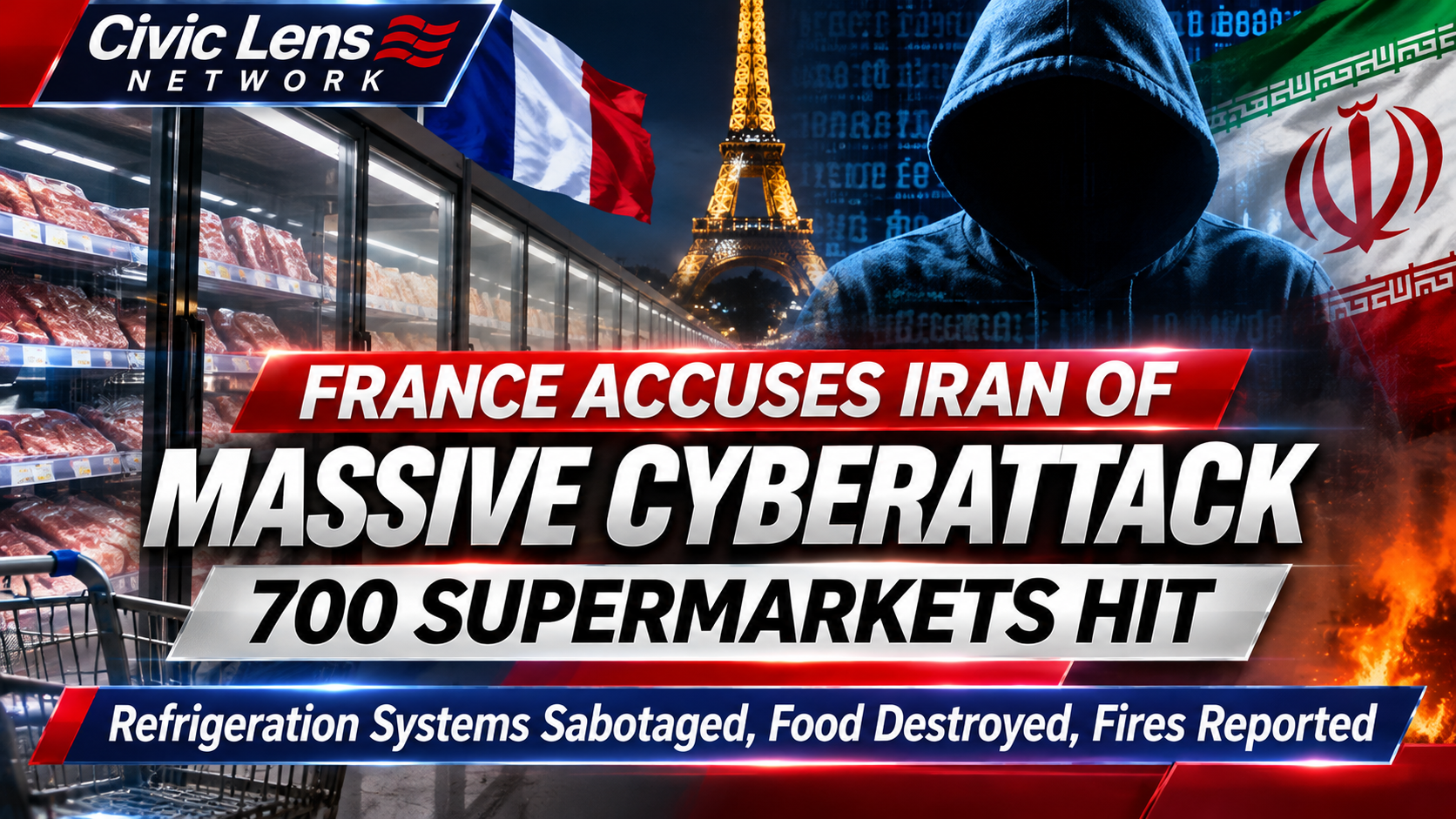
France has accused Iran’s Islamic Revolutionary Guard Corps of orchestrating a massive cyberattack that remotely sabotaged refrigeration systems at approximately 700 supermarkets, destroying food supplies, triggering fires, and exposing a dangerous new front in international cyberwarfare.
The accusation represents a major escalation in an investigation that began after commercial refrigerators and freezers across France suddenly malfunctioned during the night of October 11 and 12.
What initially appeared to be an extraordinary technological failure has now become a matter of national security.
French authorities say the attack was deliberately designed to cause physical damage by manipulating internet-connected industrial equipment. Rather than stealing passwords or confidential documents, the attackers allegedly took control of refrigeration systems and forced them to generate heat.
Some refrigeration units reportedly reached temperatures of approximately 122 degrees Fahrenheit.
Food that should have remained frozen or refrigerated was ruined. Businesses suffered substantial financial losses, and authorities reported at least 15 fires connected to the disruption.
On November 9, French officials publicly identified an Iranian military-linked cyber unit as the suspected perpetrator.
The announcement has raised serious concerns about the ability of foreign governments to interfere with everyday infrastructure far beyond traditional military targets.
Hundreds of Supermarkets Hit in Coordinated Attack
The cyberattack struck approximately 700 retail locations across France, affecting several major supermarket chains.
Investigators say hackers gained remote access to systems responsible for controlling refrigeration temperatures.
Once inside, the attackers allegedly activated abnormal defrost cycles that continued without normal operating limits. They also interfered with safety alerts intended to warn employees when temperatures became dangerous.
The consequences were immediate.
Refrigerators and freezers began warming instead of cooling, leaving large quantities of meat, dairy products, frozen foods, and other perishables unsafe for sale.
Some retailers were forced to close affected sections while employees inspected equipment and discarded damaged inventory.
The financial damage was substantial.
Intermarché reported losses reaching tens of millions of euros in a single day, according to reporting on the incident.
Other affected retailers included Carrefour, Monoprix, E.Leclerc, and Coopérative U.
Although the disruption lasted only several hours in many locations, the consequences extended well beyond the initial intrusion.
Spoiled inventory had to be replaced, equipment required inspection, and businesses faced the challenge of restoring confidence in systems that had been compromised remotely.
The incident demonstrated how a cyberattack lasting only hours can produce significant physical and economic consequences.
France Points Directly at Iran’s Revolutionary Guards
French Foreign Minister Jean-Noël Barrot publicly attributed the attack to Iran’s Islamic Revolutionary Guard Corps on November 9.
The Islamic Revolutionary Guard Corps, commonly known as the IRGC, is a powerful branch of Iran’s military establishment with extensive security, intelligence, and overseas operations.
French authorities specifically identified a cyber unit known as Shahid Kaveh.
Investigators believe the unit operates within the Revolutionary Guards’ cyber apparatus and has experience targeting industrial control systems.
French cybersecurity specialists reportedly identified technical characteristics associated with the unit, including methods of intrusion, Persian-language traces, and internet addresses linked to Iran.
Those findings formed part of the government’s public attribution.
However, identifying the suspected source of a cyberattack is not the same as securing a criminal conviction.
The French government has formally accused the Iranian-linked unit, but individual criminal responsibility remains subject to investigation and judicial proceedings.
Iran had not publicly provided a substantive response to the specific allegations at the time of the initial announcement.
International Arrest Warrants Being Pursued
The French government is taking the allegations beyond diplomatic condemnation.
Paris prosecutors have opened a judicial investigation into suspected organized cybercrime and damage allegedly committed in the interests of a foreign power.
Authorities are pursuing international arrest warrants for three individuals believed to hold leadership positions in the Iranian cyber operation.
The investigation includes allegations of unlawfully interfering with computer systems and causing dangerous damage through coordinated criminal activity.
French officials have also summoned Iran’s ambassador to protest the attack.
The government says it intends to pursue sanctions at the European level against those responsible.
The possibility of additional measures has not been ruled out.
The case represents a significant diplomatic confrontation because France is publicly accusing an arm of another country’s military establishment of carrying out sabotage against civilian businesses.
If the allegations are substantiated, the incident would demonstrate that ordinary commercial infrastructure has become a direct target in an international cyber conflict.
The Attack Was Not Designed Simply to Steal Information
Most people associate hacking with stolen passwords, compromised bank accounts, or the theft of private information.
This incident demonstrates a different and potentially more dangerous threat.
The alleged attackers were not primarily interested in collecting customer information.
Their objective, according to French investigators, was to manipulate physical equipment.
Modern commercial refrigeration systems often rely on computerized controllers to regulate temperatures, monitor performance, and notify operators when problems occur.
Some systems can be accessed remotely to allow technicians and businesses to manage equipment across multiple locations.
That convenience can become a serious vulnerability when remote interfaces are exposed to the internet or inadequately protected.
Cybersecurity investigators say attackers exploited weaknesses involving internet-connected refrigeration controllers.
By changing operating instructions, they could interfere directly with the physical processes that keep food cold.
The result was an attack capable of destroying inventory and potentially damaging equipment without requiring anyone to enter the buildings.
The distinction matters because similar industrial control technology is used throughout modern society.
Water treatment facilities, energy infrastructure, manufacturing plants, warehouses, and transportation systems all depend on computerized equipment.
A vulnerability that allows attackers to manipulate commercial refrigeration raises broader questions about the security of other industrial systems.
Fires Turn Digital Intrusion Into Physical Danger
One of the most alarming aspects of the incident was the reported outbreak of fires.
French authorities say at least 15 fires were associated with the refrigeration attacks.
That development separates the case from ordinary computer crime.
A cyber intrusion that merely interrupts a service can cause financial losses and inconvenience.
An intrusion that manipulates machinery until it overheats can create direct physical hazards.
The possibility of fires, equipment destruction, and danger to workers or customers substantially increases the seriousness of the incident.
Investigators are examining the technical circumstances surrounding the equipment failures.
The available public information does not establish that every affected refrigeration unit caught fire or that all reported damage occurred in exactly the same manner.
Nevertheless, the scale of the disruption and the reported physical consequences have made the attack a major concern for European security officials.
Blood Banks Were Also Targeted
The investigation has become even more troubling because of a separate attempted attack involving French blood banks.
Authorities reported that attackers attempted to manipulate refrigeration temperatures at facilities responsible for storing blood products.
The attempted interference did not result in reported damage to the blood products or samples.
However, the attempted targeting of medical refrigeration introduces a potentially serious public safety concern.
Blood storage depends on carefully controlled temperatures.
A successful attack that compromises those conditions could endanger critical medical supplies and disrupt healthcare operations.
The fact that such systems were reportedly targeted underscores why cybersecurity authorities are increasingly concerned about attacks against industrial equipment.
The potential consequences are not limited to spoiled groceries or financial losses.
They can extend into healthcare and other services essential to public safety.
Similar Problems Reported Beyond France
The French investigation comes amid reports of additional refrigeration-related cyber incidents elsewhere in Europe.
Belgium, Luxembourg, and Sweden have experienced similar disruptions affecting commercial refrigeration systems.
Authorities have not conclusively established that every incident was carried out by the same individuals or under the same command structure.
That distinction is important.
Similar attack methods do not automatically prove that separate incidents share a common perpetrator.
Nevertheless, the international pattern has prompted growing concern among cybersecurity specialists.
The threat also extends beyond Europe.
American authorities have warned that industrial refrigeration and cold-chain monitoring systems are being targeted by malicious cyber activity.
The FBI has urged organizations to protect vulnerable controllers, restrict unnecessary internet exposure, and strengthen access controls.
The warnings reflect a broader recognition that equipment once treated as ordinary commercial machinery can become an attractive target for cybercriminals and hostile actors.
Could American Businesses Face Similar Attacks?
The French incident raises an obvious question for the United States.
Could hackers remotely sabotage refrigeration systems at American supermarkets, food distribution centers, or medical facilities?
The underlying technology is not unique to France.
Commercial refrigeration systems throughout the world use network-connected controllers, monitoring platforms, and remote maintenance tools.
When those systems are poorly secured, attackers may be able to exploit weaknesses regardless of national borders.
American authorities have already acknowledged concerns about malicious activity targeting refrigeration and cold-chain equipment.
In August, refrigeration problems at six U.S. military commissaries prompted an investigation by the Army Criminal Investigation Division.
Officials have not established that those incidents were connected to the French attacks or that Iran was responsible.
The distinction is essential because the existence of multiple refrigeration incidents does not by itself demonstrate a single coordinated international operation.
Even without a confirmed connection, the American investigation highlights the importance of protecting commercial and government-operated facilities that depend on temperature-sensitive storage.
The larger security challenge is that many organizations have historically focused cybersecurity spending on office computers, financial systems, and customer databases.
Industrial equipment may receive less attention, particularly when it uses older software or was installed before modern cybersecurity threats became widespread.
That imbalance can leave businesses exposed to attacks capable of causing physical damage.
A Dangerous Development in Modern Cyberwarfare
The accusations against Iran arrive amid heightened international tensions and growing concern about cyber operations conducted by state-backed groups.
Governments have long used digital espionage to gather intelligence.
Cyberattacks have also been used to disrupt communications, steal sensitive information, and interfere with government operations.
But attacks designed to manipulate physical equipment represent a particularly serious escalation.
They can create damage that extends beyond computer networks into the real world.
The French supermarket incident illustrates that vulnerability.
An attacker operating remotely may be able to damage machinery, destroy inventory, and disrupt civilian services without deploying conventional weapons.
Such operations can also be difficult to investigate because attackers may route their activity through multiple networks and countries.
Determining responsibility requires technical evidence, intelligence analysis, and cooperation between national authorities.
France says it has assembled sufficient evidence to publicly identify the Iranian-linked unit responsible for the attack.
The strength of that attribution will remain an important issue as the judicial investigation progresses.
The Economic Consequences Could Be Significant
For retailers, the immediate losses involve destroyed food, damaged equipment, emergency repairs, and interrupted operations.
But the longer-term consequences may be more substantial.
Businesses may face increased cybersecurity costs as they evaluate industrial controllers and replace outdated systems.
Insurance companies may reassess the risks associated with cyberattacks that produce physical damage.
Manufacturers may also face pressure to improve the security of internet-connected equipment and provide stronger protections against unauthorized access.
The attack could accelerate demands for stricter cybersecurity standards across the European Union.
For consumers, the incident demonstrates how digital vulnerabilities can affect essential goods and services.
A compromised refrigeration controller can ultimately influence whether food remains available, safe, and affordable.
The connection between cybersecurity and everyday economic security is becoming increasingly difficult to ignore.
France Demands Accountability
France’s response suggests that officials consider the incident a matter of national security rather than an isolated commercial disruption.
The government has publicly attributed the attack to an Iranian military-linked cyber unit, opened a criminal investigation, summoned Iran’s ambassador, and announced plans to pursue European sanctions.
Those steps represent a significant escalation from the initial investigation into malfunctioning refrigeration equipment.
The central allegations remain subject to further examination, and no conviction has established the responsibility of the individuals under investigation.
Nevertheless, the physical damage and widespread disruption reported by French authorities have already exposed serious vulnerabilities in commercial infrastructure.
The most important lesson may extend far beyond the supermarket industry.
Modern economies increasingly depend on remotely managed equipment connected to digital networks.
When those systems are compromised, the consequences can reach directly into warehouses, stores, hospitals, factories, and essential public services.
France’s investigation now presents a major test of whether governments can identify, deter, and hold accountable those responsible for cyberattacks that cause real-world destruction.
What began with refrigerators overheating inside supermarkets has become an international confrontation involving alleged military cyber operations, criminal investigations, diplomatic protests, and potential European sanctions.
And the larger warning is unmistakable.
The next major cyberattack may not begin with a stolen password or a frozen computer screen.
It could begin with ordinary equipment quietly receiving malicious instructions from thousands of miles away.