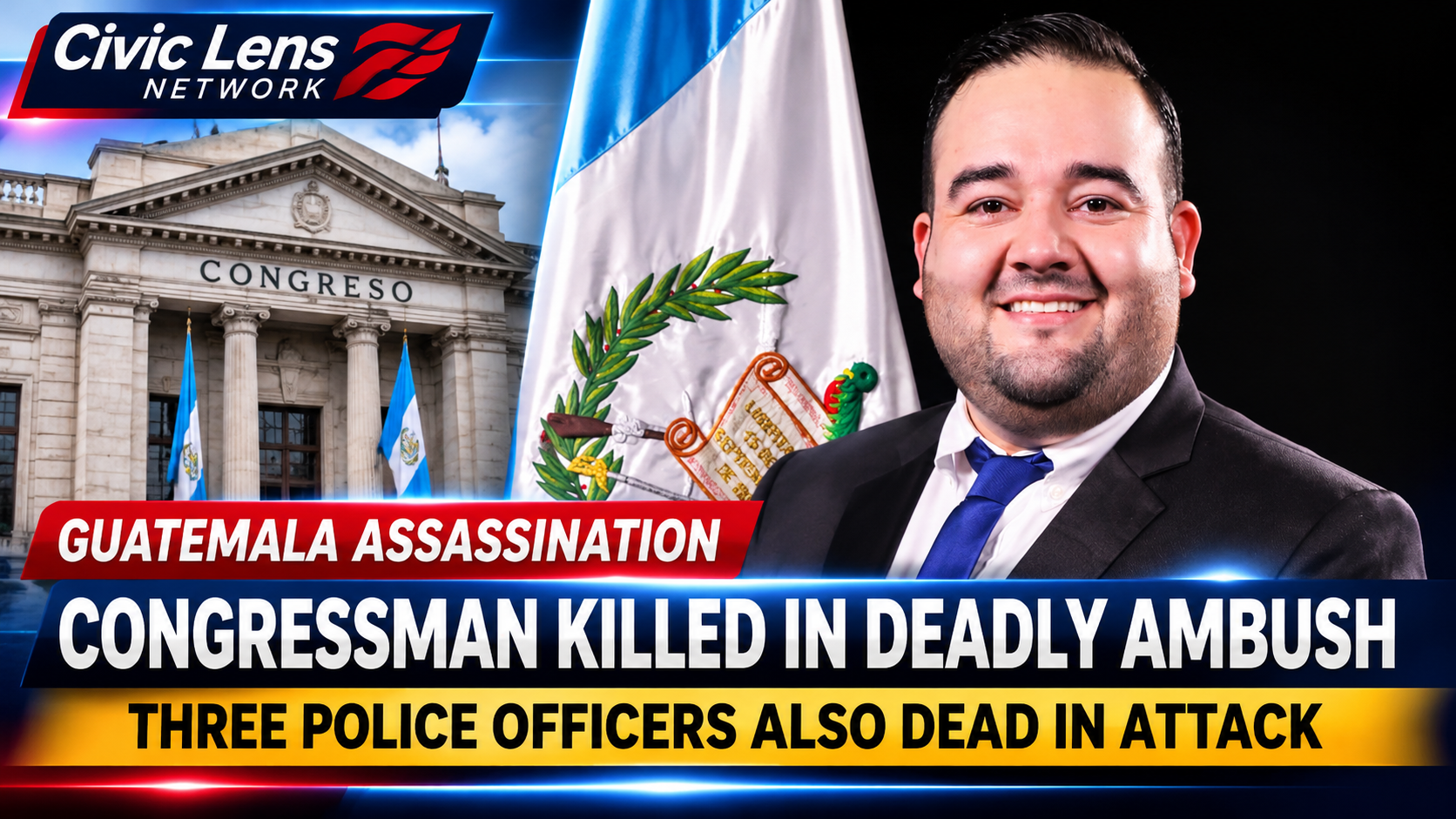
A deadly armed ambush in Guatemala has left a member of the country’s Congress and three National Civil Police officers dead, sending shockwaves through the Central American nation and raising serious questions about political violence, organized crime and the government’s ability to protect public officials.
Congressman Julio César Portillo Paz was attacked on November 6 while traveling through Río Hondo in the eastern department of Zacapa. Gunmen opened fire on the vehicle carrying the legislator, triggering a violent confrontation that claimed the lives of three police officers assigned to his security.
Portillo survived the initial attack but died hours later after being transported to a hospital.
The assassination has prompted condemnation from President Bernardo Arévalo, Guatemala’s Congress and the country’s human rights authorities.
Investigators are now working to determine who ordered the attack, who carried it out and whether the congressman was specifically targeted because of his political position.
No motive has been officially established, and authorities have not publicly identified the attackers.
Gunmen Strike Along Major Highway
The attack occurred near kilometer 137 of Guatemala’s Atlantic Highway, a major transportation route connecting the capital with the country’s eastern regions.
According to authorities, Portillo was traveling in a white vehicle when armed assailants opened fire.
Police officers responsible for protecting the legislator attempted to repel the assault.
Three officers were killed during the confrontation.
Portillo sustained serious injuries and was transported to a regional hospital, where medical personnel attempted emergency treatment.
Despite those efforts, the congressman died later that evening.
The violence unfolded in Río Hondo, a municipality in Zacapa, a department that has struggled with criminal activity and deadly attacks.
Investigators subsequently secured the scene, collected shell casings and began examining evidence that could help reconstruct the ambush.
The circumstances suggest a coordinated armed assault, although investigators have not publicly established the number of attackers or whether the perpetrators had advance knowledge of the congressman’s movements.
Three Officers Killed in the Line of Duty
The three officers who died protecting the legislator have been identified as Jorge Paau Xicol, Fernando Antonio Reyes Aldana and Erick Armides Ramos Osorio.
All three served with Guatemala’s National Civil Police.
Their deaths have drawn particular attention because they were carrying out protective duties when the attackers struck.
Guatemala’s Interior Ministry confirmed that the officers died while responding to the armed assault.
President Arévalo acknowledged their sacrifice and directed security authorities to cooperate with prosecutors investigating the killings.
The deaths highlight the dangers facing law enforcement personnel in regions where organized criminal activity and heavily armed groups remain serious security concerns.
Police officers assigned to protect public officials are expected to respond immediately to threats, often placing themselves directly in danger.
In this case, three officers lost their lives during an attack that also killed the person they were assigned to protect.
Their families now face the devastating consequences of an assault that has become a national political and security issue.
Who Was Julio César Portillo Paz?
Julio César Portillo Paz was a 35-year-old Guatemalan legislator representing the department of Zacapa.
He had been elected to Congress for the 2024 through 2028 legislative term.
Portillo originally entered Congress through the CABAL political party and was affiliated with the National Unity of Hope party, commonly known as UNE, at the time of his death.
Before his political career, he was known by the artistic nickname El Poeta del Cielo, meaning The Poet of the Sky.
His assassination has left Zacapa without one of its elected representatives and raised concerns about the safety of other political figures.
The National Unity of Hope party confirmed his death and expressed condolences.
Guatemala’s Congress also issued a statement condemning the violence and calling for an investigation.
The killing of an elected lawmaker is especially serious because it strikes at an institution responsible for representing citizens and making national laws.
When armed attackers can kill a member of Congress and three police officers in a single assault, questions inevitably arise about the reach of criminal violence and the effectiveness of existing security measures.
President Condemns Attack and Orders Investigation
President Bernardo Arévalo condemned the killings and instructed security agencies to cooperate with prosecutors.
The president declared that criminal violence would not be allowed to prevail over the safety and lives of Guatemalans.
His administration now faces pressure to ensure that investigators identify those responsible and determine whether the attack involved organized criminal groups, political motives or another cause.
The president’s response comes amid broader concerns about violent crime and the ability of authorities to protect officials, law enforcement personnel and ordinary citizens.
The killing also places additional attention on Guatemala’s Interior Ministry and National Civil Police.
Investigators must determine how the attackers approached the legislator’s vehicle, whether the security detail received any warning and how the gunmen escaped.
Those questions remain unanswered.
An effective investigation will require more than identifying the individuals who fired the weapons.
If the assault was ordered or financed by others, authorities will need to establish who directed the operation and why.
At present, there is no verified evidence publicly establishing a mastermind behind the attack.
Prosecutors Collect Evidence From Ambush Scene
Guatemala’s Public Ministry confirmed that prosecutors were investigating the killings and processing the crime scene.
Investigators collected numerous pieces of evidence, including spent cartridge casings, in an effort to reconstruct the attack.
The investigation is expected to examine the vehicles involved, the weapons used and the movements of the victims before the shooting.
Authorities may also seek witness statements and surveillance footage from the surrounding area.
One of the central questions is whether the gunmen intended specifically to kill Portillo or whether other circumstances contributed to the assault.
The fact that the congressman was traveling with a police security detail makes the attack particularly alarming.
However, the presence of armed attackers and a protected political figure does not by itself establish a political motive.
Investigators must determine whether the killing was connected to Portillo’s public responsibilities, personal disputes, organized crime or another factor.
Until evidence establishes the motive, those possibilities remain investigative questions rather than confirmed explanations.
Zacapa’s Troubling History of Violence
The assassination occurred in a department with a longstanding reputation for criminal activity.
Zacapa has been associated with drug trafficking routes and powerful criminal networks operating in eastern Guatemala.
The region’s location makes it strategically important for transportation and commerce, but it has also attracted attention from criminal organizations seeking control over trafficking corridors.
According to homicide statistics reported through September 2026, Zacapa ranked fourth among Guatemala’s departments for its homicide rate.
The department has experienced other deadly incidents in recent months.
In September, eight people were killed in an incident in the municipality of Huité, also located in Zacapa.
Those deaths intensified concerns about public security in the region.
The assassination of Portillo and the three officers has now renewed scrutiny of whether existing security operations are sufficient to confront heavily armed attackers.
Nevertheless, authorities have not established that drug trafficking organizations were responsible for the congressman’s killing.
Zacapa’s criminal history provides important context, but it cannot be treated as proof of who carried out this particular attack.
Another High-Profile Killing Raises Alarm
Portillo’s assassination follows the recent killing of former Guatemalan anti-corruption prosecutor Juan Francisco Solórzano Foppa.
Solórzano Foppa was shot dead in Guatemala City approximately three weeks before the attack on the congressman.
His death generated widespread concern because of his previous work investigating corruption and organized crime.
The two killings have intensified fears about the vulnerability of individuals associated with Guatemala’s political and judicial institutions.
However, investigators have not established a connection between the attacks.
There is also no confirmed evidence that the same criminal organization was involved.
The cases remain separate investigations.
Even without a demonstrated connection, the deaths of prominent public figures within a short period have heightened demands for stronger security and greater accountability.
Human Rights Authorities Demand Answers
Guatemala’s Human Rights Ombudsman, José Alejandro Córdova Herrera, condemned the assassination and called for a thorough, impartial investigation.
He urged prosecutors to clarify the circumstances, establish responsibility and ensure justice for the victims and their families.
The ombudsman also called on security authorities to strengthen protective measures intended to prevent further attacks.
His intervention reflects the broader significance of the case.
The killing of an elected official and three police officers is not simply another violent crime.
It raises questions about whether the state can adequately protect those responsible for public service and whether criminal groups believe they can operate without consequences.
Public confidence in law enforcement depends heavily on whether authorities can solve serious crimes and bring those responsible before the courts.
A failure to establish accountability in a case of this magnitude could deepen public fears about insecurity.
Questions Guatemala’s Government Must Answer
The attack presents difficult questions for Guatemala’s security institutions.
How did the attackers approach a vehicle carrying a protected member of Congress?
Was the legislator facing known threats before the assault?
Were police officers provided with sufficient resources and intelligence to protect him?
How quickly did additional security forces respond?
And most importantly, who planned the attack?
These are questions investigators must address through evidence rather than speculation.
The government has promised cooperation with prosecutors, but public confidence will ultimately depend on the results of the investigation.
The families of Portillo and the three officers deserve answers, and the wider public has a legitimate interest in understanding how such a deadly assault occurred.
A Deadly Warning About Guatemala’s Security Crisis
The assassination of Julio César Portillo Paz has exposed the continuing danger posed by armed violence in Guatemala.
Four people are dead, including an elected national representative and three officers who were carrying out their duties.
The attack occurred in a region already facing serious security challenges, while another recent high-profile killing has increased national concern.
For President Arévalo’s government, the immediate responsibility is clear: support a credible investigation, identify those responsible and determine whether failures in security arrangements contributed to the tragedy.
For Guatemala’s citizens, the larger concern is whether political representatives, police officers and ordinary families can rely on the state to protect them.
Until investigators establish who carried out the ambush and why, the country will be left confronting a disturbing reality.
A member of Congress was killed while traveling under police protection, and three officers died attempting to stop the attackers.
The search for justice is now underway, but the answers Guatemala needs have yet to emerge.