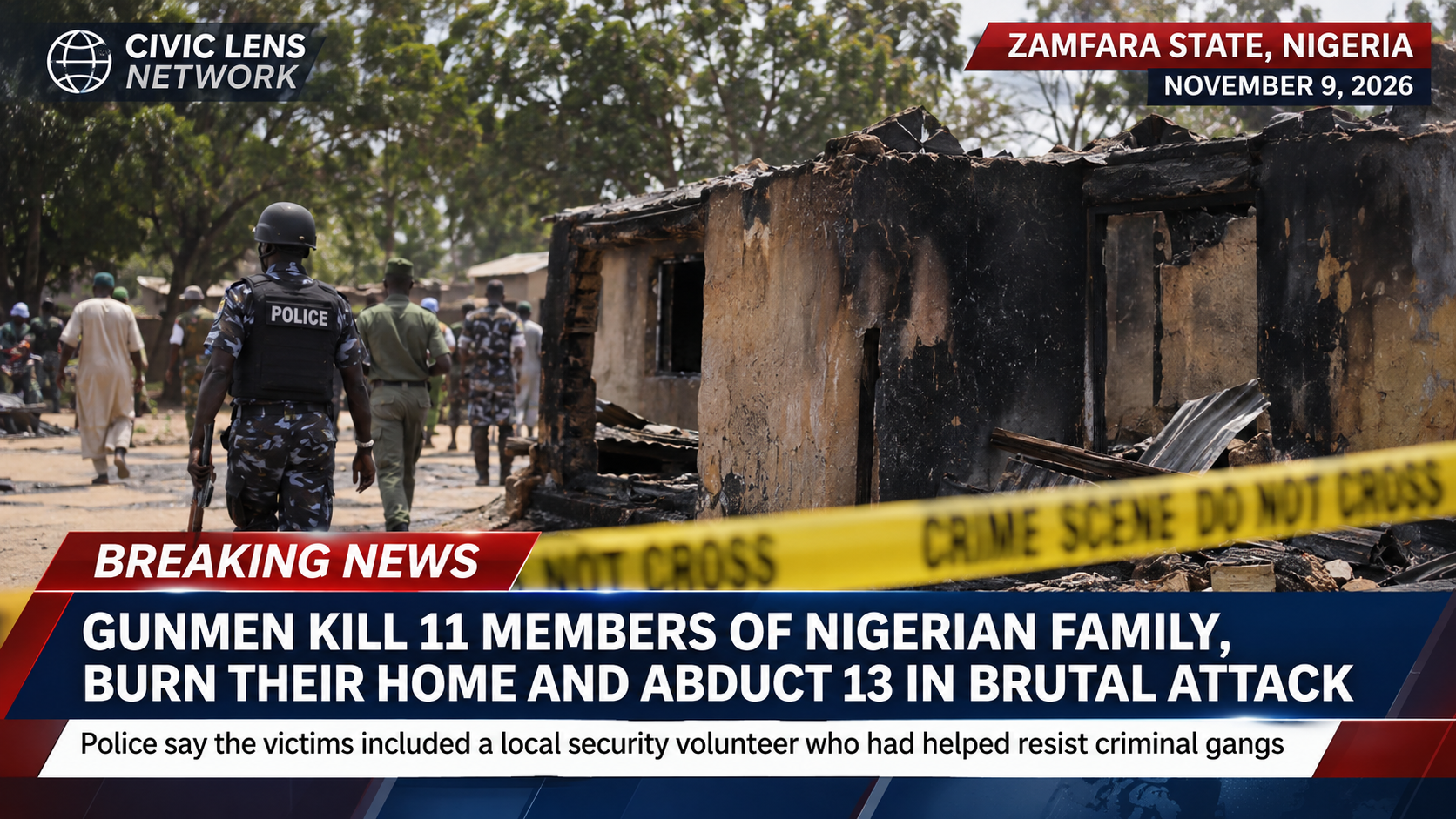
A horrifying attack in northwestern Nigeria has left 11 people dead and 13 others abducted after heavily armed gunmen targeted a local security volunteer who had repeatedly helped defend his community against criminal gangs.
The attackers killed the volunteer and 10 members of his family before burning their bodies and setting their home on fire, according to Nigerian police.
The massacre occurred over the weekend in Gidan Taba, a village in the Maradun district of Zamfara State, where residents have endured years of violence, kidnappings and attacks by heavily armed criminal groups.
Police confirmed the killings on Monday, November 9, revealing that the murdered volunteer had been actively assisting security forces in resisting armed incursions into his community.
Investigators believe his involvement in protecting local residents made him a target.
The killings have exposed the extraordinary dangers faced by ordinary Nigerians who attempt to protect their families and communities in regions where armed gangs operate with alarming freedom.
A Family Targeted for Standing Against Criminal Gangs
According to Zamfara State police spokesperson Yazid Abubakar, the murdered man was a member of a government-backed local security volunteer organization.
These groups help defend communities where police and military resources are stretched thin.
The volunteer had reportedly assisted security personnel on multiple occasions, helping repel criminal gangs attempting to enter Gidan Taba.
Police believe those actions brought him into direct conflict with the attackers.
Rather than limiting their violence to the man they considered an adversary, the gunmen allegedly targeted his family.
The attackers killed the volunteer and 10 relatives, leaving an entire household devastated.
Authorities said the gunmen then burned the victims’ bodies and set their residence ablaze.
The attack was not simply another confrontation between armed criminals and local defenders. It was an assault that extended to relatives of a man who had attempted to protect his neighbors.
Police have not publicly identified the victims or provided a detailed account of their ages.
The identities of the gunmen have also not been confirmed.
Thirteen People Abducted
The killings were accompanied by another disturbing development.
Police reported that the attackers abducted 13 people during the raid.
Authorities have not released a complete list of the abducted individuals or disclosed whether they are related to the murdered family.
Their whereabouts remain unknown in the confirmed police account.
Security forces have been deployed to the area and are working to secure their release.
Officials have not confirmed whether the kidnappers have made ransom demands or attempted to contact the families of those being held.
In northwestern Nigeria, abductions have become a major source of fear for rural communities.
Armed gangs frequently raid villages, seize residents and demand payments from relatives.
Some victims are held for extended periods, while others face violence during captivity.
The uncertainty surrounding the 13 abducted people adds another layer of suffering to a community already grieving the massacre.
For their families, the immediate concern is whether those taken away can be recovered alive.
Police Reveal Possible Motive
Police spokesperson Abubakar indicated that the attack was connected to the volunteer’s efforts to resist criminal gangs.
According to police, the attackers viewed the man as an obstacle because he had repeatedly assisted security forces.
That account suggests the killings may have been intended as retaliation against someone who challenged the gangs’ activities.
However, authorities have not publicly identified the individual attackers or announced arrests in connection with the massacre.
The precise planning of the operation remains under investigation.
It is also unclear whether the gunmen belonged to a larger organized criminal network or a smaller armed group operating in the area.
The police account provides a possible motive, but investigators have not yet established every circumstance surrounding the attack.
What is clear is that a man who helped defend his community was killed alongside 10 members of his family.
The violence raises serious concerns about the protection available to local security volunteers and their relatives.
Who Are Nigeria’s Armed Bandits?
Northwestern Nigeria has struggled for years with criminal organizations commonly described as bandits.
These groups are responsible for numerous attacks involving killings, kidnappings, cattle theft, extortion and the destruction of homes.
They frequently operate in rural areas where difficult terrain, limited infrastructure and insufficient security resources complicate law enforcement operations.
Some gangs have established bases in remote forests, allowing them to launch attacks against villages before retreating.
Their activities have disrupted farming, commerce and everyday life across several Nigerian states.
Residents have sometimes abandoned their communities because of repeated attacks or threats.
The term bandit is widely used in Nigeria to describe these armed criminal networks, but it does not mean that every group has the same leadership, ideology or objectives.
Some are primarily motivated by ransom payments and criminal profits.
Others have become involved in broader local conflicts.
There is currently no verified evidence linking the Gidan Taba massacre to a specifically named terrorist organization.
The attack should therefore not be attributed to a particular extremist movement without additional evidence.
Ordinary Citizens Forced Into Dangerous Security Roles
The massacre highlights one of the most troubling consequences of Nigeria’s prolonged security crisis.
In communities where armed groups repeatedly threaten residents, local volunteers often step forward to help defend their neighbors.
Some assist police and soldiers by providing information about suspicious movements.
Others participate in patrols, help organize local warnings or support efforts to prevent raids.
These volunteers can become important sources of intelligence because they know the surrounding communities and terrain.
However, their involvement also exposes them to retaliation.
Unlike professional security personnel, local volunteers may lack adequate equipment, protective resources or secure housing.
Their families often continue living in the same communities where the armed groups operate.
That creates an especially dangerous situation when criminals decide to punish someone for cooperating with authorities.
The killings in Gidan Taba demonstrate the potential consequences.
The volunteer’s decision to help protect his village appears to have placed him directly in the path of the attackers.
Police say his family was then targeted alongside him.
The incident raises a difficult question for Nigerian authorities: How can civilians be encouraged to cooperate with security forces if their families cannot be adequately protected from retaliation?
A Region Living Under Constant Threat
Zamfara State is among the areas most affected by armed violence in northwestern Nigeria.
For years, rural residents have faced attacks that have left communities struggling to maintain normal life.
Farmers risk encountering armed groups while traveling to their fields.
Families fear nighttime raids.
Road travel can expose motorists to ambushes and kidnappings.
Schools, markets and local businesses can also be affected when insecurity forces people to restrict their movements.
The consequences extend beyond immediate casualties.
Repeated violence can disrupt food production, displace families and undermine economic activity.
When residents flee their homes, they may lose access to farmland, livestock and other sources of income.
Children can experience interruptions to their education, while medical services become more difficult to reach.
Local governments face mounting pressure to provide security across large rural territories.
The attack in Gidan Taba illustrates how vulnerable these communities remain despite ongoing security operations.
Another Deadly Attack in Zamfara
The massacre comes amid continued violence against security personnel in Zamfara.
On November 3, attackers ambushed a police convoy in the state, killing at least eight security personnel, according to accounts from local vigilante officials.
That attack demonstrated the ability of armed groups to threaten not only civilians but also personnel tasked with maintaining public safety.
The two incidents have not been established as connected.
However, they reflect the wider insecurity facing the region.
When police officers, local volunteers and civilians are all exposed to repeated attacks, communities can lose confidence in the ability of authorities to maintain order.
That concern becomes particularly serious when individuals cooperating with law enforcement are targeted.
Without effective protection and accountability, residents may become increasingly reluctant to report criminal activity or assist security operations.
Questions for Nigerian Authorities
The killings have created an urgent need for answers.
Authorities must determine who carried out the attack, how the gunmen reached the village and whether security personnel had received warnings of an impending raid.
Investigators must also establish whether the volunteer had previously received threats because of his work.
There is currently no verified public information confirming that such warnings existed.
The circumstances surrounding the abduction of 13 people require particular attention.
Security forces must identify where the captives were taken and whether they remain together.
The possibility of additional violence against the abductees makes their recovery an immediate priority.
Beyond the investigation itself, the massacre raises broader questions about the government’s approach to protecting rural communities.
Local volunteers may provide valuable assistance, but they cannot replace an adequately resourced and accountable security system.
If authorities rely on community defenders, those individuals and their families need meaningful protection against retaliation.
The attack also underscores the importance of bringing perpetrators to justice.
Without arrests and prosecutions, criminal groups may conclude that they can continue targeting residents with little fear of consequences.
A Community Left Devastated
Behind the official death toll is a family that has suffered an almost unimaginable loss.
Eleven people were killed in a single attack, while 13 others were taken captive.
The destruction of the family’s home adds to the devastation.
Police have not released enough personal details to describe the individual victims or the circumstances of their final moments.
Their identities and lives should not be reduced to numbers.
The confirmed facts are already deeply disturbing.
A local security volunteer who had helped protect his community was murdered.
Ten members of his family were killed alongside him.
Their home was burned, and more people were abducted.
The incident demonstrates the brutal consequences of armed criminal violence in communities where ordinary residents are forced to confront threats that should be addressed by professional security forces.
What Happens Next?
Nigerian police say security personnel have been deployed to the affected area.
Their immediate priorities include protecting residents, investigating the killings and securing the release of the 13 abducted people.
Authorities have not announced confirmed arrests or publicly identified the attackers.
The final outcome of the hostage recovery effort remains uncertain.
Further information may emerge as investigators interview witnesses, examine the attack scene and attempt to identify those responsible.
For the people of Gidan Taba, however, the damage has already been done.
A family has been devastated, a home destroyed and an entire community reminded of the dangers posed by armed criminal gangs.
The massacre is another urgent warning that Nigeria’s security crisis cannot be measured solely by the number of attacks or the casualties reported.
It must also be measured by the fear imposed on communities, the lives disrupted and the risks faced by citizens who attempt to stand against violent criminals.
Until the perpetrators are identified, the abducted residents are recovered and stronger protections are established, the families of northwestern Nigeria will continue facing an unacceptable level of danger.